All species › Passerines › Swallows and martins › White-Headed Saw-Wing
White-Headed Saw-Wing | Psalidoprocne albiceps
Witkopkamzwaluw | Golondrina Cabeciblanca
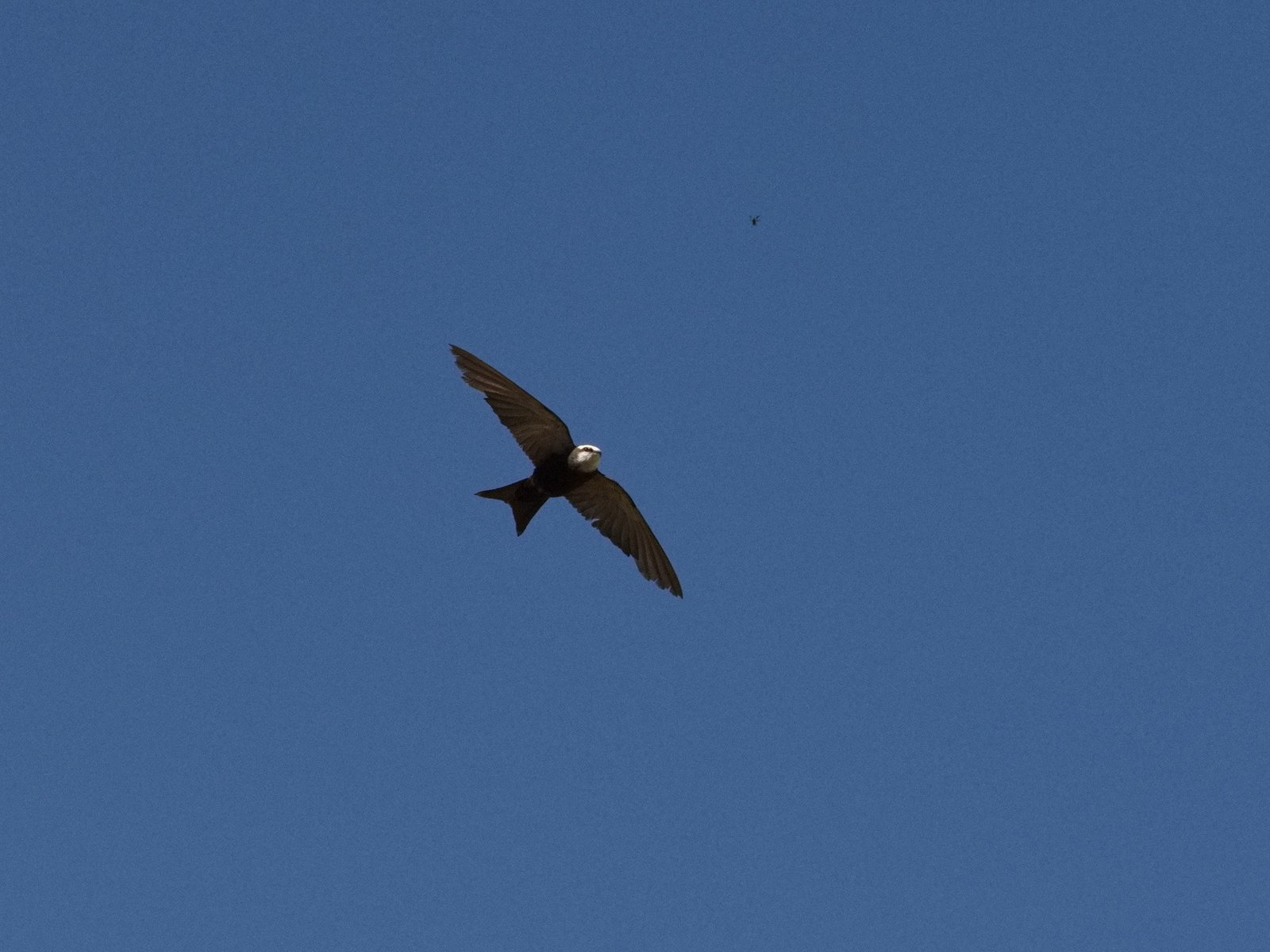
The White-Headed Saw-Wing is a dark saw-wing with, in the male, a striking white head. Within the region it reaches only the north, where it hunts low and fluttering over forest edges, grassland and clearings in the highlands.
Voice
Mostly silent. It gives a soft, thin tsip or tsweet, and a weak twittering at the nest.
Recording: Martin St-Michel — CC BY-NC-SA 4.0 · converted to mono · xeno-canto
Identification
13–14 cm, with a deeply forked tail. The male is blackish-brown with a faint olive-green gloss and has a white crown and throat, separated by a black eye-stripe running through the eye like a mask. The female has less white: the crown is greyish-white to brown and only the throat is clearly white; her tail fork is shallower. Juveniles are brown with a pale throat and almost no white on the head. The underwing is dark greyish-brown. Flight is slow and fluttering, often low with short glides, and it readily perches on bare branches.
Confusion species
The Black Saw-Wing Psalidoprocne pristoptera is wholly black with no white on the head or throat; young White-Headed Saw-Wings with their pale throat can look similar but usually already show a paler crown. The White-Bibbed Swallow Hirundo nigrita is glossy steel-blue with only a small white throat patch and hunts over rivers in forest. Swifts such as the African Black Swift Apus barbatus are larger, fly fast on stiff sickle wings and never perch on branches.
Habitat
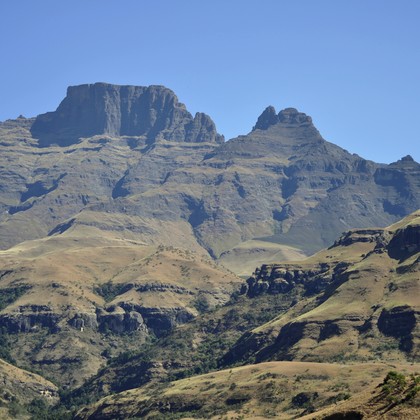
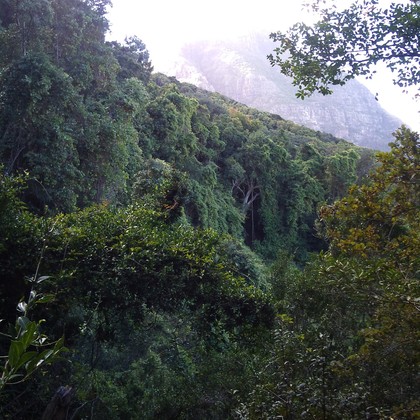
Edges of (montane) forest, clearings and felled areas in forest, grassland and open woodland in hills and highlands, often along streams and in valleys. It nests in a self-excavated tunnel in an earth bank, riverbank or road cutting.
Where the bird is most at home, classified by the vegetation units of southern Africa.
Range and movements
Within the region in north-eastern Angola, northern and north-western Zambia, and northern Malawi, including the Nyika Plateau. Beyond the region it occurs in southern and eastern DR Congo, Tanzania, Burundi, Rwanda, Uganda and Kenya north to South Sudan.
- Summer visitor (c. Oct–Mar)
- Passage (Mar–Apr, Oct–Nov)
- dark = core range, pale = thinly spread
How and when to look
Best seen in northern Malawi and in north-western Zambia around Mwinilunga, over forest edges and grassland. Look for low, fluttering dark swallows along a forest edge or stream; the male's white head shows from afar, while females and juveniles need a good view of the head and throat.
Conservation status
Not threatened; locally fairly common within its range. It benefits to some extent from clearings and road cuttings, but depends on a mosaic of forest and grassland.
Scientific name
Psalidoprocne albiceps | Sclater, 1864
Sclater described the species in 1864 and placed it straight away in the genus where it still stands. The genus Psalidoprocne was introduced in 1851 by Cabanis. Psalidoprocne comes from the Greek psalis, 'shears', and Procne, the figure of Greek myth turned into a swallow — for the deeply forked tail. albiceps comes from the Latin albus, 'white', and -ceps, 'headed' — for the male's white head. The specimen the first description was based on came from Usinza, north-western Tanzania.