All species › Passerines › Chats and flycatchers › White-Browed Robin-Chat
White-Browed Robin-Chat | Cossypha heuglini
Witbrauwlawaaimaker | Cosifa de Heuglin
The White-Browed Robin-Chat is the noisy robin-chat of the warm lowlands in the north and east of the region. Its crescendo song, often delivered as a duet at dusk, is one of the best-known sounds of riverine forest and lodge gardens from the Okavango to the Kruger National Park.

Voice
The song is a powerful crescendo of ever louder repetitions, pirpirrrr-pipipi-PIRRUP-PIRRUP-PIRRUP, that stops abruptly; male and female often duet. It also mimics other birds. The call is a soft tchee-wup, and a harsh krrrr in alarm. Sings most at dawn and dusk.
Recording: He Wenjin — CC BY-NC-SA 4.0 · converted to mono · xeno-canto
Identification
A slender robin-chat of 19 to 20 cm. The head is black with a long, broad white supercilium from bill to nape. Back and wings are olive-brown to grey-brown, rump and tail orange-rufous with dark central tail feathers. The underparts are entirely warm orange-rufous. Bill black, legs pinkish- to greyish-brown. The sexes are alike. Juveniles are dark-spotted but already show the orange tail. It flicks its tail and droops its wings on landing.
Confusion species
Cape Robin-Chat (Dessonornis caffer) also has a white supercilium, but an orange throat and breast that contrast sharply with a grey belly, and lives in cooler, higher scrub. White-Throated Robin-Chat (Dessonornis humeralis) has a white throat and a white wing stripe. Red-Capped Robin-Chat (Cossypha natalensis) lacks the supercilium and has an orange head with blue-grey wings. Chorister Robin-Chat (Cossypha dichroa) has a dark head without white, a more southerly range and lives in montane forest. Grey-Winged Robin-Chat (Sheppardia polioptera) in Angola and Zambia is smaller, with a grey crown and a shorter, greyer supercilium.
Habitat
Dense riverine and gallery forest, scrub along rivers and in ravines, thickets in savanna and mopane, and parks, homesteads and lodge gardens with dense cover. Mostly below 1500 m. Forages on the ground and in the lower branches for insects, and also takes berries.
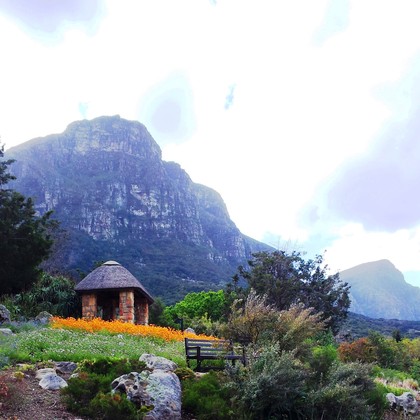
Where the bird is most at home, classified by the vegetation units of southern Africa.


Range and movements
Widespread in the north and east of the region: Angola, Zambia, Malawi, Mozambique and Zimbabwe, as well as northern Botswana (Okavango, Chobe), the Zambezi Region and north-east of Namibia, and in South Africa the Lowveld of Limpopo and Mpumalanga and northern KwaZulu-Natal, extending into Eswatini. Outside the region from Chad and Sudan to Kenya and Tanzania.
- Resident
- Summer visitor (c. Oct–Mar)
- Winter visitor (c. Apr–Sep)
- Passage (Mar–Apr, Oct–Nov)
- dark = core range, pale = thinly spread
How and when to look
Visit a lodge garden or riverine forest at dawn or dusk, for example along the Chobe or the Olifants: the crescendo duet is then impossible to miss. Sit quietly near a birdbath or compost heap; the bird often comes close but keeps to the shade of shrubs.
Conservation status
Not threatened. Common and well adapted to gardens and homesteads; numbers are stable. Loss of riverine forest to clearing and overgrazing displaces it locally, but it remains well represented in well-vegetated settled areas.
Scientific name
Cossypha heuglini | Hartlaub, 1866
Hartlaub described the species in 1866 and placed it straight away in the genus where it still stands. The genus Cossypha was introduced in 1825 by Vigors. Cossypha comes from the Greek kossyphos, 'blackbird' — for the blackbird-like build and loud, melodious song of the robin-chats. heuglini honours the German explorer and ornithologist Theodor von Heuglin (1824–1876), who travelled widely in northeast Africa. The specimen the first description was based on came from Wau, South Sudan.