All species › Passerines › Chats and flycatchers › Whinchat
Whinchat | Saxicola rubetra
Paapje | Tarabilla Norteña
The Whinchat is a Palearctic migrant that winters mainly north of the equator and reaches southern Africa only in small numbers. In northern Zambia and Malawi it is a scarce but regular winter visitor; further south every record is a rarity.

Click a thumbnail to switch the photo above.
Voice
The call is a soft whistled hu followed by one or two hard ticks: hu-tek-tek. The song, rarely heard in Africa, is a short, hurried phrase of scratchy and whistled notes, often with mimicry.
Recording: Lars Edenius — CC BY-NC-SA 4.0 · converted to mono · xeno-canto
Identification
A compact, short-tailed chat of 13 cm that perches upright on a tall grass stem or post. The broad pale supercilium above a dark cheek patch is characteristic. The upperparts are warm brown with dark streaks, the throat and breast orange-buff. The tail is dark with white patches at the base of the outer feathers, well visible on take-off. The breeding male, appearing from February, has a blackish cheek, a white supercilium and malar stripe and a white wing patch; females and non-breeding birds are paler with a buff supercilium.
Confusion species
The female African Stonechat (Saxicola torquatus) lacks the bold pale supercilium, has a darker head and an all-dark tail without white bases, and is resident in the same grassland. Northern Wheatear (Oenanthe oenanthe) is larger, sandy and has a conspicuous white rump with a black T-pattern on the tail. Pipits are slimmer and longer-tailed and walk on the ground rather than hunting from a perch.
Habitat
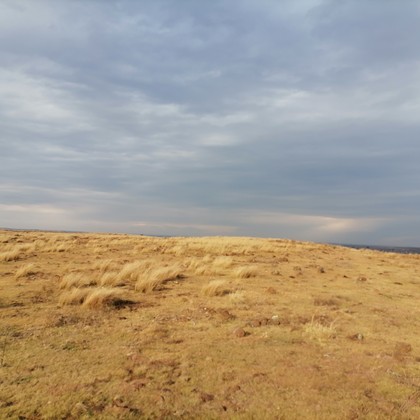
Open, moist grassland, dambos and vleis with rank vegetation, field margins and fallow land with tall stems and shrubs as lookouts; mainly on the mid-altitude plateau.
Where the bird is most at home, classified by the vegetation units of southern Africa.


Range and movements
Within the region a scarce, regular winter visitor to northern and eastern Zambia and northern Malawi, and a rare visitor to northern Angola and Mozambique; a vagrant with few records in Zimbabwe, Botswana, Namibia and South Africa. Breeds in Europe and western Asia and winters in the savanna belt of sub-Saharan Africa, mainly from West to East Africa, in small numbers south to Zambia and Malawi.
- Summer visitor (c. Oct–Mar)
- dark = core range, pale = thinly spread
How and when to look
From November to March; in northern Zambia or Malawi search wet grassland and dambos for small chats on tall stems. The broad pale supercilium and the white tail base on take-off separate it from the ubiquitous African Stonechat. Submit records from outside Zambia and Malawi, with photographs, to the rarities committee.
Conservation status
Not threatened, although the species is declining steeply across much of Europe due to intensified grassland management and early mowing. In the wintering area loss of rank grassland to cultivation plays a role.
Scientific name
Saxicola rubetra | (Linnaeus, 1758)
Linnaeus described the species in 1758 as Motacilla Rubetra; because it was later moved to another genus, the author and year stand in brackets. The genus Saxicola was introduced in 1802 by Bechstein. Saxicola is Latin, from saxum 'stone, rock' and -cola 'dweller', from colere 'to inhabit': 'rock dweller', after the open stony ground these birds keep to. rubetra is a Latin name for a small bird. The specimen the first description was based on came from Sweden.