All species › Woodpeckers and allies › African barbets › Western Tinkerbird
Western Tinkerbird | Pogoniulus coryphaea
Geelrugketellapper | Barbudito Coronado
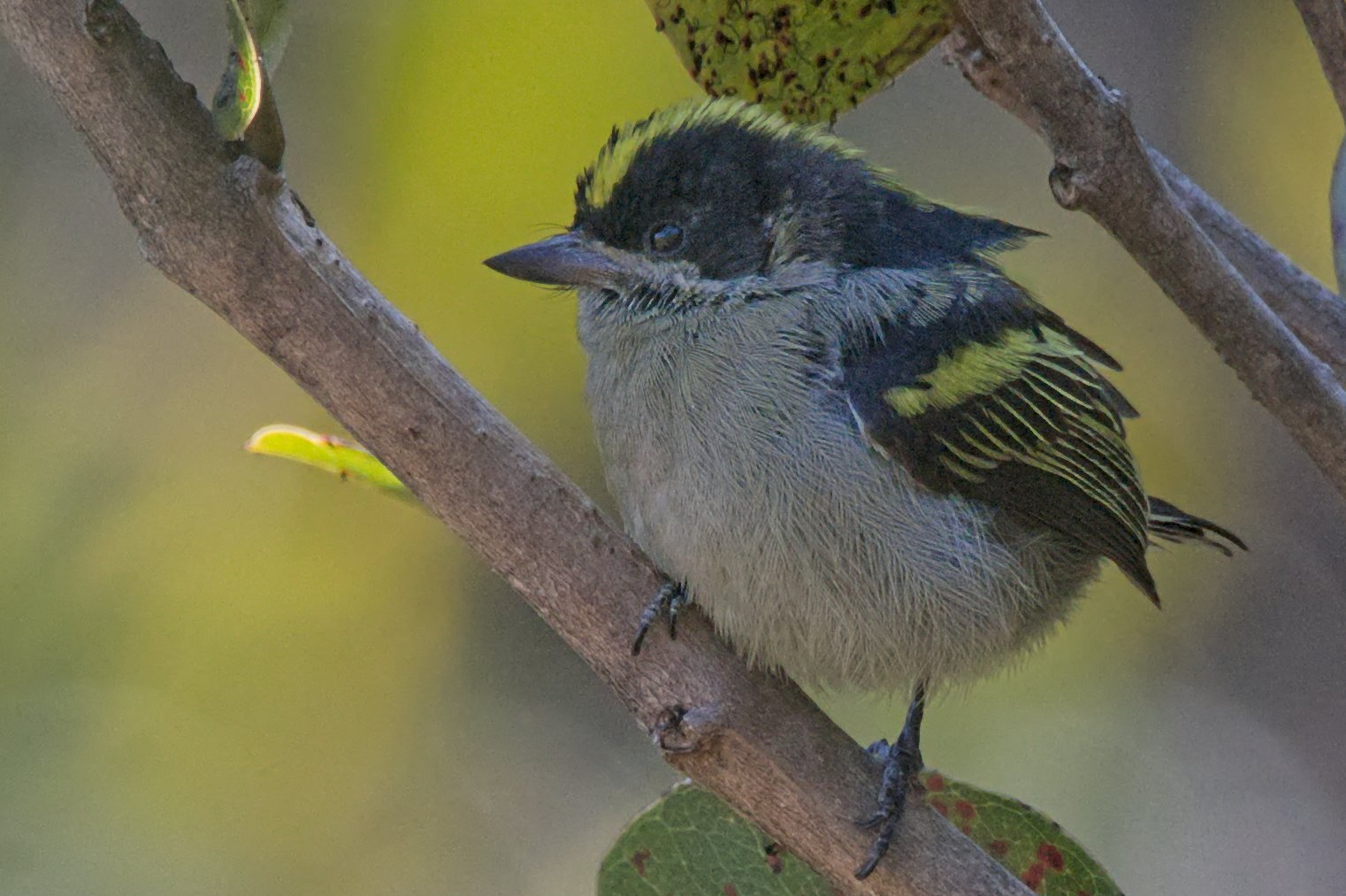
The Western Tinkerbird is a small black tinkerbird with a broad golden-yellow stripe from the forehead over the crown and back to the rump. It lives in isolated montane forests in Central and West Africa; within the region only in the western highlands of Angola, which hold an endemic subspecies.
Voice
A long, rapid series of even, hollow notes, po-po-po-po-po, often in bouts of a few seconds with short pauses, and also a fast trill. It often calls from the canopy.
Recording: Bram Vogels — CC BY-NC-SA 4.0 · converted to mono · xeno-canto
Identification
About 9–10 cm. The upperparts are black, divided by a broad, bright to golden-yellow central stripe running from forehead and crown over the mantle to the rump. The black face shows a narrow pale stripe below the eye and a pale moustachial stripe. Throat and breast are greyish, the belly grey with an olive tinge; wing coverts and flight feathers are edged yellow. The Angolan subspecies angolensis has a rather paler yellow back stripe. The sexes are alike; juveniles are duller with a narrower, pale back stripe.
Confusion species
Yellow-Rumped Tinkerbird (Pogoniulus bilineatus) has a black crown and back without a yellow central stripe, yellow only on the rump, and two white face stripes. Yellow-Fronted Tinkerbird (Pogoniulus chrysoconus) has a small yellow forehead patch, a streaked back and yellow underparts, and lives in open woodland. The continuous yellow stripe from crown to rump is diagnostic.
Habitat
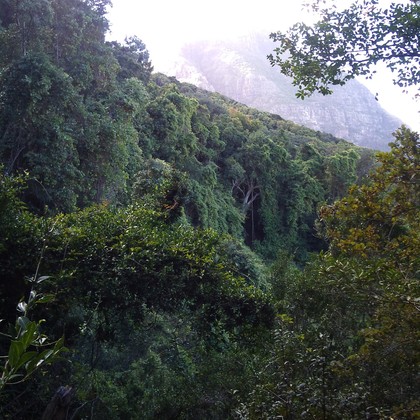
Afromontane forest, forest edges, clearings and old secondary forest in the mountains; in Angola in remnants of montane and coffee forest on the western escarpment and highlands. It forages in canopy and mid-storey for berries, especially of mistletoes, and insects.
Where the bird is most at home, classified by the vegetation units of southern Africa.
Range and movements
Within the region only in the western highlands of Angola, chiefly on the escarpment and in the mountains of Cuanza Sul; rare and local. Beyond the region in the highlands of Nigeria and Cameroon and in the mountains of the Albertine Rift in eastern DR Congo, Rwanda, Burundi and south-western Uganda.
- Resident
- dark = core range, pale = thinly spread
How and when to look
One of the sought-after species of the Angolan escarpment; forest remnants in Cuanza Sul, such as around Kumbira, offer the best chances. Listen for the hollow series and search mistletoes at the forest edge.
Conservation status
Not globally threatened. The Angolan population, however, is small and isolated and is threatened by rapid clearance of escarpment and montane forest for farming and charcoal.
Scientific name
Pogoniulus coryphaea | (Reichenow, 1892)
Reichenow described the species in 1892 as Barbatula coryphaea; because it was later moved to another genus, the author and year stand in brackets. The genus Pogoniulus was introduced in 1842 by De Lafresnaye. Pogoniulus is a diminutive of Pogonias, from the Greek pōgōnias, 'bearded' — thus 'little barbet', fitting for these smallest barbets. coryphaea is a Latinised Greek word: koruphaia, 'tuft on the crown', or koruphaios, 'at the top', both from koryphē, 'crown' — probably for the golden-yellow stripe over crown and back. The specimen the first description was based on came from Buea, Mount Cameroon, Cameroon.