All species › Passerines › Nicators › Western Nicator
Western Nicator | Nicator chloris
Grijskeelnicator | Conquistador Occidental
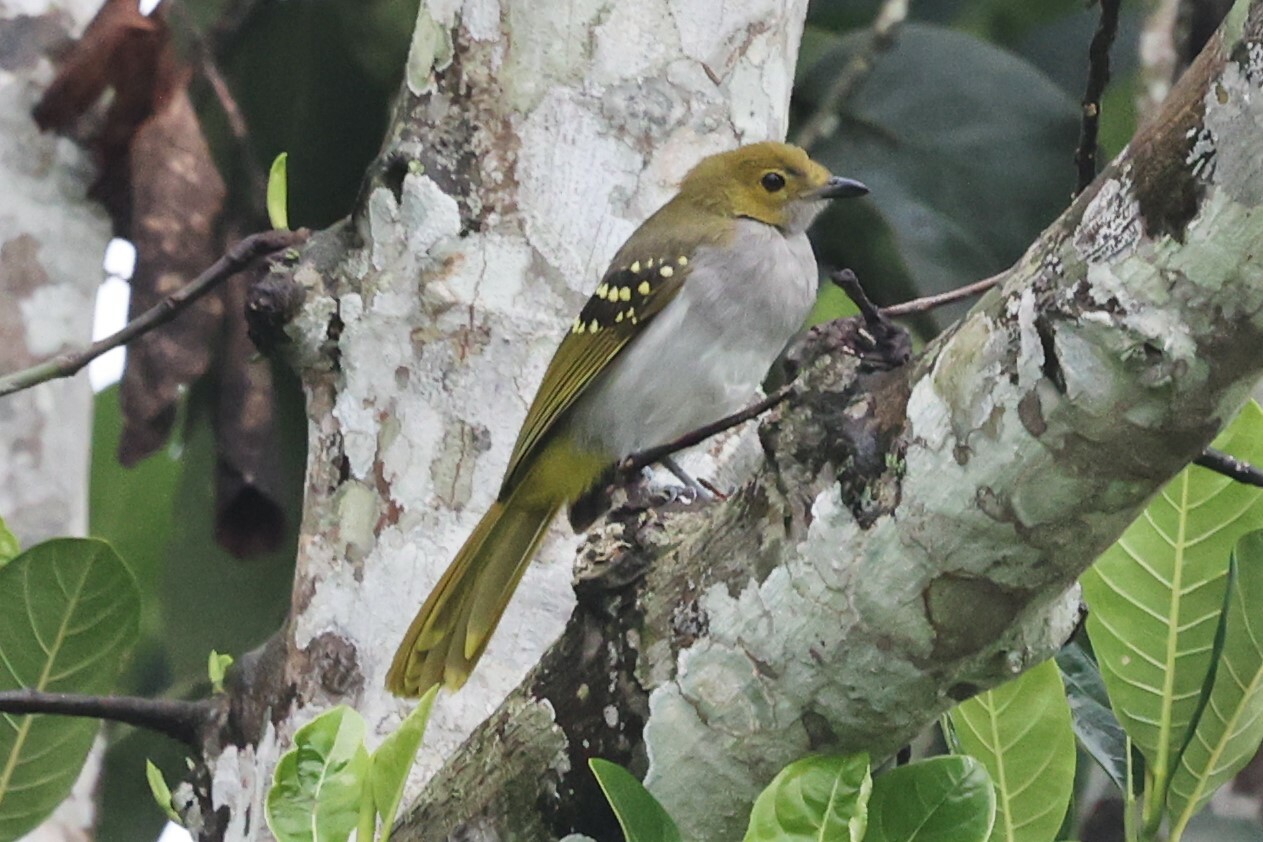
The Western Nicator is the western counterpart of the Eastern Nicator: a bulky, olive-green forest bird with large yellow spots on the wing and a heavy, slightly hooked bill. It is widespread in the rainforests of West and Central Africa, but reaches the region only in the far north. Like all nicators it keeps hidden in dense foliage and is heard far more often than seen.
Voice
A quick, loud jumble of wooden and liquid notes that bursts suddenly from dense foliage and often stops just as abruptly — similar in character to the song of Eastern Nicator. The most frequently heard sound is a penetrating, dry 'chaak'.
Recording: Jaap van der Waarde — CC BY-NC-SA 4.0 · xeno-canto
Identification
20–23 cm; the male is clearly larger and heavier than the female. The upperparts are olive-green, and unlike Eastern Nicator the crown and sides of the head are also olive-green, without a brownish tone. The wing coverts and tertials carry large, round, pale yellow spots. The underparts are pale grey, the throat slightly paler, the undertail coverts yellowish. The tail is long and rounded. The bill is heavy and slightly hooked; the eye is dark.
Confusion species
Eastern Nicator Nicator gularis is very similar but has a browner olive head; it lives in the east of the region and does not overlap with this species in Angola, so range and voice are the best guides. Yellow-Throated Nicator Nicator vireo, which shares the forests of northern Angola, is much smaller (15–17 cm), with a yellow throat, a yellow supraloral stripe and a narrow yellow eye-ring. Simple Greenbul Chlorocichla simplex is plain olive-brown with a white throat and white eye-ring, and lacks wing spots. Yellow-Whiskered Greenbul Eurillas latirostris is smaller and darker, with a conspicuous yellow moustachial stripe and no wing spots either. Honeyguide Greenbul Baeopogon indicator has a pale eye and white outer tail feathers.
Habitat
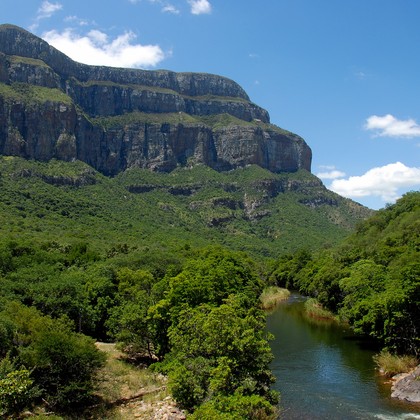
The understorey and middle stratum of moist lowland rainforest, mature secondary forest, gallery forest and dense tangles along forest edges, often where lianas are abundant. It searches slowly and unobtrusively among leaves and twigs for insects and other invertebrates.
Where the bird is most at home, classified by the vegetation units of southern Africa.

Range and movements
A widespread bird of the West and Central African rainforest, from Senegal east to southern South Sudan, Uganda and western Tanzania, and south through the Democratic Republic of the Congo. The region lies at the extreme southern edge of this large, northern range: here the species occurs only in northern Angola, including the gallery forests around Dundo in Lunda Norte and in the north-west of the country. Recent sightings along the Jimbe River in the far north-west of Zambia suggest that it also occurs there, on the fringe of the Congo Basin.
How and when to look
Present year-round. A rarely observed species that, within the region, can only be expected in the forests of northern Angola (and possibly near Ikelenge in north-western Zambia). Listen for the sudden song or the harsh 'chaak', then search patiently in the dense undergrowth; the yellow wing spots are usually the first thing you notice as the bird moves.
Conservation status
Not threatened; widespread and fairly common in the rainforests of West and Central Africa. In the region the population is small and depends on the remaining forests of northern Angola, which are losing ground to logging and cultivation.
Scientific name
Nicator chloris | (Valenciennes, 1826)
Valenciennes described the species in 1826 as Lanius chloris; because it was later moved to another genus, the author and year stand in brackets. The genus Nicator was introduced in 1870 by Hartlaub & Finsch. Nicator comes from the Greek nikatōr, 'conqueror'; why Hartlaub and Finsch chose this name is not known. chloris comes from the Greek khlōris, 'greenfinch', from khlōros, 'green' — for the olive-green plumage. The specimen the first description was based on came from Galam [Senegal].