All species › Pigeons and doves › Pigeons and doves › Western Bronze-Naped Pigeon
Western Bronze-Naped Pigeon | Columba iriditorques
Bronsnekduif | Paloma Nuquibronceada
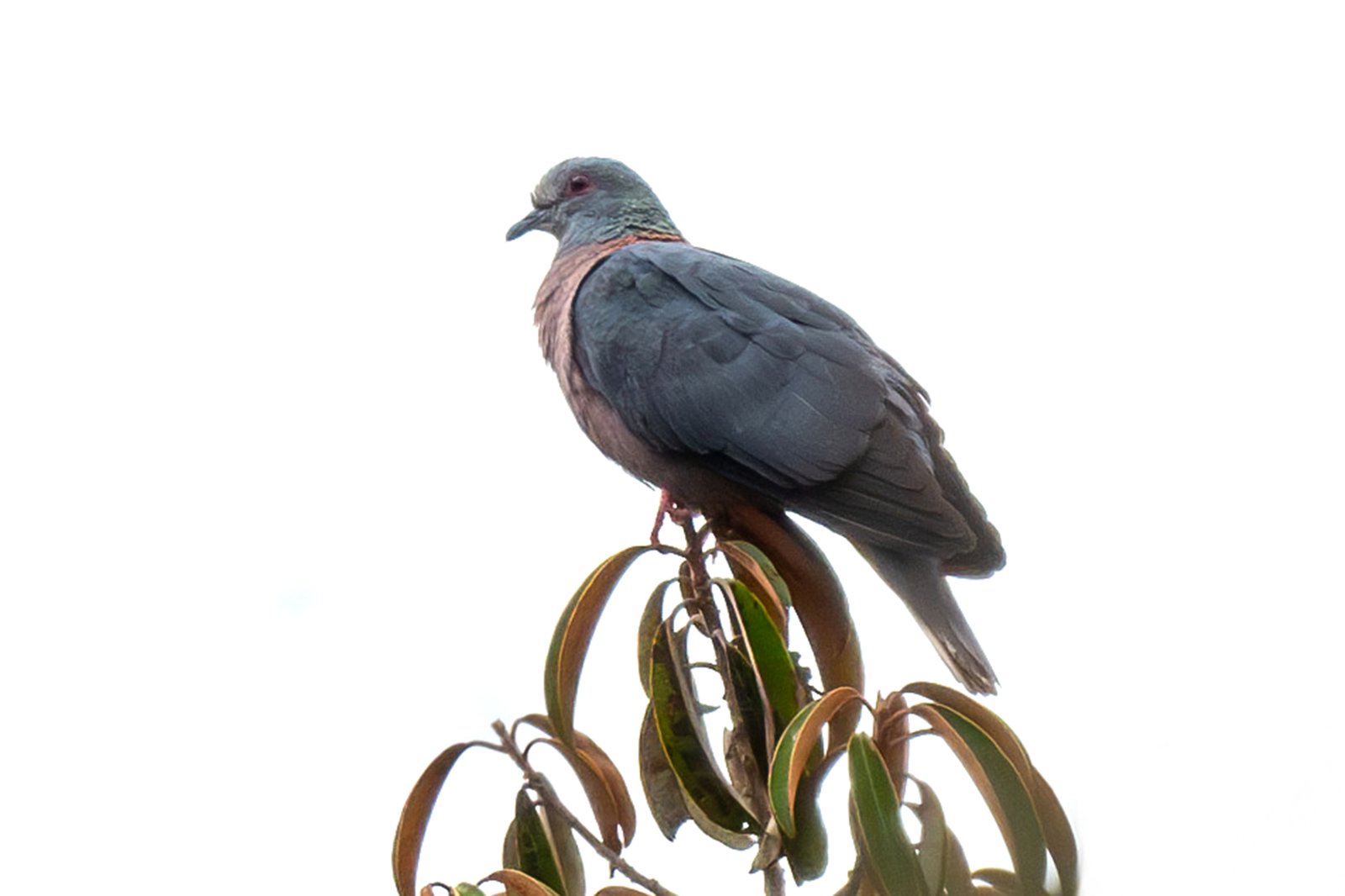
The Western Bronze-Naped Pigeon is the western counterpart of the Eastern Bronze-Naped Pigeon, a small pigeon of the Guineo-Congolian rainforest that reaches the region only in northern Angola and the extreme north-west of Zambia. It lives high in the canopy and is found mainly by its call.
Voice
A series of five to twelve soft, hollow cooing notes that first swell and then accelerate and fall, coo-coo-COO-COO-coo-coo-cucucu, from the canopy. The call is the best way to locate the species.
Recording: Étienne Leroy — CC BY-NC-SA 4.0 · converted to mono · xeno-canto
Identification
About 26 cm, small and compact. The male has a grey head, a glossy bronze to green-purple hindneck and dark slate-grey upperparts. The underparts are vinaceous pink to cinnamon, the undertail coverts rufous. The tail is dark with a broad pale grey terminal band, obvious in flight. A pale nape band as in Eastern Bronze-Naped Pigeon is lacking. The female has a rufous head, more rufous underparts and less iridescence on the neck. The eye is pale yellow to orange, the legs reddish purple. Juveniles are duller, with rufous feather fringes.
Confusion species
Afep Pigeon (Columba unicincta) is larger and much paler grey, with a pale tail band and without vinaceous underparts. Red-Eyed Dove (Streptopelia semitorquata) has a black collar and more often sits at forest edges and in open country. Eastern Bronze-Naped Pigeon (Columba delegorguei) occurs in the east of the region and does not overlap; it is darker below, lacks the pale tail band, and the male has a pale nape band.
Habitat
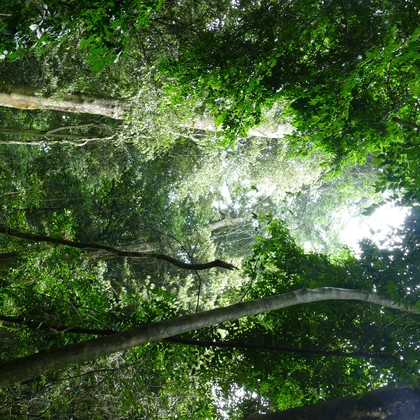
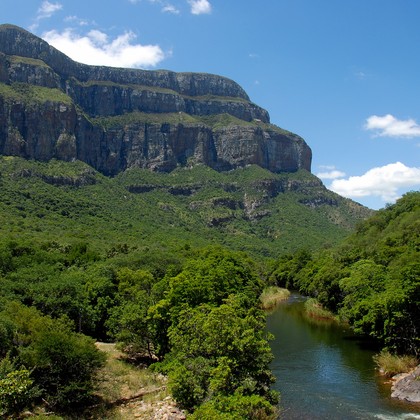
Tall, moist lowland rainforest, gallery forest along rivers and the dense evergreen forest strips (mushitu) along streams in north-western Zambia. It feeds in the canopy on fruits and berries, especially figs, and rarely comes to the ground.
Where the bird is most at home, classified by the vegetation units of southern Africa.
Range and movements
Within the region only in northern Angola (Cabinda, Uíge, Cuanza Norte and the Lunda provinces) and in the extreme north-west of Zambia (Mwinilunga), where it is scarce. Beyond the region it occurs in the rainforest of West and Central Africa, from Sierra Leone and Guinea through Nigeria, Cameroon and Gabon to the Congo Basin and western Uganda.
- Resident
- dark = core range, pale = thinly spread
How and when to look
The gallery forests near the source of the Zambezi at Mwinilunga, and the forests of Kumbira and Kalandula in Angola. Listen early in the morning for the series of coos from the canopy and search patiently for a bird perched on a bare branch above the leaves. All year.
Conservation status
Not threatened and common in the Congolian rainforest. Within the region its occurrence is small and at the edge of its range, and depends on the survival of gallery forest and rainforest, which are locally being lost to logging and farming.
Scientific name
Columba iriditorques | Cassin, 1857
Cassin described the species in 1857 and placed it straight away in the genus where it still stands. The genus Columba was introduced in 1758 by Linnaeus. Columba is the Latin word for 'dove, pigeon'. iriditorques comes from the Latin iris, iridis, 'rainbow', and torques, 'collar' — for the glossy, iridescent nape. The specimen the first description was based on came from St Paul River, Liberia.