All species › Passerines › Starlings › Wattled Starling
Wattled Starling | Creatophora cinerea
Lelspreeuw | Estornino Carunculado
The Wattled Starling is a pale, nomadic starling of open country that wanders in flocks of tens to thousands of birds in search of outbreaks of locusts and caterpillars. In the breeding season the male loses the feathers on its head and acquires a bare yellow and black head with odd black wattles.

Voice
Fairly quiet for a starling. A soft, squeaky, hissing sreee, a harsh kraa and a scratchy, squeaky song with whistles; flocks keep up a continuous chattering murmur, especially at breeding colonies.
Recording: Campbell Fleming — CC BY-NC-SA 4.0 · converted to mono · xeno-canto
Identification
20–22 cm. The plumage is pale grey-brown with black wings and a black, fairly short tail; the rump is off-white and shows well in flight. A small white patch at the base of the primaries is visible mainly in males. The breeding male has a bald head with a bright yellow hindcrown and black face, and fleshy black wattles on the forehead, crown and throat that vary greatly in size between birds. Females and non-breeding males have a feathered grey head with a small bare yellow patch behind the eye and a narrow dark malar stripe. The bill is pale pink to horn. Juveniles are browner, without yellow skin.
Confusion species
Females and juveniles can suggest a juvenile Common Starling Sturnus vulgaris, but that has no pale rump and no contrasting black wings. Pied Starling Lamprotornis bicolor is dark glossy brown with a white belly and a white eye. Pale-Winged Starling Onychognathus nabouroup is glossy black with pale wing panels and an orange eye. The combination of grey body, black wings and tail and a pale rump is unique.
Habitat
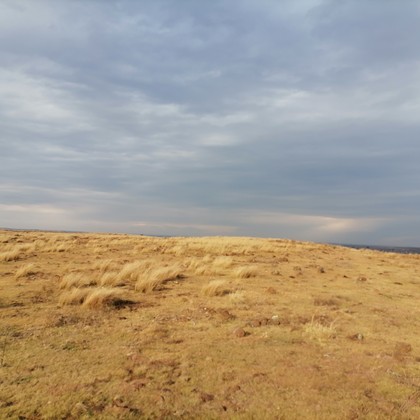
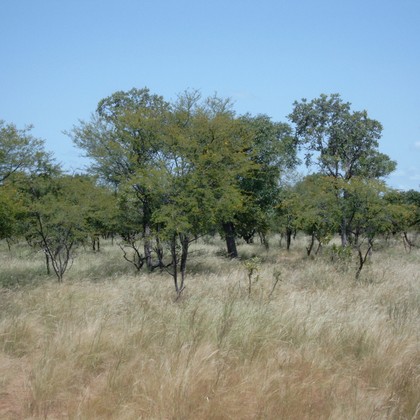
Open grassland, thornveld, semi-desert and farmland, often with grazing livestock and game, where birds catch insects on and around the animals. Food is mainly locusts, grasshoppers and caterpillars, with fruit. It breeds colonially, sometimes in hundreds of pairs, in large domed nests of sticks and grass in thorn trees, often close to a locust outbreak that feeds the colony.
Where the bird is most at home, classified by the vegetation units of southern Africa.

Range and movements
Throughout almost the whole region, from the Cape to Angola, Zambia and Malawi, most numerous on the Highveld, in the Karoo, the Kalahari and the northern savannas; scarce in closed forest, fynbos and the wettest parts of the east. Because of its nomadic habits, numbers vary widely from year to year and from place to place. Beyond the region from East Africa to Ethiopia and Somalia, and in south-western Arabia.
- Resident
- Summer visitor (c. Oct–Mar)
- Winter visitor (c. Apr–Sep)
- Passage (Mar–Apr, Oct–Nov)
- dark = core range, pale = thinly spread
How and when to look
All year, but unpredictable: where thousands of birds were present last year, there may be none now. Watch for flocks of pale starlings among grazing livestock and for the white rump in flight. In years with many locusts, breeding colonies appear suddenly; males in full breeding dress with large wattles can then be studied well.
Conservation status
Not threatened; widespread and locally very numerous. Numbers fluctuate with food supply; the use of pesticides against locusts may have local effects.
Scientific name
Creatophora cinerea | (Meuschen, 1787)
Meuschen described the species in 1787 as Rallus cinereus; because it was later moved to another genus, the author and year stand in brackets. The genus Creatophora was introduced in 1847 by Lesson. Creatophora comes from the Greek kreas, genitive kreatos, 'flesh', and -phoros, 'bearing' — for the fleshy wattles and bare yellow skin on the head of the breeding male. cinerea is Latin for 'ash-grey', from cinis, 'ash' — for the largely grey plumage. The specimen the first description was based on came from Cape of Good Hope.