All species › Passerines › Starlings › Waller's Starling
Waller's Starling | Onychognathus walleri
Wallers spreeuw | Estornino de Waller
Waller's Starling is a compact, short-tailed Onychognathus of East African Afromontane forest, which within the region occurs only on the Nyika Plateau and in the Misuku Hills of northern Malawi and adjacent Zambia. It is a true forest bird that feeds high in the crowns of fruiting trees.
Voice
A clear, fairly high whistled call, teeoo-tee-weet or chee-woo, often repeated from the canopy; the song consists of melodious whistles interspersed with chattering notes.
Recording: Oliver Fowler — CC BY-NC-SA 4.0 · converted to mono · xeno-canto
Identification
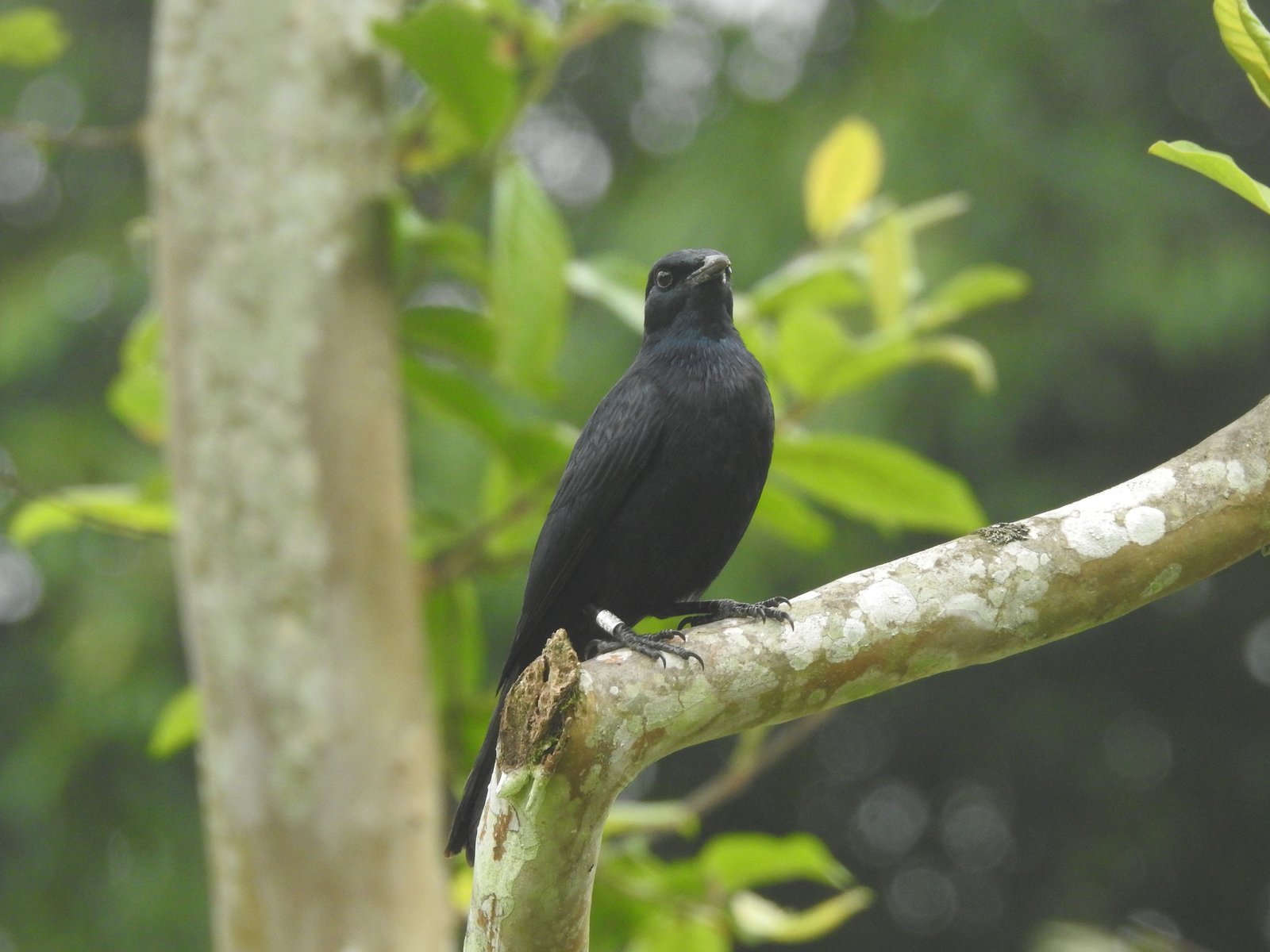
20–22 cm, clearly smaller than Red-Winged Starling, with a short, almost square tail. The male is black with a blue to purplish-blue gloss; the female has a greyish head and throat with a green gloss. Both sexes have rufous primaries with dark tips, visible in flight as a rusty wing patch. The eye is dark red, the bill black and rather short. Juveniles are duller. It lives in pairs and small groups, outside the breeding season sometimes in larger flocks at fruiting trees.
Confusion species
Red-Winged Starling Onychognathus morio occurs in the same areas but is much larger, with a long, graduated tail, and lives mainly at rocks and buildings outside forest. Slender-Billed Starling Onychognathus tenuirostris on the Nyika Plateau is also larger, with a long, thin bill and a long, pointed tail, and often feeds at waterfalls and rocks in streams. Waller's Starling is the only one of the three that keeps almost entirely to forest; the short tail in flight and the high whistled call are the best features.
Habitat
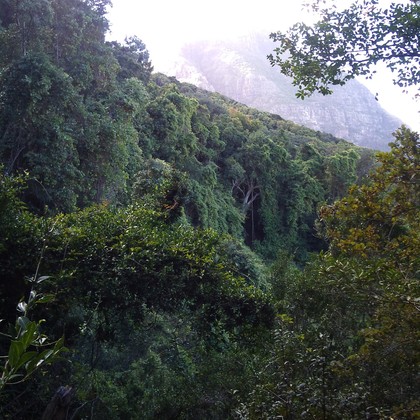
Afromontane forest and forest edges, often in the crowns of tall fruiting trees, from about 1500 m to the highest forest patches on the Nyika Plateau; sometimes in copses in the surrounding grassland. It eats mainly fruit and berries, also insects. It breeds in tree holes.
Where the bird is most at home, classified by the vegetation units of southern Africa.
Range and movements
Within the region only in northern Malawi (Misuku Hills, Nyika Plateau and Uzumara Forest) and on the Zambian side of the Nyika Plateau (including Chowo Forest). Beyond the region in the montane forests of Tanzania, Kenya, Uganda and eastern DR Congo, with a separate population in the Cameroon highlands and on Bioko.
- Resident
- dark = core range, pale = thinly spread
How and when to look
Year-round. Chowo Forest and Zovo-Chipolo Forest on the Nyika Plateau and Wilindi Forest in the Misuku Hills are the best sites. Scan fruiting trees at the forest edge and listen for the whistles; a small, red-winged, short-tailed starling in the forest is this species.
Conservation status
Not threatened and fairly common in East African montane forest. Within the region it is confined to a few small forest patches in northern Malawi and Zambia, which are vulnerable to fire and cutting.
Scientific name
Onychognathus walleri | (Shelley, 1880)
Shelley described the species in 1880 as Amydrus walleri; because it was later moved to another genus, the author and year stand in brackets. The genus Onychognathus was introduced in 1849 by Hartlaub. Onychognathus combines the Greek onyx 'nail, claw' and gnathos 'jaw'. walleri honours the English naturalist Gerald Waller. The specimen the first description was based on came from Usambara Mountains, Tanzania.