All species › Waders, gulls and terns › Sandpipers and snipes › Upland Sandpiper
Upland Sandpiper | Bartramia longicauda
Bartrams ruiter | Correlimos Batitú
The Upland Sandpiper is a slender, long-necked wader of dry grassland that breeds on the prairies of North America and winters on the pampas of South America. In southern Africa it is an exceptional vagrant, and anyone who finds one is more likely to be standing in a pasture or on an airfield than beside water.
Voice
A soft, rippling quip-ip-ip-ip, often on taking flight. The long, whistled, rising song, like a wolf whistle, is heard on the breeding grounds and is not to be expected in Africa.
Recording: Stanislas Wroza — CC BY-NC-SA 4.0 · converted to mono · xeno-canto
Identification
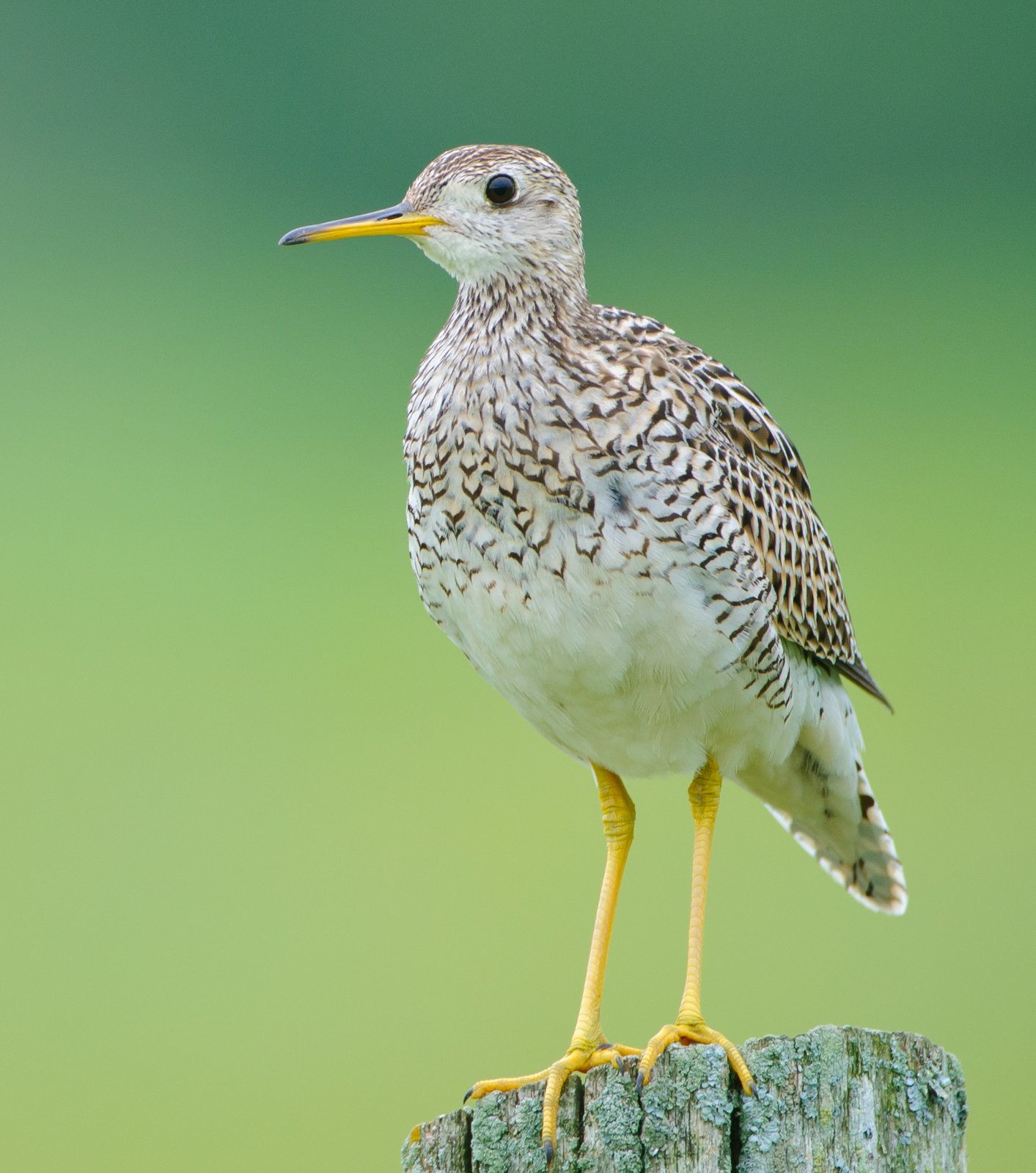
28–32 cm. A small head on a long, thin neck, large dark eyes in a pale face, a short, straight yellow bill with a dark tip, and yellow legs. The upperparts are brown with black, scaly markings and pale fringes; neck and breast are buff with fine dark streaks and chevrons, and the belly is white. The tail is long for a wader and projects well beyond the wingtips. In flight the primaries are dark and the underwing heavily barred. It walks upright and after landing often holds its wings raised for a moment.
Confusion species
Buff-Breasted Sandpiper Calidris subruficollis is smaller and plain buff below without streaks, with a shorter neck and a dark bill. Ruff Calidris pugnax has a shorter neck, a heavier body, a larger head and a shorter tail. The silhouette, with a dove-like head on a long neck and a long tail, is the strongest feature.
Habitat
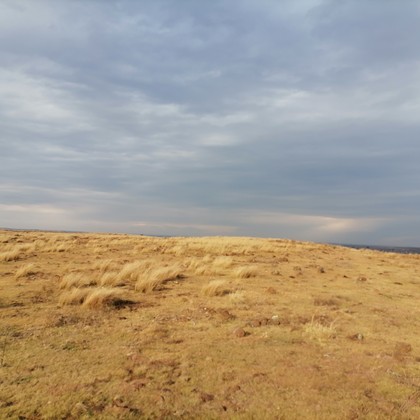
Dry, short grassland, pastures, sports fields, airfields and farmland, far from open water. It forages like a plover: walking, stopping and picking insects such as grasshoppers and beetles.
Where the bird is most at home, classified by the vegetation units of southern Africa.

Range and movements
Only a few confirmed records in the region, including in South Africa. It breeds in the grasslands of North America, from Alaska and Canada to the central United States, and winters on the pampas of Argentina, Uruguay and southern Brazil. It strays rarely to Europe and even more rarely to Africa.
How and when to look
A species to keep in mind when scanning short-grazed grassland and fields holding plovers and lapwings, especially between October and March. An oddly upright, long-necked wader among the lapwings deserves a second look and photographs.
Conservation status
Not threatened. The world population is large, although the area of natural prairie has declined greatly. As a vagrant it has no conservation significance of its own in southern Africa; records are assessed by the national rarities committees.
Scientific name
Bartramia longicauda | (Bechstein, 1812)
Bechstein described the species in 1812 as Tringa longicauda; because it was later moved to another genus, the author and year stand in brackets. The genus Bartramia was introduced in 1831 by Lesson. Bartramia honours the American naturalist William Bartram (1739–1823). longicauda combines Latin longus 'long' and cauda 'tail'. The specimen the first description was based on came from North America.