All species › Passerines › Bulbuls › Terrestrial Brownbul
Terrestrial Brownbul | Phyllastrephus terrestris
Kaapse loofbuulbuul | Bulbul Terrestre
The Terrestrial Brownbul is a brown, ground-dwelling bulbul of dense forest and thicket in the east and south of the region. It lives in noisy groups that shuffle over the forest floor turning leaves, and is heard far more often than it is seen well.

Voice
Groups keep contact with a soft, dry chrr and a repeated chuk-chuk; when alarmed they give a loud, grating chatter, chrrr-chrrr-chrrr, often all birds at once. A true song is rarely heard.
Recording: Walter Wallner — CC BY-NC-SA 4.0 · converted to mono · xeno-canto
Identification
21–22 cm. The upperparts are warm dark brown, slightly more rufous on the rump and tail; the head is greyer brown, with dark lores and an inconspicuous pale line above the eye. The throat is pure white and contrasts sharply with the grey-brown breast and flanks; the centre of the belly is dirty white. The bill is dark with a paler lower mandible, the eyes red-brown to brown, the legs grey-brown. The sexes are alike; juveniles are more rufous, with rusty edges to the wing feathers. In the field, mainly a dark, long-tailed bird with a white throat slipping low through the undergrowth.
Confusion species
Sombre Greenbul Andropadus importunus is olive-green, not brown, has a striking pale eye and sits higher in the foliage, singly or in pairs. Yellow-Streaked Greenbul Phyllastrephus flavostriatus is greener, with a grey head, a long slender bill and yellow streaks on the breast, and climbs along trunks and branches. In northern Malawi and eastern Zambia, Grey-Olive Greenbul Phyllastrephus cerviniventris is smaller, greyer olive and pale buffy below, without the crisp white throat. The behaviour of groups turning leaf litter on the ground while chattering constantly is the best feature.
Habitat
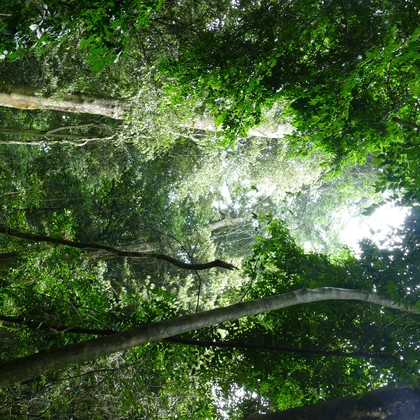
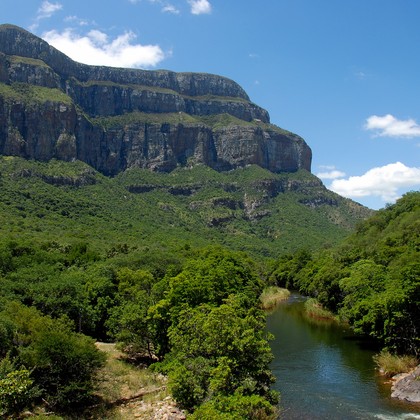
Dense undergrowth of coastal and lowland forest, riverine forest, wooded ravines, dry sand forest and thickets around termite mounds, down to large gardens with indigenous growth. It forages almost exclusively on or just above the ground, in groups of three to eight that flick over dead leaves in search of insects, spiders and small snails; sometimes with mixed foraging flocks.
Where the bird is most at home, classified by the vegetation units of southern Africa.
Range and movements
In South Africa from the Eastern Cape through KwaZulu-Natal to Mpumalanga and Limpopo, and further in Eswatini, eastern and northern Zimbabwe, Mozambique, Malawi and Zambia, northern Botswana and the Caprivi Strip in Namibia, and locally in south-eastern Angola; absent from the arid west and the highveld. Beyond the region north to Tanzania, south-eastern Kenya and southern Somalia.
- Resident
- Summer visitor (c. Oct–Mar)
- Winter visitor (c. Apr–Sep)
- Passage (Mar–Apr, Oct–Nov)
- dark = core range, pale = thinly spread
How and when to look
All year. In dense forest, listen for the grating chatter and the rustle of turned leaves; by standing still you will often see the group cross an open patch one by one. The white throat is the first thing to catch the eye. Good sites are the coastal forests of KwaZulu-Natal and the riverine forest along the rivers of the Kruger Park.
Conservation status
Not threatened and common in suitable forest. It loses habitat locally where undergrowth and coastal forest are cleared for development and farming, but it also tolerates secondary thicket and overgrown gardens.
Scientific name
Phyllastrephus terrestris | Swainson, 1837
Swainson described the species in 1837 and placed it straight away in the genus where it still stands. The genus Phyllastrephus was introduced in 1832 by Swainson. Phyllastrephus comes from the Greek phullon, 'leaf', and a form of strephō, 'to turn' — 'leaf-turner', for the way these birds search foliage for insects. terrestris is Latin for 'living on the ground' — for this bulbul's habit of foraging in the leaf litter of the forest floor. The specimen the first description was based on came from Outeniqua, Western Cape, South Africa.