All species › Passerines › Chats and flycatchers › Swamp Flycatcher
Swamp Flycatcher | Muscicapa aquatica
Moerasvliegenvanger | Papamoscas Palustre
The Swamp Flycatcher is a small, brownish-grey flycatcher of papyrus, reeds and waterside vegetation along lakes and large swamps. Within the region it is confined to Zambia and Lake Kariba, where it perches low over the water on a reed stem or dead branch and catches insects from there.

Voice
A high, thin tseep and a soft, dry tsirr. The song is a short squeaky and chirping series, tsi-tsi-tsweet, unobtrusive and mainly heard in the early morning.
Recording: GABRIEL LEITE — CC BY-NC-SA 4.0 · converted to mono · xeno-canto
Identification
13 cm, a compact flycatcher with a broad, dark bill. The upperparts are plain grey-brown, with slightly darker wings and tail and narrow pale edges to the coverts. The throat is white, bordered by a broad, faintly streaked grey-brown breast band; the belly is white and the flanks brownish-grey. A narrow pale eye-ring and lores are visible at close range. The sexes are alike; juveniles are spotted pale above and scaled on the breast.
Confusion species
Cassin's Flycatcher Muscicapa cassini is darker slate-grey with a clean grey breast band and lives along running forest rivers in north-western Zambia. African Dusky Flycatcher Muscicapa adusta is darker, without a contrasting white throat, and lives on forest edges and in riverine woodland. Spotted Flycatcher Muscicapa striata has a streaked crown and long wings and is present only from October to April; it may also hunt along marsh edges. Habitat and breast band are decisive.
Habitat
Papyrus and reed swamps, river and lake shores with overhanging bushes, dead branches, posts and floating vegetation; sometimes at jetties and around lakeside villages. It hunts in short flights low over the water for midges and other flying insects. The nest is a small cup in the fork of a bush or among papyrus stems over the water.
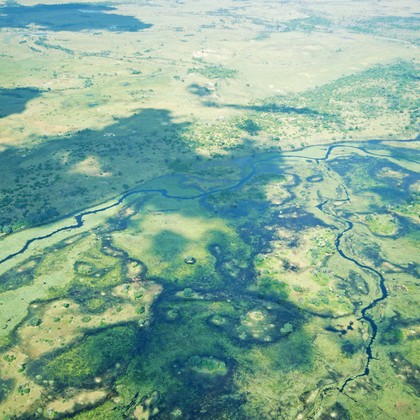
Where the bird is most at home, classified by the vegetation units of southern Africa.
Range and movements
Within the region mainly in northern Zambia: Lake Mweru, Mweru Wantipa, the Bangweulu swamps and the Luapula and Chambeshi valleys; also along the Zambezi and Kafue and on the shores of Lake Kariba, with a few records on the Zimbabwean side. Beyond the region along lakes and rivers of the Sahel from Senegal to Sudan and in Central and East Africa, including around Lakes Victoria and Tanganyika.
- Resident
- dark = core range, pale = thinly spread
How and when to look
At the Bangweulu swamps or Lake Mweru, search from a boat along the papyrus edge for a small bird perched on a protruding stem and making repeated sallies. At Lake Kariba it pays to scan shorelines with dead trees and bushes. Present all year and not shy.
Conservation status
Not threatened. Widespread and locally common in African wetlands. Drainage, burning of papyrus and fluctuating water levels in reservoirs can degrade habitat locally.
Scientific name
Muscicapa aquatica | Heuglin, 1864
Heuglin described the species in 1864 and placed it straight away in the genus where it still stands. The genus Muscicapa was introduced in 1760 by Brisson. Muscicapa is Latin, from musca 'fly' and capere 'to catch'. aquatica is Latin for 'living by water' — for its life in reedbeds and waterside vegetation. The specimen the first description was based on came from Wau River (Nahr Waw), Bahr el Ghazal, South Sudan.