All species › Passerines › Finches › Streaky-Headed Seedeater
Streaky-Headed Seedeater | Crithagra gularis
Streepkopkanarie | Serín Gris
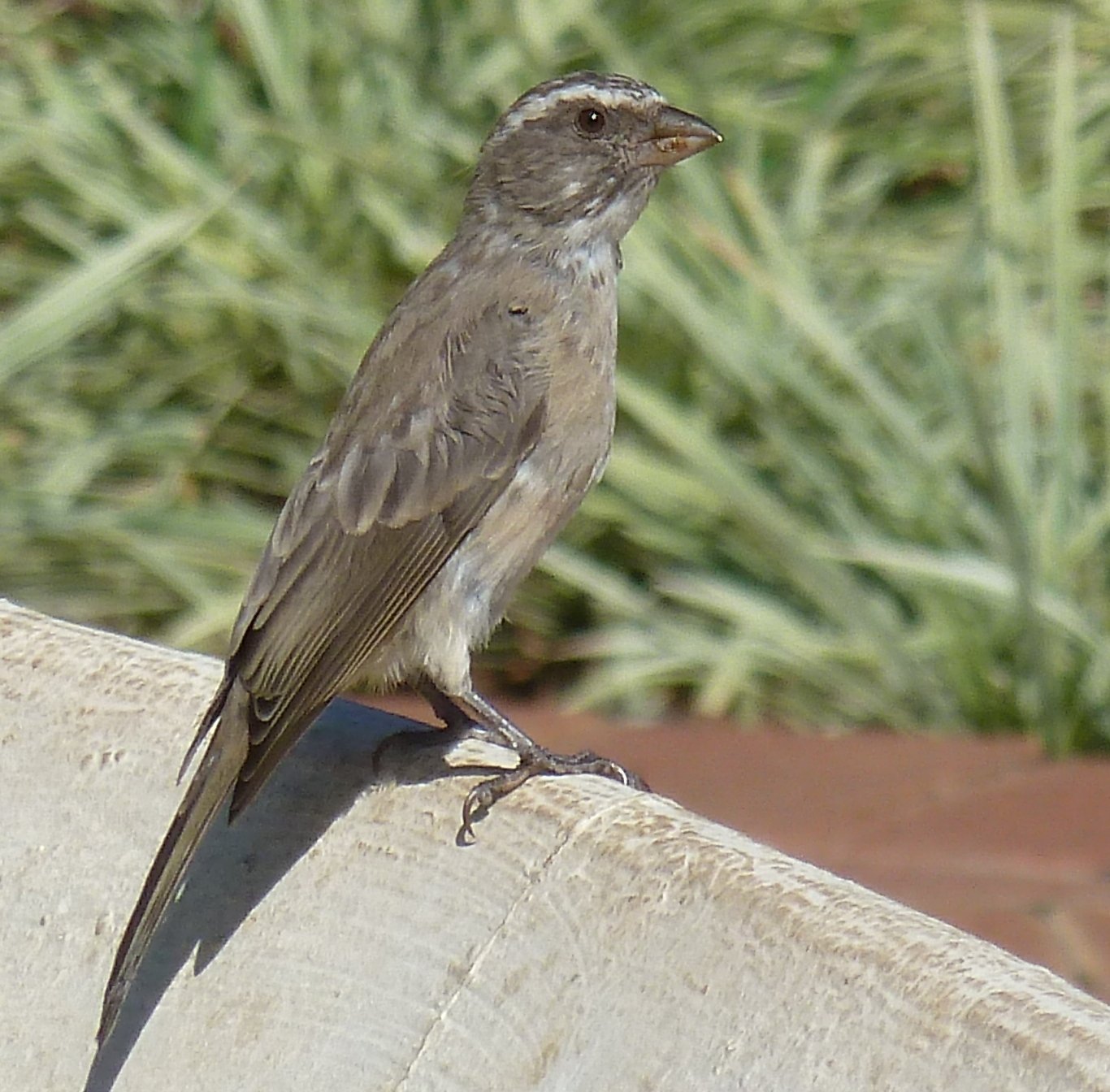
The Streaky-Headed Seedeater is a large, drab grey-brown canary without any yellow, most noticeable for a broad white supercilium above a dark cheek. It lives in pairs or small parties in woodland and gardens in the east of the region and, besides seeds, eats a striking amount of buds, flowers and nectar.
Voice
The song is a soft, slow and rather halting warble of clear whistles and squeaks, tseep-tchee-weet-tchurr, often from a high branch or a wire. The call is a soft, rising tchweee or tsee-o, also given in flight.
Recording: Walter Wallner — CC BY-NC-SA 4.0 · converted to mono · xeno-canto
Identification
15 to 16 cm, slim for a canary, with a fairly long tail and a stout, horn to pinkish-grey conical bill. Crown and forehead are grey-brown with fine dark streaks, bordered by a broad, long white supercilium that runs back onto the nape. The ear-coverts are plain dark brown and form a contrasting mask. The back is grey-brown with faint streaking; rump and tail are plain brown, without yellow or white. The throat is dirty white, the rest of the underparts pale grey-brown and almost unstreaked. The sexes are alike; juveniles are warmer brown with a faintly streaked breast.
Confusion species
White-Throated Canary (Crithagra albogularis) is paler and sandier, with a clean white throat patch, a heavier bill and a yellow rump, and lives in the arid west. Black-Eared Seedeater (Crithagra mennelli) of miombo has black ear-coverts and a heavily streaked breast. Reichard's Seedeater (Crithagra reichardi) is smaller and shorter-tailed, with fine dark streaks across breast and flanks. Females and juveniles of Yellow Canary (Crithagra flaviventris) always show yellow or yellow-green on rump and underparts.
Habitat
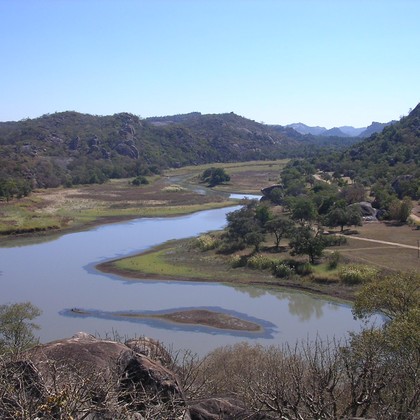
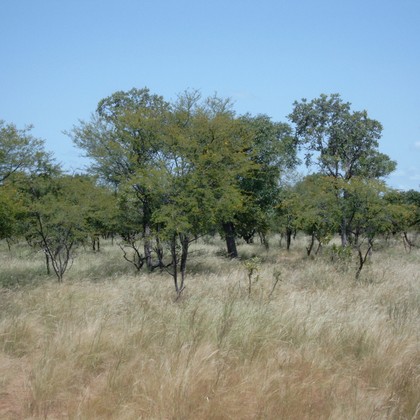
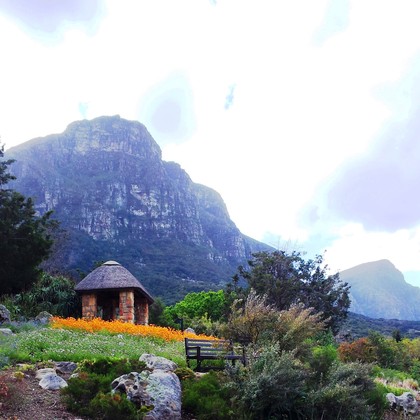
Open and mixed woodland, thornveld with tall grass, forest edges, rocky slopes with scrub, protea savanna, orchards, and gardens and parks in villages and suburbs. It forages in trees and bushes and on the ground for seeds, but also takes many buds, petals, aloe nectar and small insects. The small cup nest is placed in the fork of a shrub or tree.
Where the bird is most at home, classified by the vegetation units of southern Africa.
Range and movements
In the east and north of the region: South Africa from the southern Cape (Garden Route) east and north through the Eastern Cape, KwaZulu-Natal, Mpumalanga, Gauteng and Limpopo into North West Province, as well as Eswatini, western Lesotho, eastern Botswana, Zimbabwe, Mozambique, Malawi, Zambia and Angola. Absent from the arid west and almost entirely from Namibia. Beyond the region north to southern DR Congo and south-western Tanzania.
- Resident
- Summer visitor (c. Oct–Mar)
- Winter visitor (c. Apr–Sep)
- Passage (Mar–Apr, Oct–Nov)
- dark = core range, pale = thinly spread
How and when to look
Look for a grey-brown canary lacking yellow, whose white supercilium lies like a long pale line above the dark cheek mask; this is the best feature at a distance. It regularly visits gardens with flowering aloes and coral trees, and seed feeders. Outside the breeding season small parties wander, sometimes together with Yellow-Fronted Canaries (Crithagra mozambica).
Conservation status
Not threatened. Common and widespread in the east of southern Africa. It adapts well to gardens, orchards and woodland edges around settlements; there is no evidence of a decline.
Scientific name
Crithagra gularis | (Smith, 1836)
Smith described the species in 1836 as Linaria gularis; because it was later moved to another genus, the author and year stand in brackets. The genus Crithagra was introduced in 1827 by Swainson. Crithagra comes from the Greek krithē, 'barley', and agra, 'hunting' — a 'barley hunter', for the seed-eating diet of these canaries and seedeaters. gularis comes from the Latin gula, 'throat' — for the pale throat that contrasts with the streaked head. The specimen the first description was based on came from Latakoo near Kuruman, Northern Cape, South Africa.