All species › Pelicans, herons and ibises › Herons and bitterns › Squacco Heron
Squacco Heron | Ardeola ralloides
Ralreiger | Garcilla Cangrejera
The Squacco Heron is a small, compact heron that is buff-brown and inconspicuous at rest, but suddenly flashes brilliant white when it takes off. That contrast between the warm brown bird in the vegetation and the white bird in the air is its best feature.

Voice
Usually silent. On take-off a hoarse, crow-like karr or kaak, especially at dusk; croaks and guttural sounds at the colony.
Recording: Xavier Riera — CC BY-NC-SA 4.0 · converted to mono · xeno-canto
Identification
About 43 cm, with a short, thick neck and short legs. At rest mainly ochre to buff-brown, with a light brown back and a finely dark-streaked head and neck; the wings, rump and tail are white but largely hidden at rest. In breeding plumage it has a warm ochre mantle with long plumes and long black-and-white-streaked nape plumes; the bill is then blue with a black tip and the legs briefly flush pink to red. Outside the breeding season the bill is greenish-yellow with a dark tip and the legs yellow-green. The sexes are alike; juveniles are duller and more heavily streaked.
Confusion species
Malagasy Pond Heron Ardeola idae is larger and heavier, with a thicker bill and a more heavily and darkly streaked, less warmly coloured head, neck and breast. Western Cattle Egret Ardea ibis is likewise all white in flight, but is also white at rest and has a short yellow bill. Striated Heron Butorides striata and young Black-Crowned Night Heron Nycticorax nycticorax show dark wings in flight.
Habitat
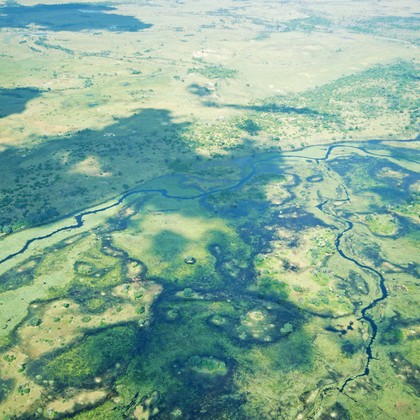
Marshes, riverbanks, dams and flooded grassland with floating and fringing vegetation, rice fields and the edges of reedbeds and papyrus. It hunts standing or creeping slowly, often on floating plants, for frogs, small fish and insects. It breeds in mixed heronries in reeds or trees over water.
Where the bird is most at home, classified by the vegetation units of southern Africa.
Range and movements
Mainly in the north and east of the region: Angola, Zambia, Malawi, Mozambique, Zimbabwe, northern Botswana and Namibia, and in South Africa in Limpopo, Mpumalanga, Gauteng, the Free State, North West and KwaZulu-Natal; scarcer southwards to the Eastern Cape and rare in the Western Cape. Beyond the region it occurs in sub-Saharan Africa, Madagascar, southern Europe and the Middle East.
- Resident
- Summer visitor (c. Oct–Mar)
- Winter visitor (c. Apr–Sep)
- Passage (Mar–Apr, Oct–Nov)
- dark = core range, pale = thinly spread
How and when to look
Best in the Okavango Delta, at Nylsvley or along the Chobe, where the birds stand on water lilies and floating vegetation. At rest a Squacco is often overlooked; when a group of white birds flushes over a marsh, count how many have a brown back.
Conservation status
Not threatened and widespread. Drainage of marshes and changes in water levels affect numbers locally.
Scientific name
Ardeola ralloides | (Scopoli, 1769)
Scopoli described the species in 1769 as Ardea ralloides; because it was later moved to another genus, the author and year stand in brackets. The genus Ardeola was introduced in 1822 by Boie. Ardeola is Latin, a diminutive of ardea 'heron', so 'little heron'. ralloides combines Latin rallus 'rail' with Greek -oides 'resembling'. The specimen the first description was based on came from Carniola, Slovenia.