All species › Passerines › Bushshrikes › Southern Boubou
Southern Boubou | Laniarius ferrugineus
Waterfiskaal | Bubú Ferrugíneo
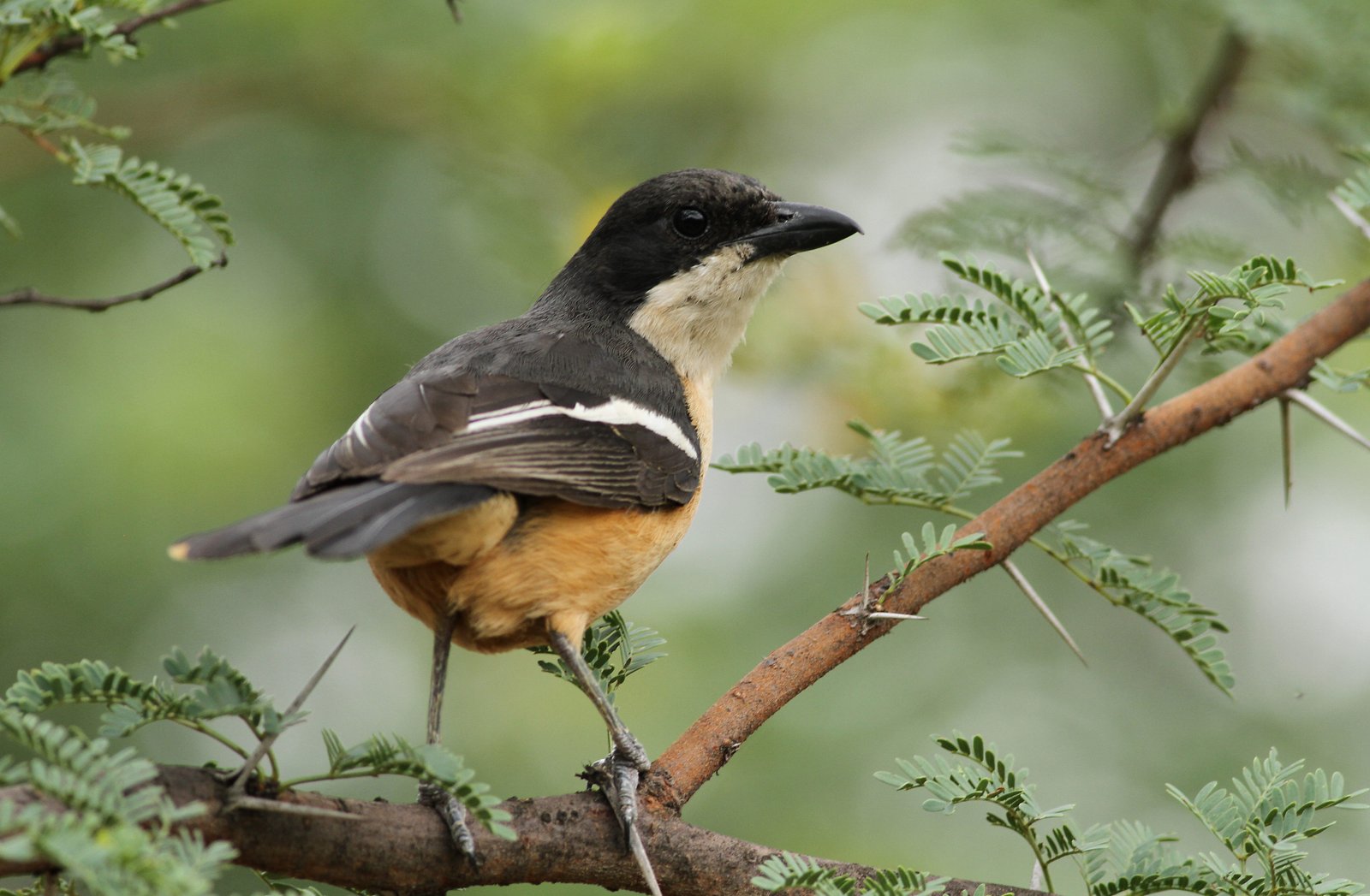
The Southern Boubou is glossy black above with a white wing stripe and rufous below, but it is heard far more often than it is seen. From dense thicket comes a duet sung by two birds that sounds like one voice: one calls, the other answers within a fraction of a second. The species is almost confined to southern Africa.
Voice
Duets by a male and a female, so tightly timed that they sound like one bird: the male a deep, liquid boo-boo or oo-op, the female answering instantly with a harsh weee or a rattling chrrr. The repertoire is large and varies by district and by pair. When alarmed it gives a hard, rasping series of kwee-kwee-kwee.
Recording: Walter Wallner — CC BY-NC-SA 4.0 · converted to mono · xeno-canto
Identification
20–23 cm. Head, back, wings and tail are glossy black, with a long white stripe along the wing. The throat and upper breast are white, grading below into warm cinnamon-rufous on the belly and flanks. The bill is heavy, black and hooked, and the eye is dark. The female is duller, slightly browner on the back and deeper buff below. Juveniles are buff-brown with fine dark barring and a horn-coloured bill. The bird moves low and skulking through dense cover and rarely comes into the open.
Confusion species
Tropical Boubou Laniarius major, which overlaps in the north-east of the region, is white below with at most a pink wash and sings a faster, more even duet. Swamp Boubou Laniarius bicolor of the Okavango, the Caprivi and Angola is pure white below. Crimson-Breasted Shrike Laniarius atrococcineus is black and white with bright scarlet underparts. Black-Backed Puffback Dryoscopus cubla is smaller, with a red eye and a white rump pad.
Habitat
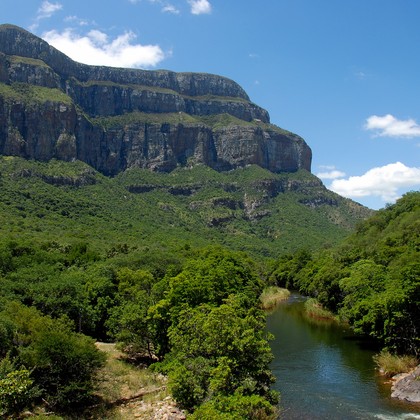
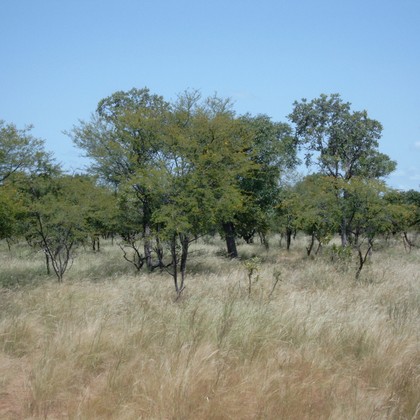
Dense tangled cover: forest edge, coastal forest and dune thicket, riverine growth along rivers and dry Karoo watercourses, planted hedges and gardens with thick shrubbery. It forages on or just above the ground among leaf litter and low branches, taking insects, small lizards, eggs and fruit.
Where the bird is most at home, classified by the vegetation units of southern Africa.
Range and movements
Almost endemic to southern Africa: from the Western Cape along the southern and eastern seaboard through the Eastern Cape, KwaZulu-Natal, Eswatini and eastern and northern South Africa to southern Zimbabwe and southern Mozambique, with extensions west along the Karoo watercourses. Further north it is replaced by Tropical Boubou.
- Resident
- Passage (Mar–Apr, Oct–Nov)
- dark = core range, pale = thinly spread
How and when to look
Year-round, best at dawn in dense bush or a well-vegetated garden. Wait at a duet and watch for movement low down rather than for the bird itself; it often walks across open sand beneath the shrubs. In winter, when the undergrowth is thinner, it comes further into view.
Conservation status
Not threatened; common and increased in many places. The species does well in suburban gardens and in thickets of alien shrubs, and is expanding along wooded watercourses and plantings. No large-scale threats are known.
Scientific name
Laniarius ferrugineus | (Gmelin, 1788)
Gmelin described the species in 1788 as Lanius ferrugineus; because it was later moved to another genus, the author and year stand in brackets. The genus Laniarius was introduced in 1816 by Vieillot. Laniarius comes from the Latin lanius, 'butcher', the same root as for the true shrikes — for the hooked bill and the habit of impaling prey on thorns. ferrugineus is Latin for 'rust-coloured', for the rufous underparts. The specimen the first description was based on came from Cape of Good Hope.