All species › Passerines › Chats and flycatchers › Southern Black Flycatcher
Southern Black Flycatcher | Melaenornis pammelaina
Kaapse drongovliegenvanger | Papamoscas Sudafricano
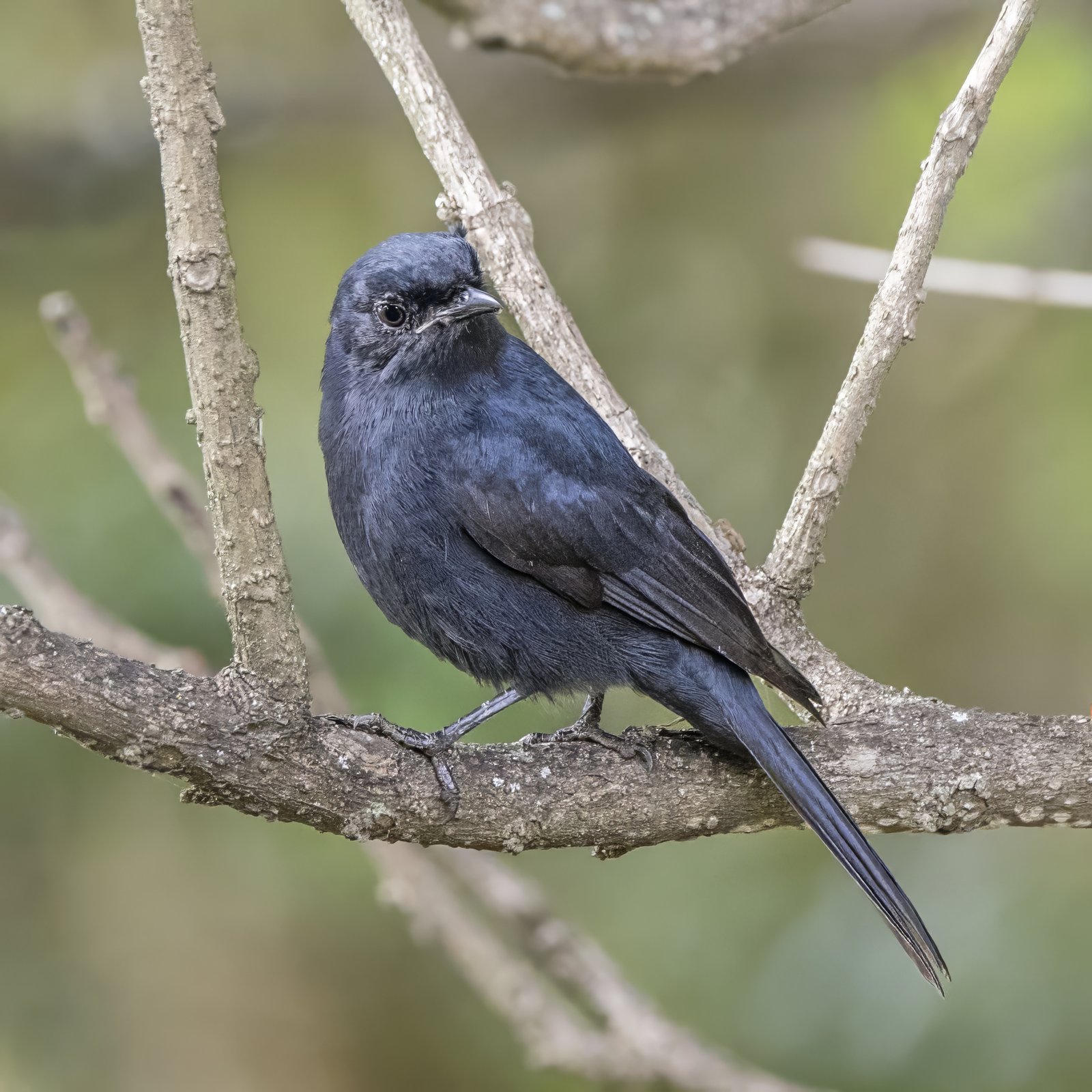
The Southern Black Flycatcher is an all-black flycatcher of woodland and forest edges that closely resembles a drongo. It sits quietly and upright on a low branch at the edge of a clearing and drops to the ground or snaps insects from the air.
Voice
Inconspicuous. The song is a thin, high, repeated tsee-tsee-tchurr, sometimes with mimicry of other species, mainly at dawn. The call is a soft, sibilant tsweet or sweep.
Recording: Niall Perrins — CC BY-NC-SA 4.0 · converted to mono · xeno-canto
Identification
19–22 cm, wholly matt blue-black with a faint gloss; the sexes are alike. The eye is dark brown and the bill fairly slender and black. The tail is long and square-ended, at most with a slight central notch. Juveniles are dull black with fine buff spots on the head, back and breast. It often sits still for long periods low in the shade, and is far less active and noisy than a drongo.
Confusion species
Fork-Tailed Drongo (Dicrurus adsimilis) has a red eye, a heavier bill and a deeply forked tail with outcurved tips, and is noisy and aggressive. Square-Tailed Drongo (Dicrurus ludwigii) also has a red eye and a notched tail, and lives in dense forest. Male Black Cuckooshrike (Campephaga flava) has an orange-yellow gape, often a yellow shoulder patch, and creeps through the canopy in search of caterpillars. Sooty Chat (Myrmecocichla nigra) perches on termite mounds in open grassland and has a white shoulder patch. Southern Black Tit (Melaniparus niger) has white wing edgings.
Habitat
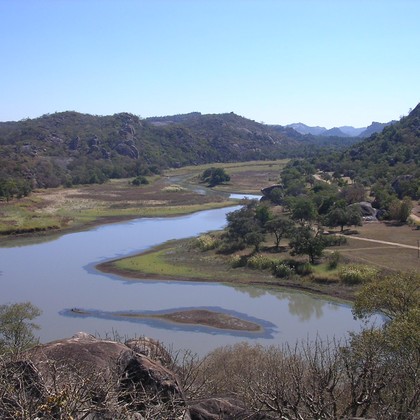
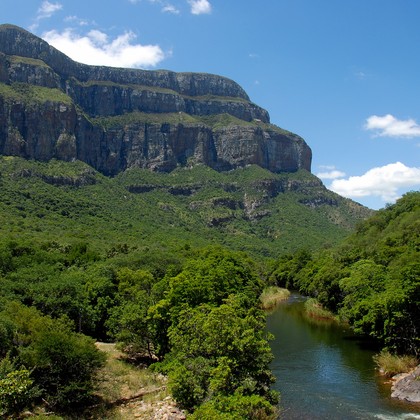
Open and closed woodland, miombo, riverine forest, forest edges, plantations and large gardens. It takes insects from a low lookout perch, often on the ground, and also eats fruit. The nest is a shallow cup in a crevice in a tree, behind loose bark or in an old nest of another species.
Where the bird is most at home, classified by the vegetation units of southern Africa.

Range and movements
In the east and north of the region: the Eastern Cape, KwaZulu-Natal, Eswatini, Mpumalanga and Limpopo, eastern Botswana and the Okavango, north-eastern Namibia (Zambezi Region), Zimbabwe, Mozambique, Malawi, Zambia and eastern and southern Angola. Beyond the region north to Tanzania, Kenya and southern Uganda.
- Resident
- Summer visitor (c. Oct–Mar)
- Winter visitor (c. Apr–Sep)
- Passage (Mar–Apr, Oct–Nov)
- dark = core range, pale = thinly spread
How and when to look
A black bird sitting quietly and low at a woodland edge and dropping to the ground is more likely this species than a drongo; check eye colour and tail shape at once. At close range the dark eye is decisive.
Conservation status
Not threatened. Common to fairly common in suitable woodland; the population is regarded as stable.
Scientific name
Melaenornis pammelaina | (Stanley, 1814)
Stanley described the species in 1814 as Sylvia pammelaina; because it was later moved to another genus, the author and year stand in brackets. The genus Melaenornis was introduced in 1840 by Gray. Melaenornis combines the Greek melas, feminine melaina, 'black', with ornis, 'bird' — for the all-black plumage of the type species. pammelaina comes from the Greek pammelas, 'all black' — for the entirely black, glossy plumage. The specimen the first description was based on came from Island of Mozambique, Mozambique.