All species › Tubenoses › Petrels and shearwaters › Sooty Shearwater
Sooty Shearwater | Ardenna grisea
Grauwe pijlstormvogel | Pardela Sombría
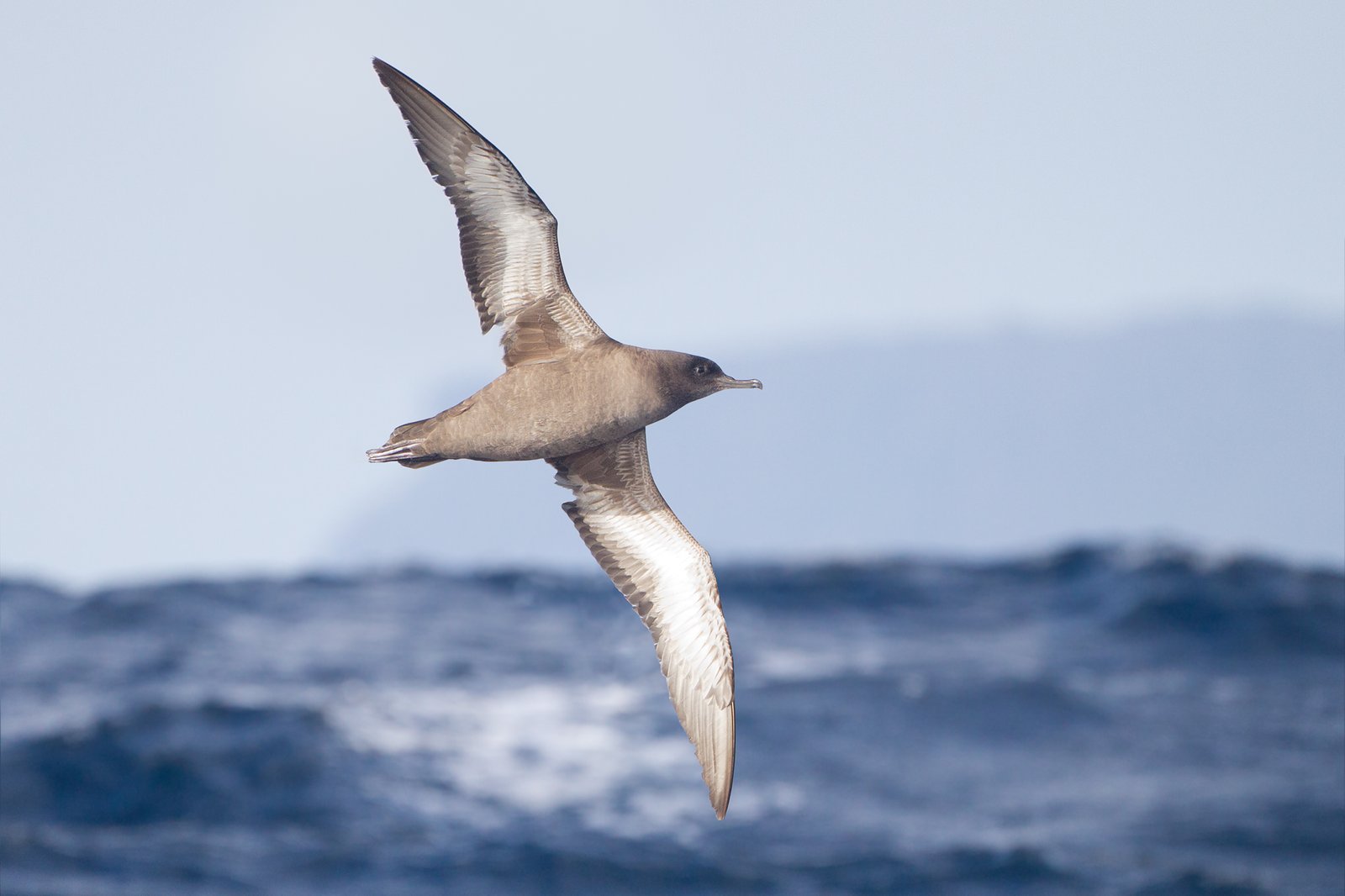
The Sooty Shearwater is a dark, slender shearwater with striking silvery-white underwing coverts. It is among the most migratory birds in the world: from breeding colonies in the southern hemisphere birds complete a loop of tens of thousands of kilometres through the Pacific and Atlantic each year.
Voice
Silent at sea. At the breeding colonies, a groaning, hoarse koo-wee-oo from the burrows at night.
Recording: David Boyle — CC BY-NC-SA 4.0 · shortened to the first 60 s, mono · xeno-canto
Identification
Medium-sized, 40 to 51 cm, with long, narrow wings slightly angled back at the carpal. The plumage is uniform dark sooty brown, the throat sometimes slightly paler. The key feature is the silvery-grey to white panel across the underwing coverts, which flashes in the light and broadens towards the wing base. The slender bill is dark grey and the legs are greyish. Sexes alike. It flies fast and purposefully, with bursts of stiff, rapid wingbeats alternating with high arcs in strong winds.
Confusion species
Flesh-Footed Shearwater (Ardenna carneipes) is heavier, with a pale pinkish bill with a dark tip, pale legs and a wholly dark underwing. White-Chinned Petrel (Procellaria aequinoctialis) is larger and bulkier, with a pale horn-coloured bill and a dark underwing. Great-Winged Petrel (Pterodroma macroptera) has a short, thick black bill, a dark underwing and a wild, careening flight. Young jaegers such as Pomarine Jaeger (Stercorarius pomarinus) show pale flashes at the base of the primaries and fly differently.
Habitat
Open sea, both over the continental shelf and beyond; it comes close inshore more often than other shearwaters. It dives in pursuit of prey to tens of metres and hunts shoals of small fish, krill and squid. It forms large flocks that rest on the water or stream along the coast in long lines. It breeds in burrows on islands with tussock grass or forest.
Where the bird is most at home, classified by the vegetation units of southern Africa.

Range and movements
Present year-round off Namibia and the Western and Southern Cape, especially in the austral winter, when thousands sometimes feed close inshore; smaller numbers along the east coast to KwaZulu-Natal and Mozambique, and scarce in the waters around the Prince Edward Islands. It breeds around New Zealand, in south-eastern Australia, southern Chile and the Falkland Islands, and after breeding migrates to the North Pacific and North Atlantic.
- Resident
- dark = core range, pale = thinly spread
How and when to look
In the austral winter often visible from shore, for example at Cape Point, Walvis Bay and Lüderitz, as long lines of dark birds passing low over the waves. In good light look for the flashing silvery underwing. At trawlers the species usually stays in the background; it prefers to dive on fish shoals by itself.
Conservation status
Near Threatened. The world population is large but has declined through fisheries bycatch, the traditional harvest of chicks in New Zealand and changes in the food chain caused by ocean warming.
Scientific name
Ardenna grisea | (Gmelin, 1789) (GBIF: Puffinus griseus)
Gmelin described the species in 1789 as Procellaria grisea; because it was later moved to another genus, the author and year stand in brackets. The genus Ardenna was introduced in 1853 by Reichenbach. Ardenna goes back to Artenna, the spelling the Italian naturalist Ulisse Aldrovandi used for a seabird in 1603 and which Reichenbach cited when naming the genus. grisea is medieval Latin for 'grey'. The specimen the first description was based on came from New Zealand.