All species › Waders, gulls and terns › Plovers and lapwings › Siberian Sand Plover
Siberian Sand Plover | Anarhynchus mongolus
Mongoolse plevier | Chorlitejo Mongol Chico
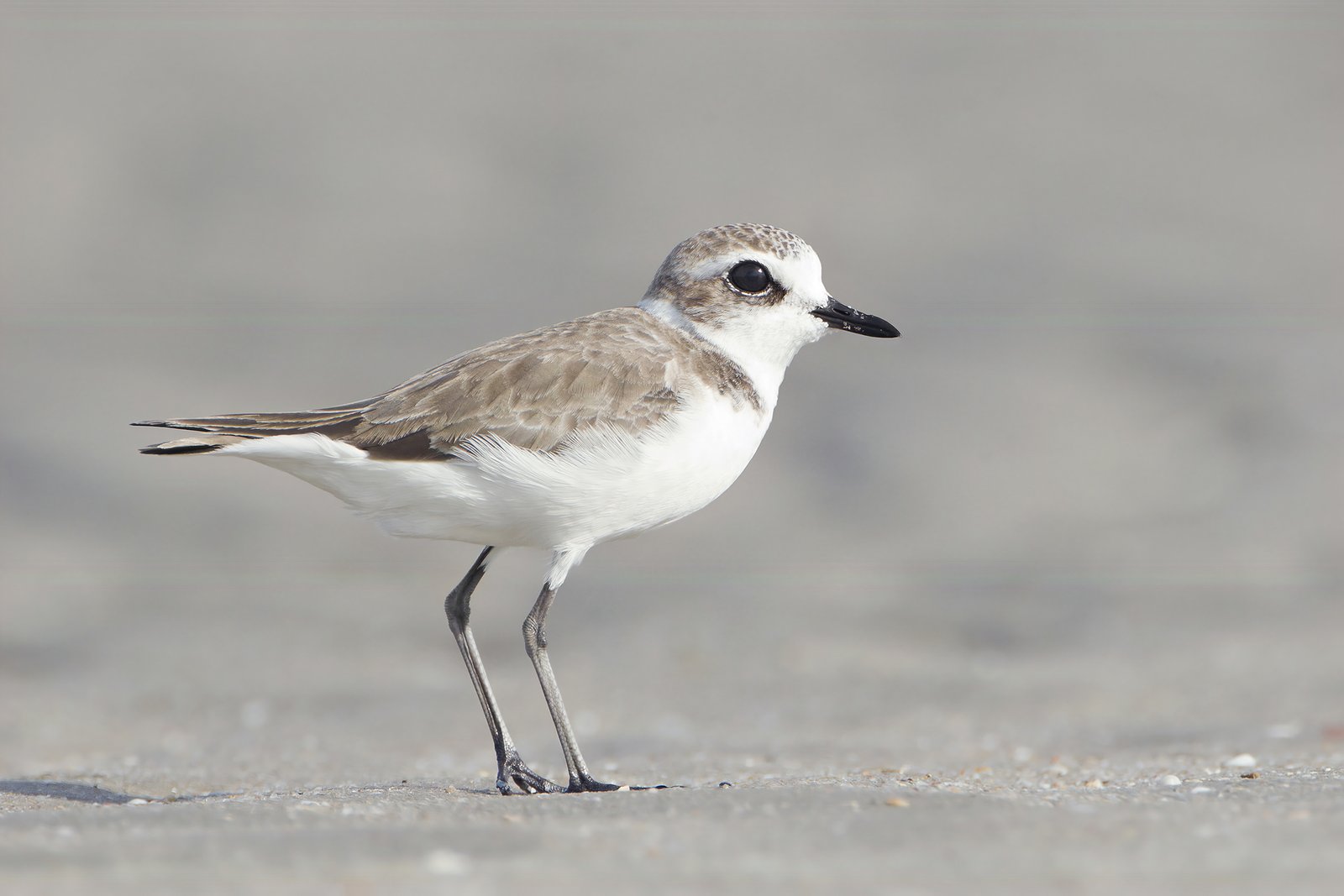
The Siberian Sand Plover is a compact sand plover with a short, blunt bill that visits the tidal flats of the Mozambican coast in small numbers. Since the old species was split, the name in the strict sense applies to the East Siberian birds; most sand plovers reaching East Africa belong to the Tibetan group (Anarhynchus atrifrons, subspecies pamirensis). In non-breeding plumage the two cannot be separated with certainty in the field.
Voice
A short, hard trill, drrit or kruit, often in flight; harder and drier than the call of the Greater Sand Plover.
No recording with a suitable Creative Commons licence is available for this species yet.
Identification
18–21 cm. In non-breeding plumage the upperparts are plain grey-brown, the forehead and supercilium white, and there are grey-brown patches on the sides of the breast, sometimes joined into a narrow band. The bill is short, black and blunt, no longer than the distance from bill base to the rear of the eye. The legs are dark grey to greenish-grey. In breeding plumage, acquired from March, the male has a black mask and a broad rufous breast band. In flight there is a narrow white wing bar; the toes barely or do not project beyond the tail.
Confusion species
The Greater Sand Plover Anarhynchus leschenaultii is larger, with a longer and heavier bill with a swollen tip, a bigger head, longer and paler legs and toes that project beyond the tail in flight; in mixed flocks the size difference is the best feature. The Common Ringed Plover Charadrius hiaticula has an orange bill base, orange legs and a complete breast band. The Caspian Plover Anarhynchus asiaticus is longer-legged, has a fuller breast band and stands on dry grassland.
Habitat
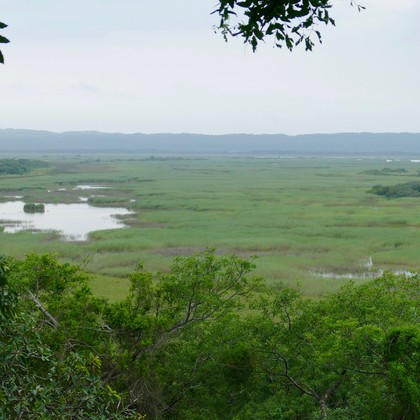
Tidal mudflats, sand and mud banks in estuaries, mangrove creeks and lagoons; at high tide on sandy beaches and shingle bars. It feeds scattered over the mud with the typical run-stop-peck action, taking small crabs, worms and small molluscs.
Where the bird is most at home, classified by the vegetation units of southern Africa.
Range and movements
Mainly along the coast of Mozambique, from Maputo Bay and Inhaca via Inhambane and the Bazaruto archipelago to Beira; in small numbers in KwaZulu-Natal and beyond that a vagrant to the Western Cape and Namibia. The species in the strict sense breeds in eastern Siberia and winters mainly from South-East Asia to Australia; the Tibetan group breeds in the high mountains of Central Asia and winters on the coasts of the Red Sea, East Africa and South Asia.
- Summer visitor (c. Oct–Mar)
- Passage (Mar–Apr, Oct–Nov)
- dark = core range, pale = thinly spread
How and when to look
Best from November to March on the flats of Inhaca, Maputo Bay and the estuaries around Vilankulo, on a rising tide when the birds are pushed closer to the beach. Always compare with the Greater Sand Plover in the same flock: bill length relative to the head and leg length give the best hold.
Conservation status
Endangered. The East Siberian birds have declined steeply through the loss of the tidal flats around the Yellow Sea, their main staging area on migration. The Tibetan group is less at risk. In southern Africa disturbance on the flats and degradation of mangroves are the main threats.
Scientific name
Anarhynchus mongolus | (Pallas, 1776)
Pallas described the species in 1776 as Charadrius mongolus; because it was later moved to another genus, the author and year stand in brackets. The genus Anarhynchus was introduced in 1832 by Quoy & Gaimard. Anarhynchus is Greek, from ana- 'backward' and rhunkhos 'bill', after the sideways-bent bill of the wrybill, the type species of the genus. mongolus means 'Mongolian' — for the type locality near the Mongolian border in Siberia. The specimen the first description was based on came from salt lakes near the Mongolian border (Onon River), Siberia.