All species › Birds of prey › Hawks, eagles and kites › Shikra
Shikra | Tachyspiza badia
Shikra | Gavilán Chikra
The Shikra is a small, pale grey hawk of dry savanna and woodland, formerly known in southern Africa as the Little Banded Goshawk. It hunts mainly from cover for lizards, large insects and small birds and is one of the commonest small raptors in the northern half of the region.

Voice
A high, sharp kewick-kewick or a repeated tu-wee tu-wee, mainly around the nest in the breeding season; also a fast kik-kik-kik when excited. Often heard before it is seen.
No recording with a suitable Creative Commons licence is available for this species yet.
Identification
28–30 cm, wingspan 50–62 cm. Adults are pale blue-grey above, without a white rump, and white below with fine rufous barring, weaker in the male than in the female. The throat is white with a faint grey mesial stripe. The central tail feathers are plain grey, the outer ones with narrow dark bars. The iris is deep red in the male and orange-red in the female; cere and legs are yellow. Juveniles are brown above with pale fringes and white below with brown teardrop spots on the breast and barred flanks, with a yellow iris. In flight the underwings are pale with dark tips; the wings are rather short and rounded.
Confusion species
Gabar Goshawk Micronisus gabar has a conspicuous white rump, a plain grey throat and breast, red cere and legs and a dark iris; an all-black form also occurs. Little Sparrowhawk Tachyspiza minulla is smaller and darker grey, with two white spots on the tail, a white rump band and a yellow iris. Ovambo Sparrowhawk Accipiter ovampensis is larger, finely barred grey below and has white spots along the tail shafts. African Goshawk Aerospiza tachiro is larger, dark slate above and lives in forest.
Habitat
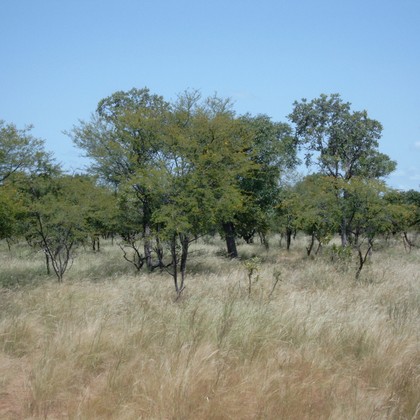
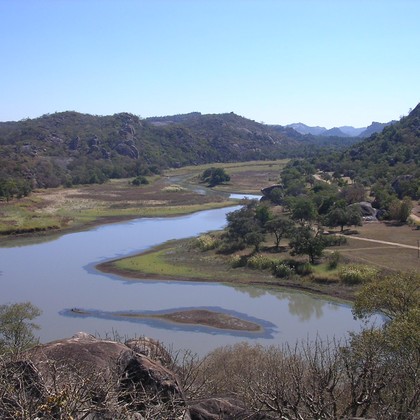
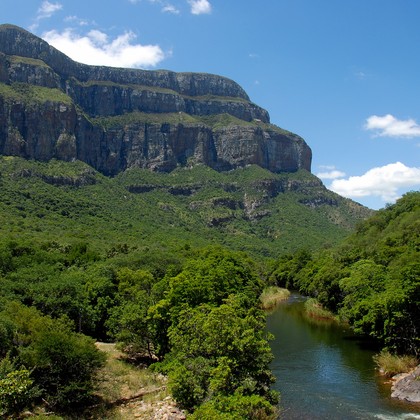
Dry and semi-arid savanna, acacia thornveld, mopane and mixed woodland and well-wooded banks of dry rivers; also gardens and villages with large trees. It avoids dense forest and open grassland. It hunts from a shaded perch with a short, fast dash at prey on the ground: lizards, grasshoppers, termites, small birds and at times small rodents or bats.
Where the bird is most at home, classified by the vegetation units of southern Africa.
Range and movements
Widespread in the north and east of the region: Angola, Zambia, Malawi, Mozambique, Zimbabwe, northern and eastern Botswana, northern and central Namibia, and in South Africa in Limpopo, Mpumalanga, northern North West and northern KwaZulu-Natal, extending to Eswatini. Absent from the arid south-west and the highveld. Beyond the region throughout sub-Saharan Africa and in southern and south-eastern Asia, from Iran to Vietnam.
- Resident
- Summer visitor (c. Oct–Mar)
- Winter visitor (c. Apr–Sep)
- Passage (Mar–Apr, Oct–Nov)
- dark = core range, pale = thinly spread
How and when to look
In the warm part of the day watch for a small grey hawk dashing low from tree to tree and then sitting still in the canopy. In the Kruger National Park and northern Botswana it is often seen in camps and around rest stops, where it snatches lizards from walls and posts. The unbarred central tail feathers and the lack of a white rump are the quickest features against Gabar Goshawk.
Conservation status
Not threatened; common and stable over most of its range. Locally it suffers from clearance of woodland for firewood and charcoal, but it adapts well to villages and well-wooded farmland.
Scientific name
Tachyspiza badia | (Gmelin, 1788)
Gmelin described the species in 1788 as Falco badius; because it was later moved to another genus, the author and year stand in brackets. The genus Tachyspiza was introduced in 1844 by Kaup. Tachyspiza is Greek, from takhus 'fast' and spizias 'hawk'. badia comes from the Latin badius, 'chestnut-brown' — for the rufous-barred underparts. The specimen the first description was based on came from Sri Lanka.