All species › Passerines › Chats and flycatchers › Sharpe's Akalat
Sharpe's Akalat | Sheppardia sharpei
Sharpes akalat | Akelat de Sharpe
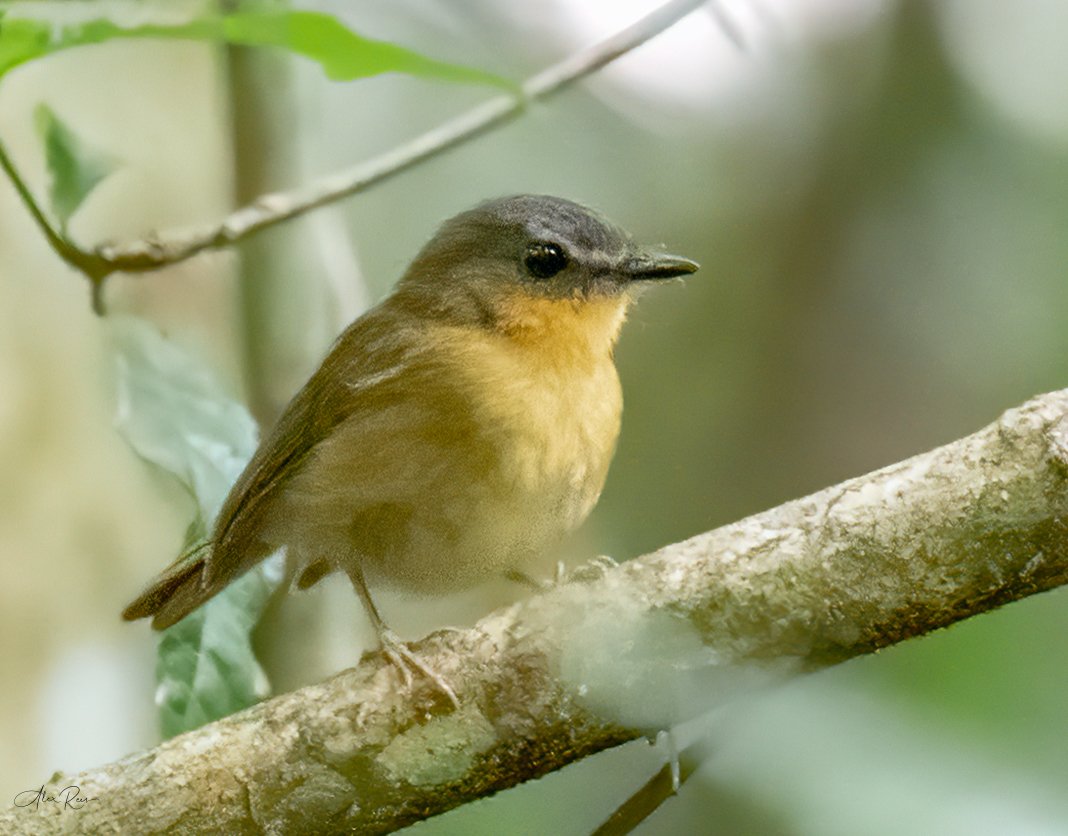
Sharpe's Akalat is a small, inconspicuous robin of the undergrowth of montane forest in northern Malawi and adjacent north-eastern Zambia. Within the region it is a speciality of the Nyika Plateau and the Misuku Hills.
Voice
The song is a short, thin, high series of a few whistles, often in varying order, soft and gives little clue to its direction. The alarm is a dry, rapid rattling trrrrt, which is often the first clue. Sings mainly in the early morning and at the start of the rainy season.
Recording: isaac kilusu — CC BY-NC-SA 4.0 · converted to mono · xeno-canto
Identification
A small, round akalat of 12 to 13 cm. The upperparts are plain olive-brown, the tail slightly warmer brown. A small white spot above the lores stands out in the gloom of the forest. Throat and breast are warm orange-tawny, paling to a lighter belly; the flanks are greyish olive. The eye is large and dark, the legs pinkish-grey. Sexes alike. Juveniles are dark with buff spots. It perches upright and motionless on low twigs and drops to the ground onto prey.
Confusion species
Olive-Flanked Ground Robin (Dessonornis anomalus) is larger, with a white throat, grey supercilium and grey breast. White-Starred Robin (Pogonocichla stellata) has yellow underparts and yellow tail patches. Cape Robin-Chat (Dessonornis caffer) is larger, with an orange tail and white supercilium, and keeps to forest edges. East Coast Akalat (Sheppardia gunningi) is the most similar, but lives in lowland forest and has blue-grey wing coverts; their ranges do not overlap within the region.
Habitat
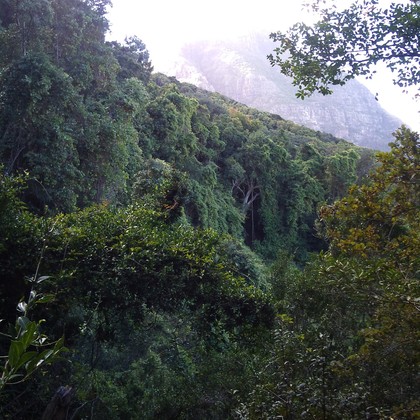
Undergrowth of moist montane evergreen forest, forested ravines and forest edges, also in older secondary growth, mostly between 1600 and 2500 m. Forages low in the undergrowth and on the forest floor for small insects, sometimes at driver-ant swarms.
Where the bird is most at home, classified by the vegetation units of southern Africa.
Range and movements
In northern Malawi on the Nyika Plateau and in the Misuku Hills; in north-eastern Zambia in the forests on the Zambian side of Nyika and in the Mafinga Mountains. Beyond the region in the mountains of southern and central Tanzania.
- Resident
- Summer visitor (c. Oct–Mar)
- Winter visitor (c. Apr–Sep)
- Passage (Mar–Apr, Oct–Nov)
- dark = core range, pale = thinly spread
How and when to look
Chowo Forest and the forests around Chelinda on the Nyika Plateau are the best-known sites. Listen for the dry rattling alarm and then stand motionless: the bird often comes to look at eye level. A thin, high whistle from the undergrowth with no bird in view is often this species or Olive-Flanked Ground Robin.
Conservation status
Not threatened. The species is not rare in suitable forest, but its habitat is restricted to fragmented montane forests. Within the region the main populations are in protected forest on the Nyika Plateau; clearance and fire in the Misuku Hills and Mafinga Mountains are a local threat.
Scientific name
Sheppardia sharpei | (Shelley, 1903)
Shelley described the species in 1903 as Callene sharpei; because it was later moved to another genus, the author and year stand in brackets. The genus Sheppardia was introduced in 1909 by Haagner. Sheppardia honours P. A. Sheppard, a farmer and bird collector near Beira in Mozambique, who found the first specimen of East Coast Akalat. sharpei honours the English ornithologist Richard Bowdler Sharpe (1847–1909), curator of the bird collection at the British Museum. The specimen the first description was based on came from Masisi Hill (location not specified).