All species › Waders, gulls and terns › Plovers and lapwings › Senegal Lapwing
Senegal Lapwing | Vanellus lugubris
Rouwkievit | Avefría Lúgubre
The Senegal Lapwing is a small, dark lapwing of open woodland and burnt grassland in the lowlands. It often appears in small groups on freshly burnt ground, drawn by the short new grass and exposed insects, and is gone again once the grass grows tall.
Voice
A clear, fluting tee-yeet or tee-oo, and a rapidly repeated tee-tee-tee in flight; softer and more melodious than the grating calls of Crowned Lapwing. Groups call a lot when flushed, and also at night.
Recording: Rory Nefdt — CC BY-NC-SA 4.0 · converted to mono · xeno-canto
Identification
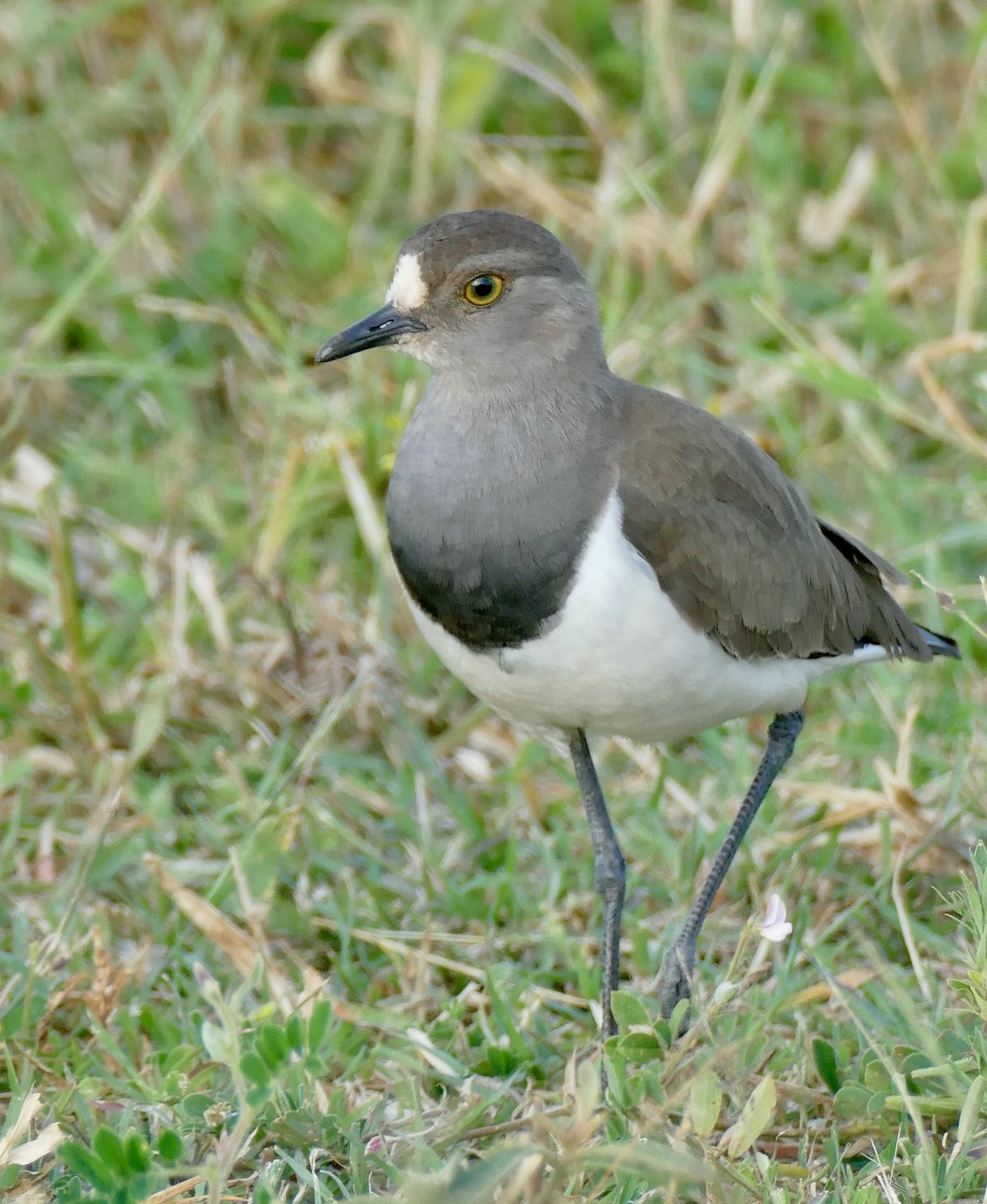
22–26 cm. Head and neck are grey with a small, sharply defined white forehead patch. The grey breast is bordered below by a narrow black band, and the belly is white. The back is grey-brown with a slight olive tone. The bill is black, the eye yellow and the legs dark, blackish to dark olive. In flight the trailing edge of the wing across the secondaries is broadly white and the primaries are black; there is no white band across the coverts. The sexes are alike; juveniles have pale feather fringes and a duller head.
Confusion species
Black-Winged Lapwing Vanellus melanopterus is very similar but larger and heavier, with a larger white forehead patch, a broader black breast band, red legs and a red eye-ring; in flight it shows a white diagonal band across the coverts and black secondaries, the reverse of Senegal Lapwing. It also lives in higher-lying grassland. Crowned Lapwing Vanellus coronatus is larger and sandy brown, with a black cap ringed in white and red legs.
Habitat
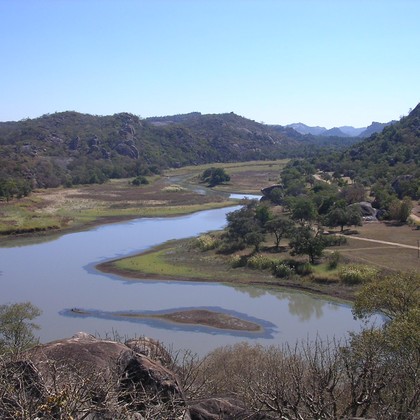
Short grass in open lowland woodland, especially freshly burnt patches, as well as airfields, closely grazed fields and clearings in miombo and mixed woodland. Not tied to water. It breeds on bare or burnt ground, often shortly after a fire.
Where the bird is most at home, classified by the vegetation units of southern Africa.

Range and movements
In the north and east of the region: Angola, Zambia, Malawi, Mozambique and eastern Zimbabwe, south to eastern Eswatini and north-eastern KwaZulu-Natal and the Kruger National Park in South Africa. Irregular and nomadic: sometimes numerous in an area, then absent for years. Beyond the region from Senegal to Somalia and south through East Africa.
- Resident
- Summer visitor (c. Oct–Mar)
- Winter visitor (c. Apr–Sep)
- Passage (Mar–Apr, Oct–Nov)
- dark = core range, pale = thinly spread
How and when to look
Search after veld fires, in the late dry season, on blackened flats in the lowlands of Zululand, Mozambique or Zambia. The birds are inconspicuous until they fly; then watch for the broad white trailing edge to the wing.
Conservation status
Not threatened; widespread but irregular. Scarce in South Africa at the southern edge of its range, where changes in fire management and the conversion of grassland to sugarcane and timber plantations reduce its habitat.
Scientific name
Vanellus lugubris | (Lesson, 1826)
Lesson described the species in 1826 as Charadrius lugubris; because it was later moved to another genus, the author and year stand in brackets. The genus Vanellus was introduced in 1760 by Brisson. Vanellus is the diminutive of the Latin vannus, 'winnowing fan' — for the sound and shape of the broad, rounded wings in flight, which recall a fan being winnowed. lugubris is Latin for 'mournful' — for the sober grey-brown plumage. The specimen the first description was based on came from Senegal.