All species › Gamebirds › Pheasants and partridges › Scaly Spurfowl
Scaly Spurfowl | Pternistis squamatus
Geschubde frankolijn | Francolín Escamoso
The Scaly Spurfowl is a dark, plain forest spurfowl of central and eastern Africa that reaches only the northern edge of our region. It lives hidden in the undergrowth of forest and forest edge and is heard far more often than seen.

Voice
A loud, grating, rising ke-rak ke-rak ke-rak, accelerating into a fast series, mainly at dawn and dusk from a raised spot on the forest floor or a fallen log. When alarmed a short, sharp kek.
Recording: Jaap van der Waarde — CC BY-NC-SA 4.0 · converted to mono · xeno-canto
Identification
About 32 cm. The plumage is uniform dark olive-brown, with fine pale feather edges on the underparts that make breast and flanks look finely scaled at close range; at a distance the bird appears almost unmarked. The throat is dull white to greyish, without bare skin. The bill and legs are strikingly orange-red, a good feature in the gloom of the forest floor. The male carries spurs; otherwise the sexes are alike. Juveniles are more finely barred with a duller bill. It walks with a slightly hunched back and when disturbed prefers to run rather than fly into cover.
Confusion species
Red-Necked Spurfowl has bare red skin on the throat and around the eye and usually strongly streaked or black-and-white patterned underparts. Grey-Striped Spurfowl, on the Angolan escarpment, is paler with grey-streaked neck and breast and a small bare red patch around the eye. Coqui and Crested Francolins are smaller, with clear head patterns. Within the region the combination of unmarked dark plumage with orange-red bill and legs is diagnostic.
Habitat
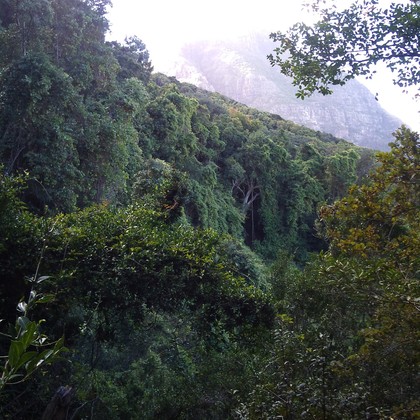
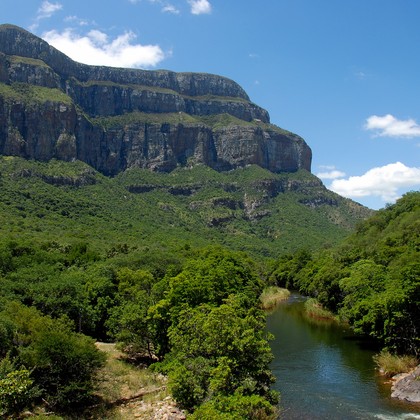
Moist lowland and montane forest, riverine and gallery forest and the dense undergrowth of forest edges, also secondary growth, abandoned gardens and field edges bordering forest. It forages in pairs or small family groups on the forest floor for seeds, fruit, tubers, snails and insects, scratching through the leaf litter.
Where the bird is most at home, classified by the vegetation units of southern Africa.
Range and movements
Within the region only on the northern edge: in northern and north-western Angola, in the forests of Cabinda, Uíge, Cuanza Norte and Malanje, and marginally in the montane forests of far northern Malawi and north-eastern Zambia. Beyond the region it ranges from Nigeria and Cameroon through DR Congo and Uganda to Ethiopia, Kenya and Tanzania.
- Resident
- dark = core range, pale = thinly spread
How and when to look
At first light, listen at the edge of a forest or wooded valley for the grating call series, then stand quietly on a forest track: pairs often step briefly into the open in the early morning and after rain. Look for the orange-red of bill and legs in the half-light.
Conservation status
Not threatened and fairly common across much of its range. On the southern edge in Angola and Malawi the species depends on remaining forest patches and suffers from deforestation, cultivation and snaring.
Scientific name
Pternistis squamatus | (Cassin, 1857)
Cassin described the species in 1857 as Francolinus squamatus; because it was later moved to another genus, the author and year stand in brackets. The genus Pternistis was introduced in 1832 by Wagler. Pternistis comes from Greek pternistēs 'one who strikes with the heel', from pterna 'heel', after the spurs on the legs. squamatus is Latin for 'scaly', for the scale-like pattern of the plumage. The specimen the first description was based on came from Cape Lopez, Gabon.