All species › Waders, gulls and terns › Gulls and terns › Saunders's Tern
Saunders's Tern | Sternula saundersi
Saunders' dwergstern | Charrancito de Saunders
Saunders's Tern is the eastern counterpart of Little Tern, breeding around the Red Sea, the Persian Gulf and the coasts of Pakistan and Sri Lanka and wintering along the East African coast. In the region it is an extreme rarity that can only be confirmed with good photographs and close attention to the rump, tail and primaries.
Voice
Barely distinguishable from Little Tern: a high kee-ick and a chattering kirrik, perhaps slightly softer and slower. Usually silent on the wintering grounds.
Recording: David Darrell-Lambert — CC BY-NC-SA 4.0 · converted to mono · xeno-canto
Identification
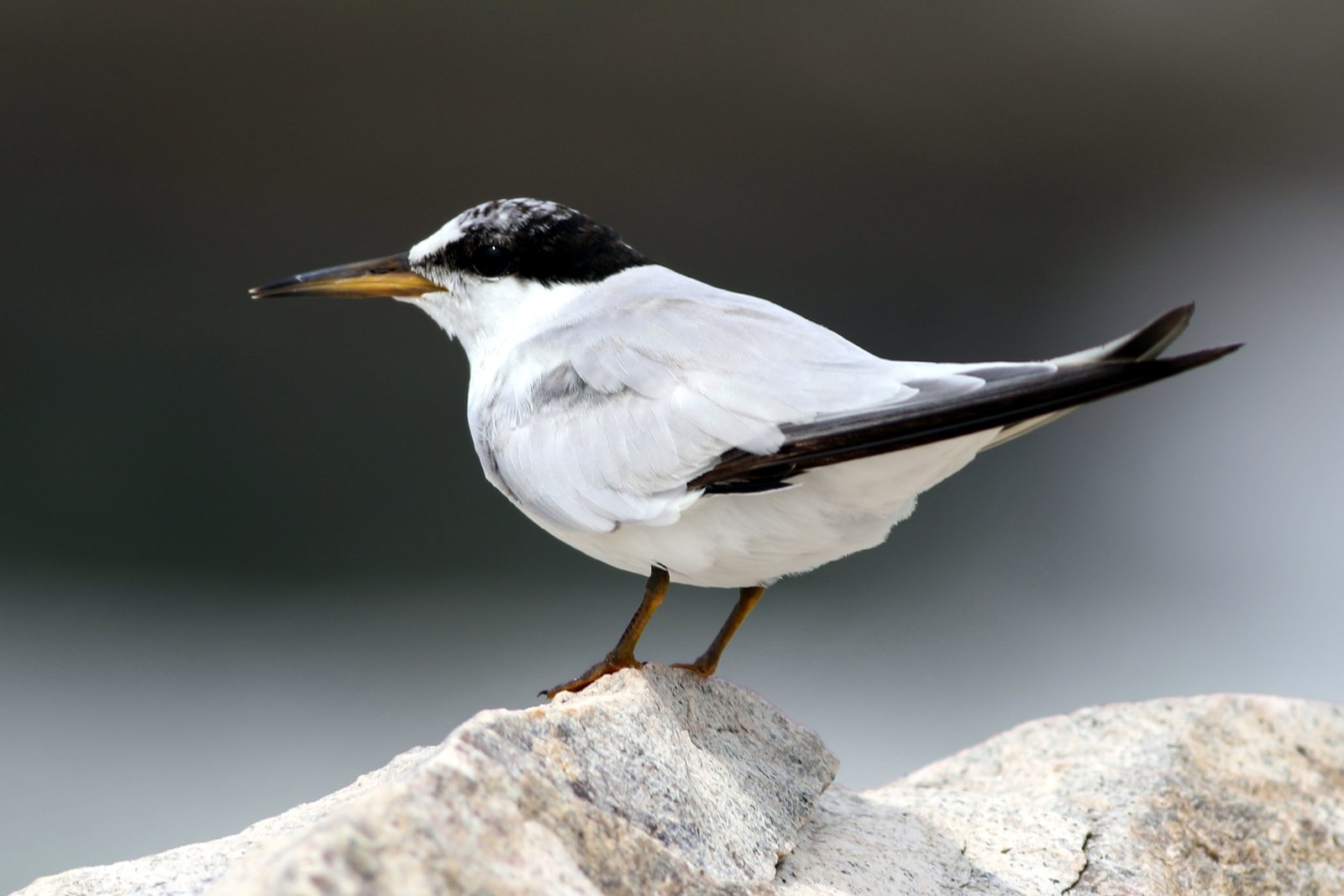
About 22 cm, very similar in build and plumage to Little Tern. The key features are the grey rump and tail, which barely contrast with the back, and three or four dark outer primaries with conspicuously black shafts, forming a broader and more sharply defined dark wingtip. In breeding plumage the white forehead patch is square-cut and does not extend behind the eye; the bill is yellow with a black tip and the legs are duller, brownish to olive-yellow. In non-breeding plumage bill and legs are dark and separation from Little Tern often rests on the wing pattern and tail colour alone. The tail feathers are relatively short.
Confusion species
Little Tern Sternula albifrons has a white rump and tail, only two or three dark outer primaries, orange-yellow legs in breeding plumage and a white forehead patch that continues behind the eye as a narrow supercilium. Damara Tern Sternula balaenarum also has a grey rump and tail, but a longer, slightly decurved black bill and in breeding plumage an entirely black crown without a white forehead patch. Many older reports from East Africa are uncertain precisely because of this overlap.
Habitat
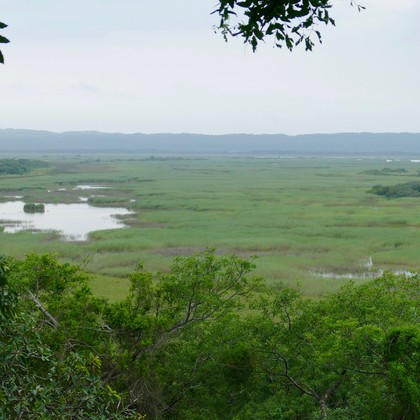
Shallow coastal waters, estuaries, tidal creeks and sandy beaches, often with Little Terns and other terns at high-tide roosts. It fishes by hovering and plunging for small fish and shrimps. It breeds on bare sand and shell banks and small coral islets.
Where the bird is most at home, classified by the vegetation units of southern Africa.
Range and movements
In the region known only from a few documented records along the coast of southern Mozambique; it is probably overlooked among Little Terns. It breeds around the Red Sea, the Gulf of Aden, the Persian Gulf and along the coasts of Pakistan, western India and Sri Lanka, and winters mainly along the coasts of Somalia, Kenya and Tanzania, and also in the Seychelles.
How and when to look
In the estuaries of southern Mozambique, check every Little Tern for the colour of the rump and tail, ideally as the bird takes off or stretches its wings. Photographs of the upperwing and tail are essential for a safe identification; a sighting should be submitted to the national rarities committee for acceptance.
Conservation status
Not threatened, but poorly known; because of its similarity to Little Tern it can be confused with that species in censuses. Breeding colonies on low islets and beaches are vulnerable to disturbance, egg collecting and coastal development.
Scientific name
Sternula saundersi | (Hume, 1877)
Hume described the species in 1877 as Sterna Saundersi; because it was later moved to another genus, the author and year stand in brackets. The genus Sternula was introduced in 1822 by Boie. Sternula is a Latin diminutive of Sterna and so means 'little tern'. saundersi honours the British ornithologist Howard Saunders (1835–1907), a specialist in gulls and terns. The specimen the first description was based on came from Karachi, Sindh, Pakistan.