All species › Waders, gulls and terns › Gulls and terns › Sandwich Tern
Sandwich Tern | Thalasseus sandvicensis
Grote stern | Charrán Patinegro
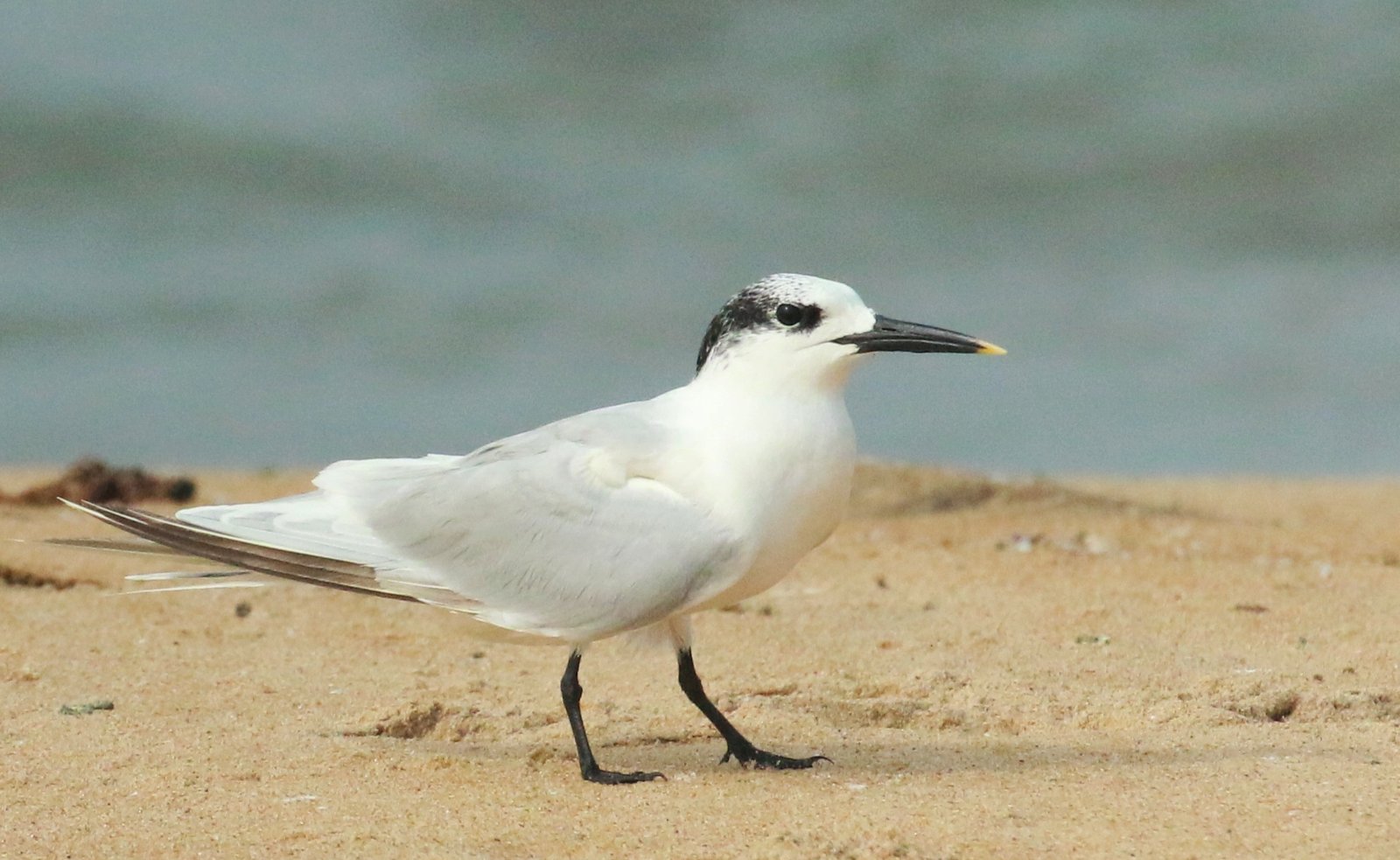
The Sandwich Tern is a slender, pale crested tern with a long black bill tipped yellow. It breeds in western Europe and around the Black and Caspian Seas and spends the northern winter along the cold coasts of southern Africa, where it roosts on beaches and sandbars alongside Greater Crested Terns.
Voice
A harsh, grating kerr-ick or kirrick, mainly in flight and from flocks lifting off the roost; juveniles beg with a high, thin kri-kri.
Recording: Paul Kelly — CC BY-NC-SA 4.0 · converted to mono · xeno-canto
Identification
About 40 cm, with long narrow wings and a short forked tail. The upperparts are very pale silver-grey and the underparts white, so that the bird looks almost white at distance. During its stay here the forehead is white and the black hind crown forms a shaggy crest; in March and April some birds regain a full black cap. The bill is long, thin and black with a yellowish tip; the legs are black. In flight the dark outer primaries stand out, forming a dark wedge as they wear through the winter. Juveniles have dark V-shaped markings on the mantle and coverts and a shorter bill, sometimes without the yellow tip.
Confusion species
Greater Crested Tern (Thalasseus bergii) is much larger, darker grey above and has a thick yellow bill. Lesser Crested Tern (Thalasseus bengalensis) has an orange bill and a grey rump. The rare Elegant Tern (Thalasseus elegans) has a long, slightly drooping orange bill; bear in mind possible hybrids and Sandwich Terns with pale bills. Common Tern (Sterna hirundo) is smaller, with red legs and a shorter bill without a yellow tip.
Habitat
Inshore waters, bays, lagoons and estuaries, usually within a few kilometres of the coast. It plunge-dives from about ten metres for small shoaling fish. It roosts in flocks on sandy beaches, sandbars, jetties and in harbours, often among Greater Crested Terns, Common Terns and gulls.
Where the bird is most at home, classified by the vegetation units of southern Africa.


Range and movements
Most numerous along the west coast, from southern Angola along the Namibian coast (Walvis Bay, Sandwich Harbour, Lüderitz) to the Western Cape; in smaller numbers east along the Eastern Cape and scarce to KwaZulu-Natal and Mozambique. Breeds in Europe from Ireland to the Black Sea and around the Caspian, with a related form in the Americas; winters along the coasts of Africa, the Mediterranean and the Middle East.
- Resident
- Summer visitor (c. Oct–Mar)
- Winter visitor (c. Apr–Sep)
- Passage (Mar–Apr, Oct–Nov)
- dark = core range, pale = thinly spread
How and when to look
Look for Sandwich Terns in the summer months at the roosts in Walvis Bay lagoon, at the Berg River mouth and in Langebaan Lagoon. On a rising tide they gather with Greater Crested Terns on the sandbars; the slim, almost white birds with black bills stand out at once. Ringed birds from Europe are regularly read here.
Conservation status
Not threatened. The European breeding population is vulnerable to avian influenza, which struck large colonies in 2022, and to disturbance and flooding of breeding islands. In southern Africa there are no specific threats, although disturbance of roosts by recreation and dogs can matter locally.
Scientific name
Thalasseus sandvicensis | (Latham, 1787)
Latham described the species in 1787 as Sterna sandvicensis; because it was later moved to another genus, the author and year stand in brackets. The genus Thalasseus was introduced in 1822 by Boie. Thalasseus derives from Ancient Greek thalassa 'sea'. sandvicensis means 'of Sandwich', the town in the English county of Kent that was the type locality. The specimen the first description was based on came from Sandwich, Kent, England.