All species › Waders, gulls and terns › Gulls and terns › Sabine's Gull
Sabine's Gull | Xema sabini
Vorkstaartmeeuw | Gaviota de Sabine
Sabine's Gull is a small, tern-like gull that breeds on the Arctic tundra and winters in the cold upwelling waters of the Benguela Current. Off Namibia and western South Africa it is one of the most numerous gulls at sea in the southern summer, but it is seldom seen from land.
Voice
Usually silent in the region. At times a high, grating krree, tern-like, on taking off or in groups.
Recording: Stein Ø. Nilsen — CC BY-NC-SA 4.0 · shortened to the first 60 s, mono · xeno-canto
Identification
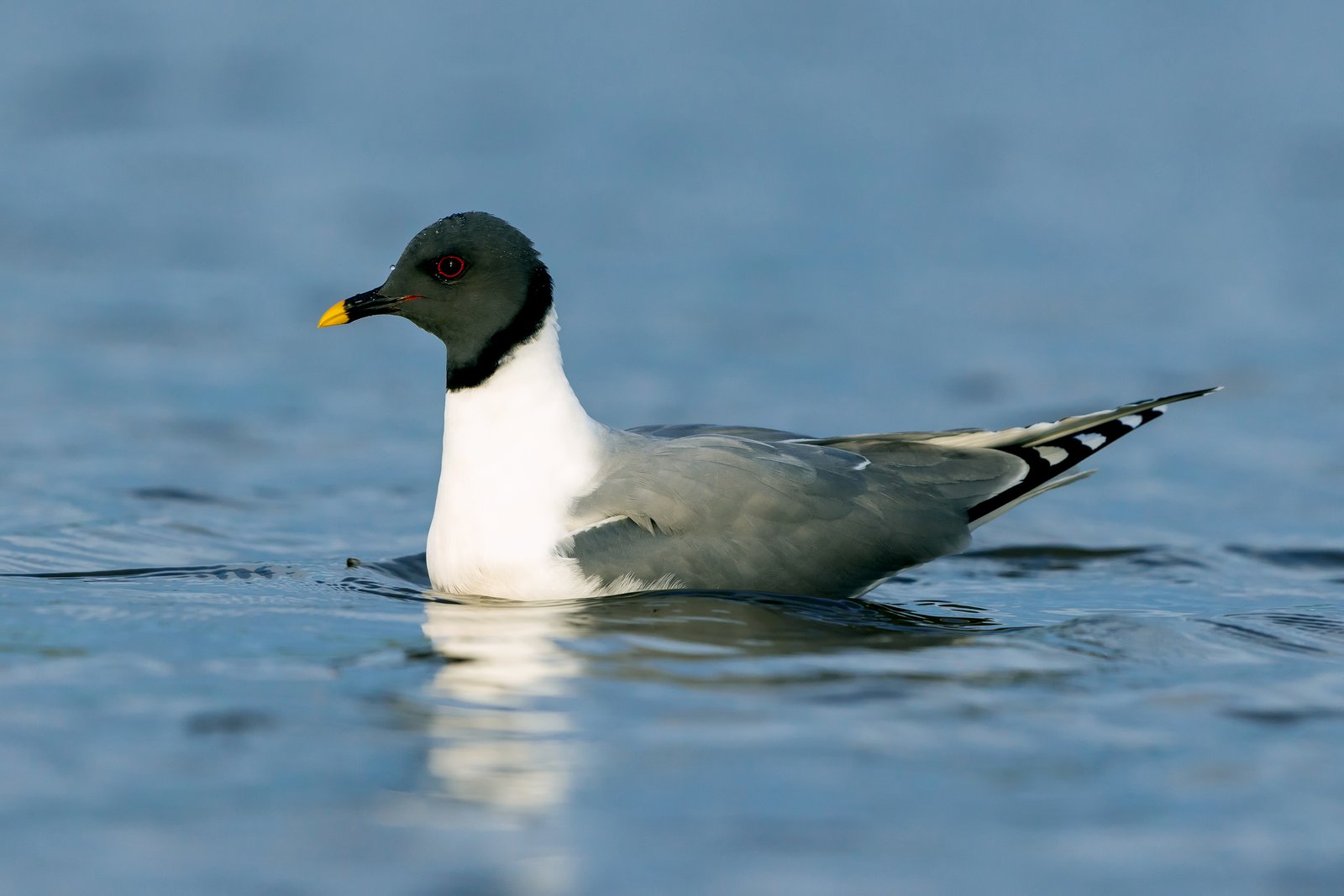
30–34 cm. In every plumage an unmistakable tricoloured wing pattern: black outer primaries, a large white triangle over the rear half of the wing, and a grey (brownish-grey in juveniles) forewing and back. The tail is white and clearly forked. Adults in breeding plumage have a dark grey hood with a black border and a black bill with a yellow tip; in the region they are mostly in non-breeding plumage, with a white head and dark grey hind neck, and hooded again by March–April. Juveniles have a scaly grey-brown head, neck and back, and a black tail band. The legs are dark. The flight is light and tern-like; it picks food from the surface in flight or while swimming.
Confusion species
Juvenile Black-Legged Kittiwake Rissa tridactyla has a black W across the wings and a black collar, but no large white triangle, and is larger. Juvenile Little Gull Hydrocoloeus minutus is smaller, with a dark W and dark crown. Hartlaub's Gull Chroicocephalus hartlaubii and Grey-Headed Gull Chroicocephalus cirrocephalus have a white leading edge to the wing and a square tail. In poor light groups at sea can suggest terns, but the wing pattern settles it.
Habitat
Open sea over the continental shelf and along the shelf edge, where cold upwelling water concentrates plankton. It eats small crustaceans, fish larvae and other invertebrates from the surface, and sometimes follows fishing boats. In strong winds it enters bays and harbours, such as at Walvis Bay and Lüderitz.
Where the bird is most at home, classified by the vegetation units of southern Africa.
Range and movements
Mainly at sea off Namibia and the west coast of South Africa, in groups of tens to hundreds of birds; scarcer around the Cape and off the south coast, and rare off the east coast. It also passes off Angola. There are a few inland records. It breeds around the Arctic; birds from Arctic Canada and Greenland winter in the Benguela Current, those from Alaska and Siberia off western South America.
- Summer visitor (c. Oct–Mar)
- Passage (Mar–Apr, Oct–Nov)
- dark = core range, pale = thinly spread
How and when to look
The best chance is a pelagic trip out of Cape Town or Walvis Bay between November and March; they often sit in small groups on the water near the shelf edge. From the shore, it is best after onshore storms, for example in the harbour and lagoon at Walvis Bay.
Conservation status
Not globally threatened; the population is large and stable. At sea the species is vulnerable to oil pollution and changes in plankton supply.
Scientific name
Xema sabini | (Sabine, 1819)
Sabine described the species in 1819 as Larus Sabini; because it was later moved to another genus, the author and year stand in brackets. The genus Xema was introduced in 1819 by Leach. Xema appears to be an invented name without meaning; William Leach introduced it in 1819 without explanation. sabini honours the British polar explorer Edward Sabine (1788–1883), who collected the first specimens on islets off the west coast of Greenland; his brother Joseph described the species from that material. The specimen the first description was based on came from the Sabine Islands, Greenland.