All species › Parrots › Parrots › Rüppell's Parrot
Rüppell's Parrot | Poicephalus rueppellii
Rüppells papegaai | Lorito de Rüppell
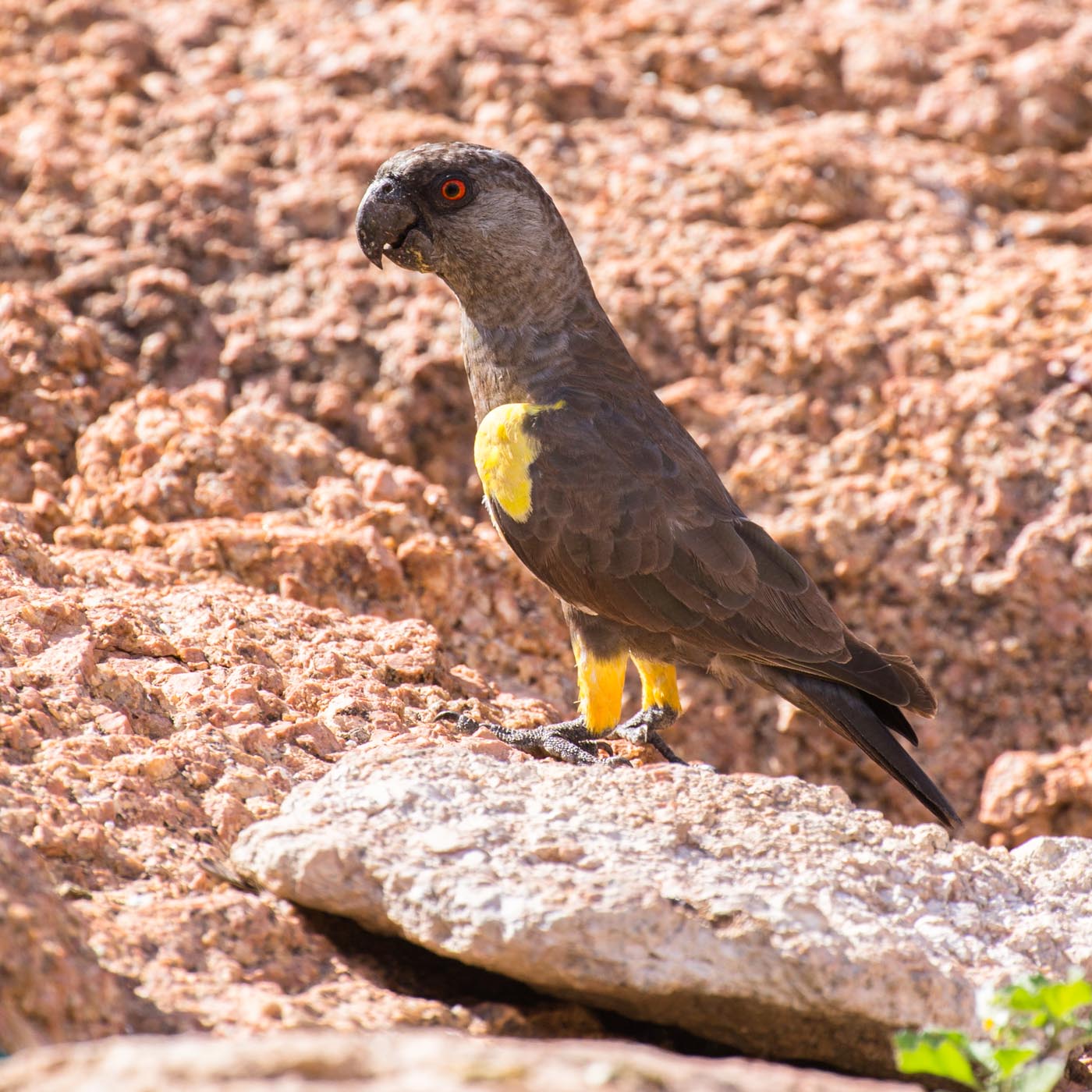
Rüppell's Parrot is a small grey-brown parrot of the arid north-west of Namibia and south-western Angola, the only area in the world where it occurs. It is one of the few parrots in which the female is more colourful than the male.
Voice
A high chee-chee and a hard, screeching kree-kree, usually in flight; softer chattering when perched. The calls are somewhat thinner and higher than those of Meyer's Parrot.
Recording: Derek Engelbrecht — CC BY-NC-SA 4.0 · converted to mono · xeno-canto
Identification
About 23 cm, with a short tail. The head and throat are grey-brown, the ear coverts slightly silvery grey; the rest of the body is dark grey-brown. The bend of the wing, the underwing coverts and the thighs are bright yellow. The male has a grey-brown rump and belly with at most a hint of blue. The female has a bright blue lower back, rump, belly and undertail coverts, conspicuous both in flight and on perched birds. The bill is dark grey, the iris orange-red. Juveniles resemble the female, with blue on rump and belly, but lack the yellow at the bend of the wing.
Confusion species
Meyer's Parrot (Poicephalus meyeri) is browner, often with a yellow crown band, and has a blue-green to turquoise belly and rump in both sexes, without yellow thighs. The two species meet in northern Namibia, where hybrids with intermediate features occur. Rosy-Faced Lovebird (Agapornis roseicollis), which shares the same area, is smaller and green with a pink face.
Habitat
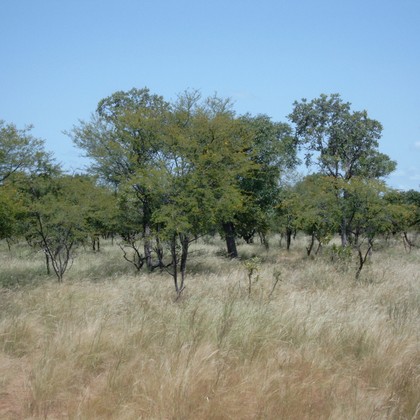
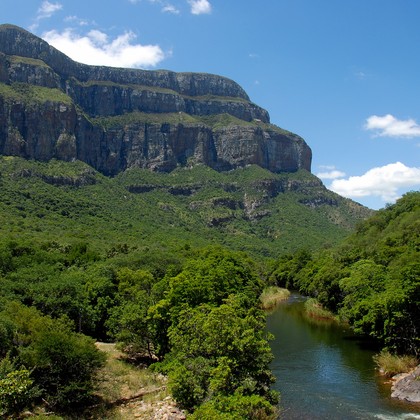
Dry woodland and thornveld, especially the tall trees along dry riverbeds, such as Ana Tree (Faidherbia albida), wild figs and mopane, and woodland around waterholes and pans. It eats seeds, fruit, nuts, flowers and nectar, and acacia pods. It drinks daily. It nests in tree holes, often old woodpecker holes.
Where the bird is most at home, classified by the vegetation units of southern Africa.
Range and movements
Near-endemic to the region: north-western and northern Namibia, from the Kaokoveld and Damaraland through Etosha and the Waterberg Plateau to the Ovambo plain and western Kavango, and south-western Angola, from Namibe and Huíla provinces to Cunene and Benguela. The species occurs nowhere else in the world.
- Resident
- Winter visitor (c. Apr–Sep)
- Passage (Mar–Apr, Oct–Nov)
- dark = core range, pale = thinly spread
How and when to look
Search in the morning along the dry riverbeds of the Kaokoveld and Damaraland, around Kamanjab and Opuwo, and in woodland on the western side of Etosha and around the Waterberg Plateau. Waterholes where flocks come to drink give the best chance of perched birds. In flocks, note the difference between the blue females and the dull males.
Conservation status
Not threatened on the global list, but with a small world range. The species was heavily trapped for the cage-bird trade in the twentieth century, leading to a ban on exports from Namibia. Loss of old hole-bearing trees to firewood cutting and drought may limit nest sites.
Scientific name
Poicephalus rueppellii | (Gray, 1849)
Gray described the species in 1849 as Psittacus Rüppellii; because it was later moved to another genus, the author and year stand in brackets. The genus Poicephalus was introduced in 1837 by Swainson. Poicephalus comes from the Greek poikilos, 'mottled, variegated', and kephale, 'head' — for the strongly contrasting head pattern of these parrots. rueppellii honours the German explorer and naturalist Eduard Rüppell (1794–1884). The specimen the first description was based on came from Damaraland, Namibia.