All species › Passerines › Cisticolas › Rufous-Winged Cisticola
Rufous-Winged Cisticola | Cisticola galactotes
Zwartruggraszanger | Cistícola Alirrojo
The Rufous-Winged Cisticola is the wetland cisticola of the eastern lowlands of southern Africa, from Zululand to southern Malawi. Its former name Black-Backed Cisticola refers to the heavily black-streaked back in breeding plumage. After the split of the Winding Cisticola complex it is a species found almost only in the area of this guide.

Voice
A rasping, buzzing zzzrreeeee, often alternated with clear tee-tee-tee series and a dry prrrt, from the top of a reed stem. It calls a loud chwee; in alarm a scolding chrrrr.
Recording: Magnus Wadstein — CC BY-NC-SA 4.0 · converted to mono · xeno-canto
Identification
12–14 cm. In breeding plumage (summer) a rufous-brown crown, a back with such broad black streaks on grey that it looks blackish above, a bright rufous wing panel and white underparts with a greyish wash on the breast and flanks. The tail is grey-brown with a black band before the white tips. In non-breeding plumage (winter) the back is browner and less contrasting, the crown streaked, the underparts warmer buff and the tail longer. The sexes are alike, the male larger. Juveniles are yellower below.
Confusion species
Levaillant's Cisticola Cisticola tinniens lives in highveld vleis and sometimes comes close in Mpumalanga and KwaZulu-Natal, but has a bright rufous tail, a more rufous crown and a liquid, warbling song. Luapula Cisticola Cisticola luapula and Winding Cisticola Cisticola marginatus are very similar but live further west and north; in northern Malawi and Mozambique the boundary is unclear. Chirping Cisticola Cisticola pipiens is larger and longer-tailed. Zitting Cisticola Cisticola juncidis is smaller, short-tailed and sings in song flight. Lesser Swamp Warbler Acrocephalus gracilirostris has an unstreaked back.
Habitat
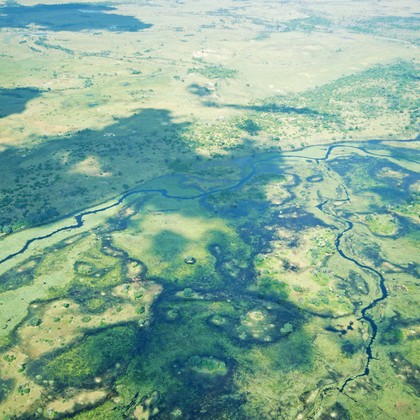
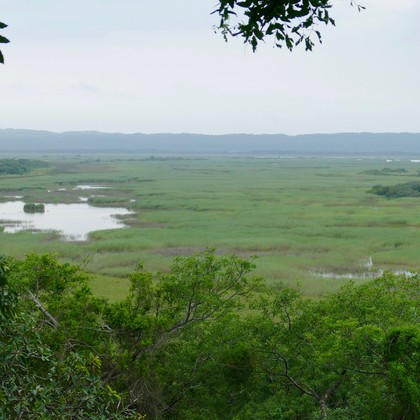
Reedbeds, sedge beds and rank grass along lakes, pans and rivers, coastal marshes and estuary margins, and wet grassy flats; mainly in the lowlands below about 1,000 m. It forages low in the vegetation, usually in pairs.
Where the bird is most at home, classified by the vegetation units of southern Africa.
Range and movements
Within the region in eastern South Africa (the coastal plain and lowlands of KwaZulu-Natal, especially Zululand, and the Mpumalanga lowveld), in the lowlands of Eswatini, in southern and central Mozambique, in south-eastern and eastern Zimbabwe and in southern Malawi (Shire valley, Lake Chilwa and the south of Lake Malawi). It does not occur outside southern Africa.
- Resident
- Summer visitor (c. Oct–Mar)
- Winter visitor (c. Apr–Sep)
- Passage (Mar–Apr, Oct–Nov)
- dark = core range, pale = thinly spread
How and when to look
Present all year; most conspicuous in summer. Good sites are iSimangaliso at St Lucia, Mkhuze and Ndumo. Walk along reed fringes and look for singing birds on reed plumes; in breeding plumage the dark back is obvious at once, in winter the species is seen much less often.
Conservation status
Not threatened. Fairly common in suitable wetlands. Drainage, conversion of wetlands to sugarcane and other agriculture, and coastal development locally damage its habitat.
Scientific name
Cisticola galactotes | (Temminck, 1821)
Temminck described the species in 1821 as Malurus galactotes; because it was later moved to another genus, the author and year stand in brackets. The genus Cisticola was introduced in 1829 by Kaup. Cisticola combines the Ancient Greek kisthos 'rock-rose' with the Latin colere 'to dwell'. galactotes comes from the Greek galaktōdēs, 'milky' — for the pale, whitish underparts. The specimen the first description was based on came from probably Durban area, South Africa (originally given in error as 'New Holland').