All species › Passerines › Grasshopper warblers › River Warbler
River Warbler | Locustella fluviatilis
Krekelzanger | Buscarla Fluvial
The River Warbler is a dark, extremely secretive Palearctic migrant that winters late in the season, mainly from December to March, in the east of the region. It creeps mouse-like over the ground in dense thickets and is almost always noticed only by its mechanical, insect-like song.

Voice
A monotonous, rhythmic and dry song of rapidly repeated buzzing double notes, dze-dze-dze-dze, like a sewing machine or a large grasshopper, sometimes sustained for minutes. In the wintering area it sings mainly at dusk and at night, most in March just before departure. Call a sharp tchik.
Recording: Abe Bakker — CC BY-NC-SA 4.0 · shortened to the first 60 s, mono · xeno-canto
Identification
13–14 cm, with a rounded tail, long, broad undertail coverts and a fairly short, fine bill. Upperparts uniform dark olive-brown, unstreaked. A faint pale supercilium is often barely visible. Throat and upper breast dull white with vague, diffuse grey-brown streaks, flanks olive-brown. The brown undertail coverts have broad white tips, creating a striking scaly pattern that reaches almost to the tail tip. The legs are pinkish-brown. The sexes are alike. It keeps on or just above the ground, walking and creeping rather than hopping.
Confusion species
Little Rush Warbler Bradypterus baboecala is warmer brown, with a broader, rounder tail and fine spots on the breast, lives in reeds and wet rank growth and sings an accelerating series with wing-snaps. Barratt's Warbler Bradypterus barratti is a resident of montane forest and bracken, with warmer brown upperparts and a more clearly streaked breast. Thrush Nightingale Luscinia luscinia is larger, with a rufous-brown tail and a song of rich whistles. Garden Warbler Sylvia borin lacks streaks, has a short, stubby bill and lives higher in the bushes. Song, behaviour and the scaly undertail are decisive.
Habitat
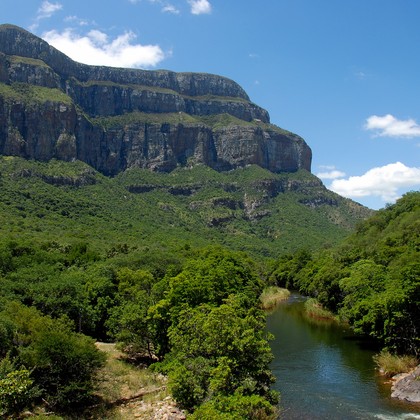
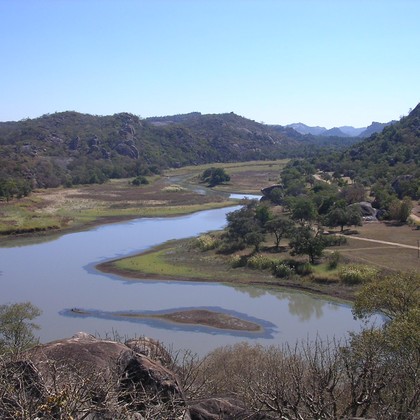
Dense thickets and rank undergrowth in woodland, riverine forest and along dry watercourses, in overgrown gardens and forest edges, often with a dense layer of herbs and creepers; rarely in true reeds. It searches on and just above the leaf litter for small insects and spiders.
Where the bird is most at home, classified by the vegetation units of southern Africa.
Range and movements
Within the region mainly in the east: Malawi, eastern Zambia, Zimbabwe, Mozambique, eastern Botswana and, in South Africa, Limpopo, Mpumalanga and northern KwaZulu-Natal; scarce to rare in Eswatini and further south and west. It breeds from central and eastern Europe to western Siberia, migrates through East Africa and winters in south-eastern Africa.
- Summer visitor (c. Oct–Mar)
- Passage (Mar–Apr, Oct–Nov)
- dark = core range, pale = thinly spread
How and when to look
Listen from January to March at dusk near dense thickets for the sewing-machine song, for example in the north of the Kruger National Park, at Nylsvley or in the lowveld of Zimbabwe and Mozambique. A singing bird sometimes perches a little higher in a bush and can then be seen with patience; outside song the species is almost impossible to find.
Conservation status
Not threatened; the breeding population is large. Because of its secretive habits the species is heavily under-recorded in the wintering area. Loss of dense thicket through clearing and overgrazing may play a local role.
Scientific name
Locustella fluviatilis | (Wolf, 1810)
Wolf described the species in 1810 as Sylvia fluviatilis; because it was later moved to another genus, the author and year stand in brackets. The genus Locustella was introduced in 1829 by Kaup. Locustella is Latin, a diminutive of locusta 'grasshopper'. fluviatilis is Latin for 'of the river', from fluvius 'river', after the damp riverside woods where it breeds. The specimen the first description was based on came from the Danube, Austria.