All species › Passerines › Weavers › Red-Headed Weaver
Red-Headed Weaver | Anaplectes rubriceps
Scharlaken wever | Tejedor Cabecirrojo Sureño
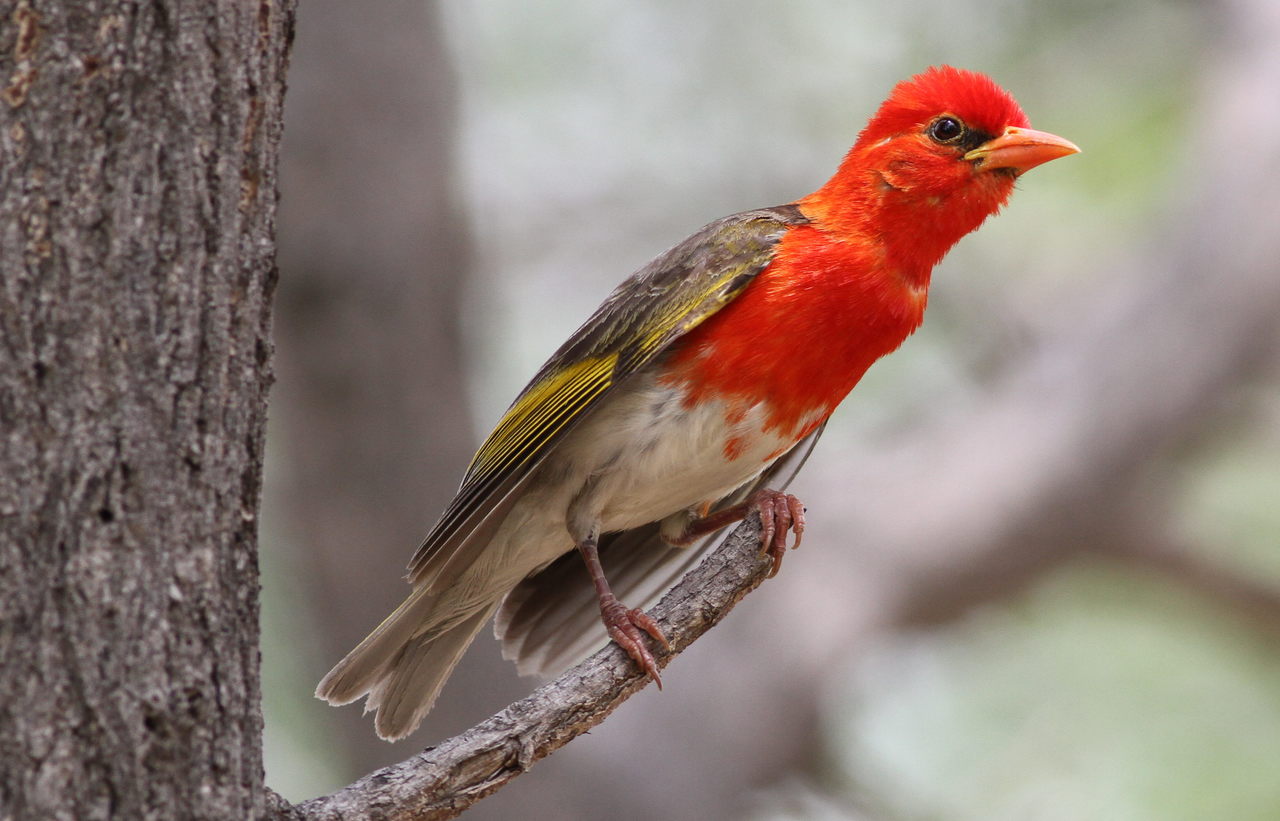
The Red-Headed Weaver is a slim, largely insectivorous weaver of broadleaved woodland. The breeding male has a scarlet head and breast, a white belly and a pink-orange bill. Its ragged nest of twigs and leaf stalks, with a long entrance tube, is so unlike that of other weavers that it is often noticed before the bird.
Click a thumbnail to switch the photo above.
Voice
A high, squeaky and scratchy twitter, chee-chee-cherrr-chirrr, from the male at the nest, and a thin, sharp tseep contact call. Less noisy than most weavers.
Recording: James Apolloh Omenya — CC BY-NC-SA 4.0 · shortened to the first 60 s, mono · xeno-canto
Identification
13–15 cm, slim, with a fairly long, pointed, pink to orange-red bill. The breeding male has head, throat, breast and mantle scarlet, sometimes with a narrow black mask around the eye, a grey-brown back, dark wings and tail with the feathers edged yellow to orange, and a pure white belly and undertail coverts. The female and non-breeding male have a lemon-yellow head and breast, grey upperparts with yellow-edged flight feathers, a white belly and likewise a pink-orange bill. Juveniles resemble the female, with a duller bill. It forages like a tit in the canopy.
Confusion species
The male Red-Headed Quelea (Quelea erythrops) also has a red head, but a dark bill, a streaked brown back and buffy underparts, and lives in grassland and marshes. The breeding male Red-Billed Quelea (Quelea quelea) has a red bill, often a black mask, and a streaked brown back. The Cardinal Quelea (Quelea cardinalis) is smaller, with a dark bill and streaked upperparts. The yellow female may suggest a yellow weaver, but the pink bill, grey back and pure white belly are decisive.
Habitat
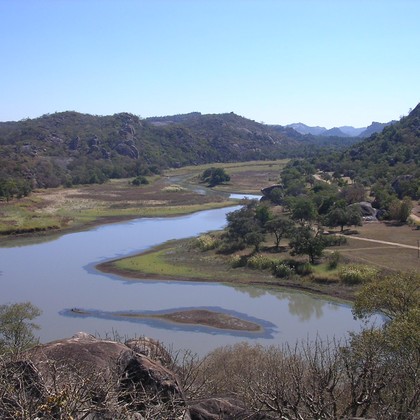
Miombo, mopane and other broadleaved woodland, also riverine woodland, dry woodland and gardens with tall trees; it avoids dense thornveld and closed forest. It breeds singly or in small groups; the nest hangs beneath a branch, from the eaves of a building or even from a telephone wire. It eats mainly insects and caterpillars, few seeds.
Where the bird is most at home, classified by the vegetation units of southern Africa.


Range and movements
In the region in Angola, northern Namibia (from Kaokoveld and Owambo to the Zambezi Region), northern and eastern Botswana, Zambia, Malawi, Zimbabwe, Mozambique, north-eastern South Africa (Limpopo, the Mpumalanga lowveld and northern KwaZulu-Natal) and eastern Eswatini. Beyond the region to southern DR Congo and Tanzania; further north it is replaced by the Northern Red-Headed Weaver (Anaplectes leuconotos), often treated as the same species.
- Resident
- Summer visitor (c. Oct–Mar)
- Winter visitor (c. Apr–Sep)
- Passage (Mar–Apr, Oct–Nov)
- dark = core range, pale = thinly spread
How and when to look
In the Kruger National Park, the Zimbabwe lowveld and Zambian miombo, look for the typical nest: an untidy-looking bag of twigs and leaf stalks with a downward entrance tube up to 20 cm long, sometimes under the eaves of a rest camp. The red male often hangs upside down at the nest. In mixed foraging flocks in woodland the bird can also be picked out by its tit-like behaviour.
Conservation status
Not threatened. Fairly common in suitable woodland; it may decline locally through logging and the loss of miombo, but it also uses gardens and buildings for nesting.
Scientific name
Anaplectes rubriceps | (Sundevall, 1850)
Sundevall described the species in 1850 as Ploceus (Hyphanthornis) rubriceps; because it was later moved to another genus, the author and year stand in brackets. The genus Anaplectes was introduced in 1863 by Reichenbach. Anaplectes comes from the Greek anaplekō, 'to entwine, to braid' (compare ana, 'with', and the genus Symplectes), for the woven nests of these weavers. rubriceps comes from the Latin ruber, 'red', and -ceps, 'headed' — for the male's red head. The specimen the first description was based on came from Mohapoani, Witfontein Mountains, North West Province, South Africa.