All species › Turacos › Turacos › Red-Crested Turaco
Red-Crested Turaco | Tauraco erythrolophus
Roodkuiftoerako | Turaco Crestirrojo
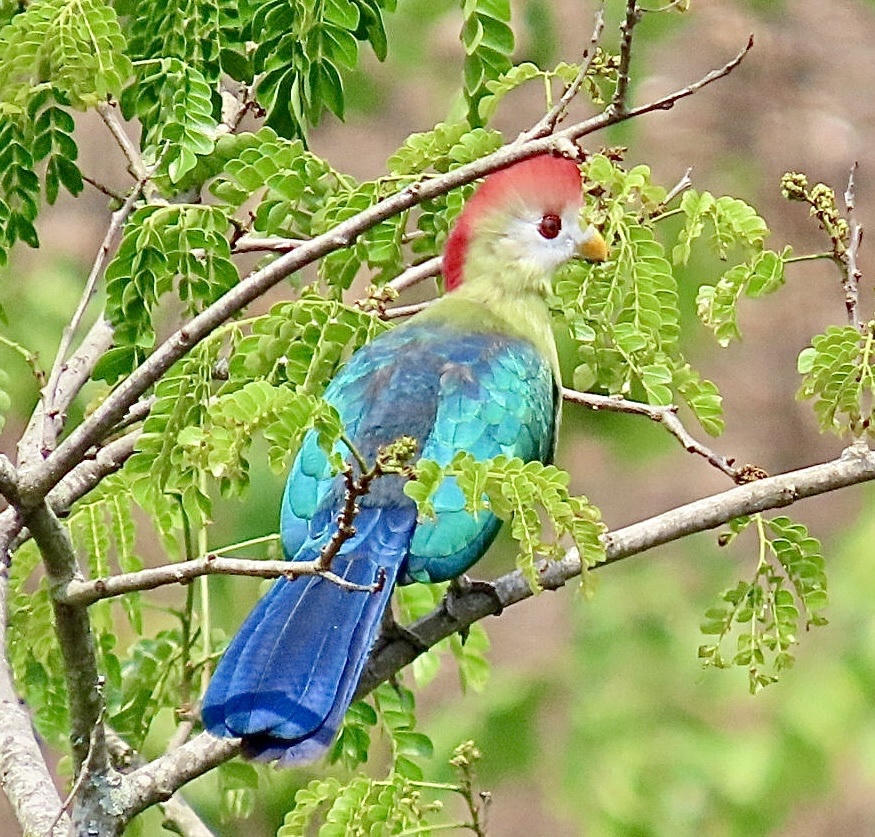
The Red-Crested Turaco is a green turaco with a bright red crest and a white face, endemic to the forests of the Angolan escarpment. It is one of the sought-after endemics for visitors to Angola.
Voice
A loud, hoarse, fast kow-kow-kow-kow, ending in a rolling cackle, similar to the calls of other green turacos. Partners often call together.
Recording: Arnon Dattner — CC BY-NC-SA 4.0 · converted to mono · xeno-canto
Identification
About 40 to 43 cm, with a long tail. Head, neck and breast are green, the belly darker grey-green. The tall, rounded crest is crimson, sometimes with a narrow grey-white fringe at the rear. Forehead, lores and cheeks are white and form a bright facial patch; the bill is yellow and the eye-ring red. Back, wings and tail are glossy blue-violet. The primaries are crimson and conspicuous in flight. Sexes alike. It runs and hops through the canopy.
Confusion species
No other turaco in the region has a red crest above a white face and a green body. Ross's Turaco (Tauraco rossae) also has a red crest and a yellow bill, but is entirely violet-black. Schalow's Turaco (Tauraco schalowi) and Guinea Turaco (Tauraco persa) have a green crest and a red bill.
Habitat
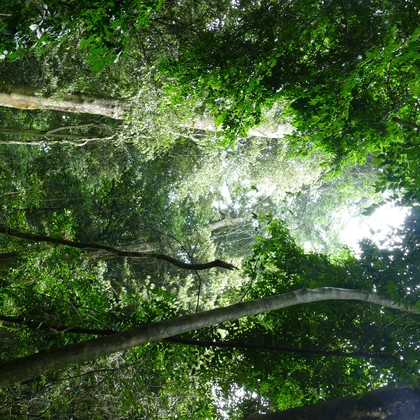
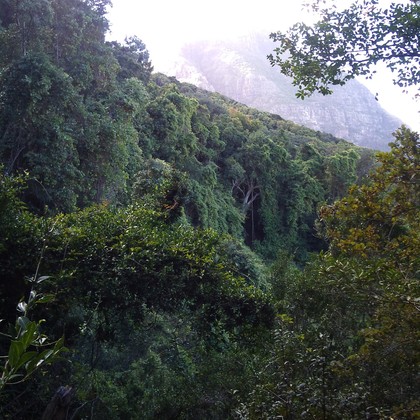
Evergreen forest and forest edges on the western escarpment, gallery forest, secondary forest and old coffee plantations with shade trees, up to middle elevations. It eats fruit, leaves and flowers.
Where the bird is most at home, classified by the vegetation units of southern Africa.
Range and movements
Endemic to western Angola. The species inhabits the forests of the escarpment and the adjacent interior, from Cuanza Norte south through Cuanza Sul (including Gabela and Kumbira) to Benguela and the edges of the Huambo and Huíla highlands. It does not occur outside Angola.
- Resident
- dark = core range, pale = thinly spread
How and when to look
The escarpment forests of Kumbira and Gabela in Cuanza Sul are the best-known sites, together with other Angolan endemics. The bird is noisy and often heard; the red crest and white face are best seen in the forest gloom at fruiting trees.
Conservation status
Not threatened, but with a limited range. The escarpment forest is being degraded by logging, farming and the thinning of shade trees in old plantations; the species tolerates some disturbance and also occurs in secondary forest.
Scientific name
Tauraco erythrolophus | (Vieillot, 1819)
Vieillot described the species in 1819 as Opaethus erythrolophus; because it was later moved to another genus, the author and year stand in brackets. The genus Tauraco was introduced in 1779 by Kluk. Tauraco is a Latinisation of 'touraco', a native name in a West African language for the Guinea turaco; it entered European literature through George Edwards (1743). erythrolophus comes from the Greek erythros, 'red', and lophos, 'crest' — for the crimson crest. The specimen the first description was based on came from Africa (unspecified).