All species › Passerines › Oxpeckers › Red-Billed Oxpecker
Red-Billed Oxpecker | Buphagus erythroryncha
Roodsnavelossenpikker | Picabueyes Piquirrojo
The Red-Billed Oxpecker spends almost its entire life on large mammals, from Impala and giraffe to rhino and cattle. With its flattened red bill it combs ticks and other parasites from the coat, but it also drinks blood from small wounds and keeps them open. It is the commoner of the two oxpeckers in the region.

Voice
A hissing, rasping tsssss and a dry, grating krisss-krisss, often in flight between herds; also a sharp rattling alarm. Small groups on a host keep up a continuous hissing chatter.
No recording with a suitable Creative Commons licence is available for this species yet.
Identification
20–22 cm. Upperparts, head and breast are plain olive-brown, the belly and undertail-coverts pale buff. The bill is entirely bright red, fairly slender and laterally flattened. A conspicuous bare yellow ring (eye-wattle) surrounds the red eye. The tail is long, graduated and stiffened, used as a prop when clambering over the host's hide; the legs are short with sharp claws. The sexes are alike. Juveniles have a dark, blackish-brown bill and lack the yellow eye-ring; the bill turns through yellow and orange to red over the first months.
Confusion species
Yellow-Billed Oxpecker Buphagus africanus has a thicker bill with a yellow base and red tip, lacks the yellow eye-wattle and has a pale rump contrasting sharply with the darker back. Dark-billed young Red-Billed Oxpeckers are the most often confused: then check the uniform brown rump and the accompanying adults. Glossy starlings and Wattled Starlings also perch on livestock and game, but do not clamber over the hide.
Habitat
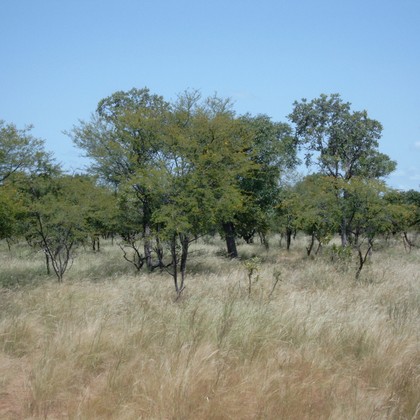
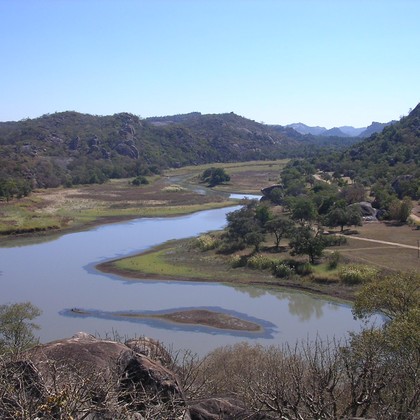
Savanna, thornveld, mopane and open woodland with enough large mammals, both in reserves and on cattle farms. It eats ticks, lice and fly larvae, as well as blood, wound tissue, earwax and skin flakes. It breeds in tree holes, often old woodpecker or barbet holes, lined with hair plucked from its hosts.
Where the bird is most at home, classified by the vegetation units of southern Africa.

Range and movements
In the region in the north and east: north-eastern South Africa (Limpopo, Mpumalanga, KwaZulu-Natal, with reintroduced populations further south in the Eastern Cape), Eswatini, Zimbabwe, northern and eastern Botswana, northern Namibia, Mozambique, Zambia, Malawi and southern Angola. Cattle dipping with toxic chemicals eliminated it from large areas in the twentieth century, but it has recovered since less harmful products came into use. Beyond the region in East Africa, north to Ethiopia and Somalia.
- Resident
- Summer visitor (c. Oct–Mar)
- Winter visitor (c. Apr–Sep)
- Passage (Mar–Apr, Oct–Nov)
- dark = core range, pale = thinly spread
How and when to look
All year; most often seen in game reserves such as Kruger NP, Hluhluwe-iMfolozi and the Okavango. Check the oxpeckers on Impala, giraffe and buffalo one by one: the adult Red-billed with its bright yellow eye-wattle is the norm, but a Yellow-billed may be among the groups. The host often gives a clue: on Impala and cattle it is nearly always Red-billed.
Conservation status
Not threatened. It declined heavily in the past through the dipping of cattle with arsenic and organophosphate products; since the switch to less toxic products and reintroductions in parts of South Africa, it is spreading again, including on cattle farms.
Scientific name
Buphagus erythroryncha | (Stanley, 1814) (GBIF: Buphagus erythrorhynchus)
Stanley described the species in 1814 as Tanagra erythroryncha; because it was later moved to another genus, the author and year stand in brackets. The genus Buphagus was introduced in 1760 by Brisson. Buphagus comes from the Greek bouphagos, 'ox-eating' — for the oxpeckers' habit of picking ticks and other parasites off cattle and large game. erythroryncha comes from the Greek eruthros, 'red', and rhunkhos, 'bill' — for the bright red bill; the irregular spelling without an 'h' is the describer's. The specimen the first description was based on came from Ethiopia (not further specified).