All species › Kingfishers, bee-eaters and rollers › Rollers › Racket-Tailed Roller
Racket-Tailed Roller | Coracias spatulatus
Vlagstaartscharrelaar | Carraca de Raquetas
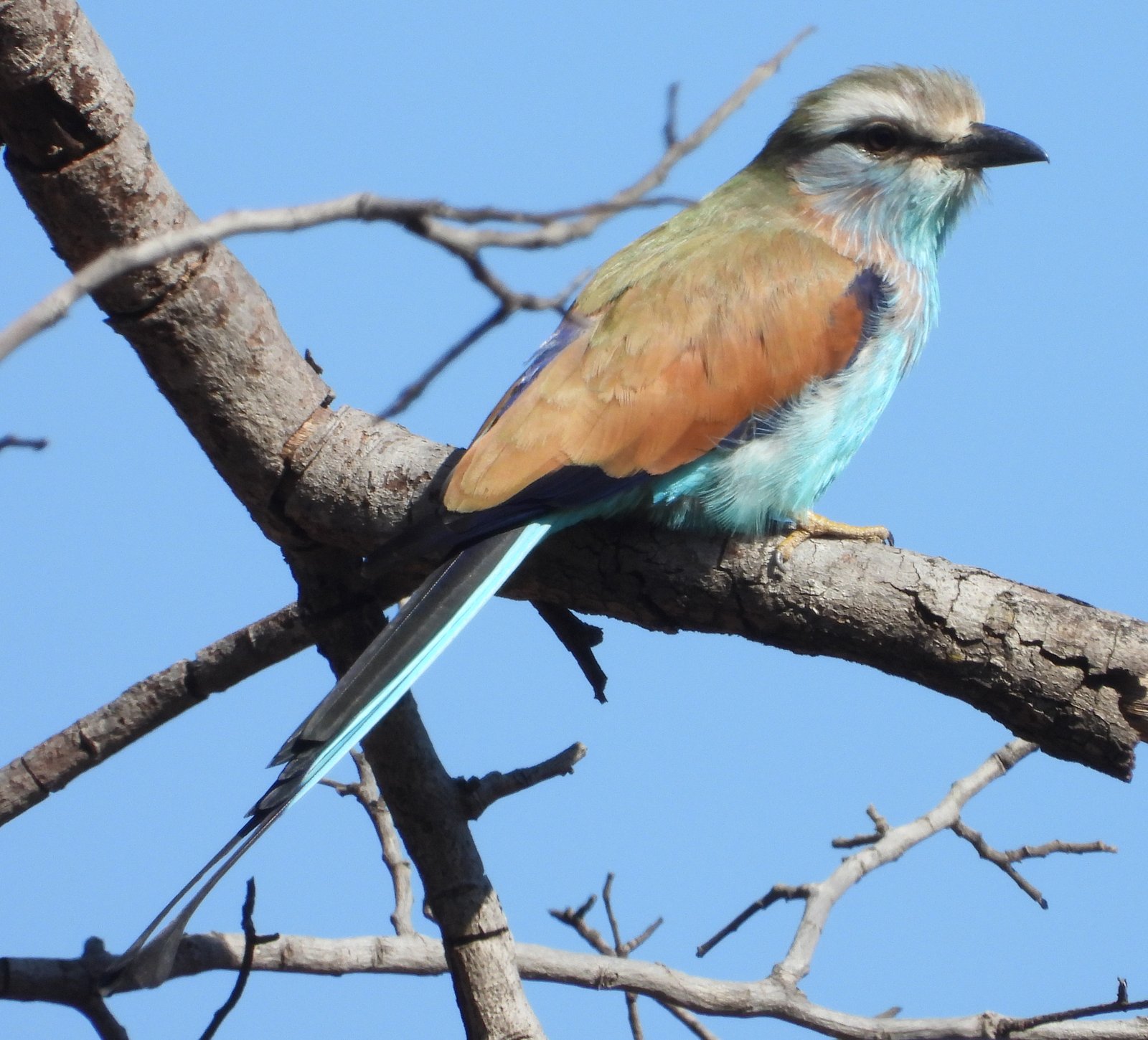
The Racket-Tailed Roller is the roller of miombo woodland, slim and mainly pale blue, with two elongated outer tail feathers ending in dark spatules. It is far less conspicuous than the Lilac-Breasted Roller and often perches inside the canopy rather than on top.
Voice
A hard, raucous grating series, kraa-kraa-kraa, and a rattling cackle, especially during the display flight, in which the bird climbs and then dives with rolling, rocking sweeps. Quieter and less often heard than Lilac-Breasted Roller.
Recording: Lynette Rudman — CC BY-NC-SA 4.0 · converted to mono · xeno-canto
Identification
About 35 cm, of which the elongated tail feathers make up several centimetres. Forehead and supercilium are white, crown and nape greenish-blue, mantle and back olive-brown. The underparts are pale blue, the throat and upper breast washed lilac with fine white streaks. The wing shows pale blue coverts against dark purple-blue flight feathers. The two outer tail feathers are elongated, with a bare, thin shaft and a dark blue, spatulate tip. The sexes are alike. Juveniles are duller and browner, without rackets.
Confusion species
Lilac-Breasted Roller (Coracias caudatus) has a lilac throat and breast, a turquoise belly and narrow, pointed streamers without spatules, and usually perches openly on the highest branches. European Roller (Coracias garrulus), a Palearctic migrant from November to March, has a blue head, a chestnut back and no elongated tail feathers. Juveniles without rackets can be confused with the other rollers; then check the white supercilium and the wooded habitat.
Habitat
Tall, closed miombo woodland with Brachystegia and Julbernardia, locally also mopane woodland and tall mixed woodland. It hunts from a branch in or below the canopy for large insects such as grasshoppers and beetles, and occasionally small lizards, taken on the ground or among the foliage. It nests in tree cavities.
Where the bird is most at home, classified by the vegetation units of southern Africa.


Range and movements
Within the region in the miombo belt: Angola, Zambia, Malawi, northern and central Mozambique and Zimbabwe (mainly the north and the south-eastern lowveld); rare and irregular in north-eastern South Africa (Pafuri in northern Kruger). Beyond the region in southern Tanzania and southern DR Congo.
- Resident
- dark = core range, pale = thinly spread
How and when to look
Search tall miombo in the dry season, June to October, when the woodland is more open. Listen for the grating call and scan the middle layers of the woodland, not just the bare tops. The display flight, September to November, gives pairs away from afar; the rackets are then visible.
Conservation status
Not threatened, but dependent on intact miombo woodland. Clearance for charcoal, farming and tobacco growing has degraded large areas of this woodland, especially in Malawi, Zambia and Mozambique, and the species disappears where the woodland becomes fragmented.
Scientific name
Coracias spatulatus | Trimen, 1880
Trimen described the species in 1880 and placed it straight away in the genus where it still stands. The genus Coracias was introduced in 1758 by Linnaeus. Coracias is the Greek word for a crow-like bird, used by Aristotle for a jackdaw or raven; later authors applied the name to the rollers, which are not related to crows in any way. spatulatus comes from the Latin spatula, 'spatula' — for the broadened, spatula-shaped tips of the outer tail feathers. The specimen the first description was based on came from Leshumo Valley, near Victoria Falls.