All species › Passerines › Indigobirds and whydahs › Purple Indigobird
Purple Indigobird | Vidua purpurascens
Purperstaalvink | Viuda Purpúrea
The Purple Indigobird is the indigobird of thornveld and rank woodland in the north-east of the region. The male is glossy black with a purple sheen, a white bill and strikingly pale, whitish-pink legs. It parasitises Jameson's Firefinch and mimics its calls.

Voice
The male sings a fast, scratchy and squeaky chatter with imitations of Jameson's Firefinch, including a fast, dry rattling trrrrt and a thin, rising weet. The call is a short chip.
Recording: Niall Perrins — CC BY-NC-SA 4.0 · converted to mono · xeno-canto
Identification
11–12 cm, small and compact. The breeding male is black with a purple to bluish-purple gloss and a brownish panel in the wings. The bill is white to pale pink, the legs very pale whitish-pink. The female and the non-breeding male are brown with dark streaking on the back and pale underparts, with a bold head pattern of a pale crown stripe and dark lateral crown stripes; their legs are also pale. Juveniles are plain brown.
Confusion species
Village Indigobird (Vidua chalybeata) has a red bill and red legs and a blue gloss over most of the region. Dusky Indigobird (Vidua funerea) also has a white bill, but reddish legs and a duller blue-black gloss. Zambezi Indigobird (Vidua codringtoni) has a greenish gloss with all-black wings and pale red legs. In South Africa leg colour is the best field mark; everywhere else the mimicked call of Jameson's Firefinch settles it.
Habitat
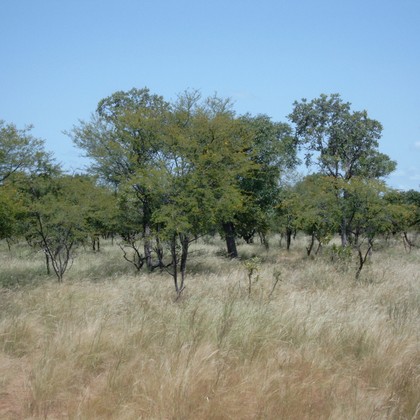
Dry thornveld and mixed woodland with rank, tall grass, scrub and tangles, also field edges and riverine thickets. It eats grass seeds from the ground, close to cover. It lays its eggs in the nests of Jameson's Firefinch (Lagonosticta rhodopareia); the chicks mimic the mouth markings of the host young.
Where the bird is most at home, classified by the vegetation units of southern Africa.

Range and movements
In the north-east and north of the region: north-eastern South Africa (Limpopo, the Mpumalanga lowveld and northern KwaZulu-Natal), Eswatini, Zimbabwe, Mozambique, northern and eastern Botswana, the Zambezi Region of Namibia, Zambia, Malawi and Angola. Beyond the region to Tanzania, Kenya and southern DR Congo.
- Resident
- Summer visitor (c. Oct–Mar)
- Winter visitor (c. Apr–Sep)
- Passage (Mar–Apr, Oct–Nov)
- dark = core range, pale = thinly spread
How and when to look
In Kruger and the lowveld of Mpumalanga and Eswatini, from January to April. Find a singing indigobird male and look carefully at the legs: in this species they appear almost white in the field. Where Jameson's Firefinches call in the rank growth, a Purple Indigobird often sits in a nearby treetop.
Conservation status
Not threatened; fairly common in the lowveld. No major threats are known.
Scientific name
Vidua purpurascens | (Reichenow, 1883)
Reichenow described the species in 1883 as Hypochera purpurascens; because it was later moved to another genus, the author and year stand in brackets. The genus Vidua was introduced in 1816 by Cuvier, GLCFD. Vidua is the Latin word for 'widow'. purpurascens is Latin for 'purplish' — for the purple gloss on the male's black plumage. The specimen the first description was based on came from Usegua, Tanzania.