All species › Turacos › Turacos › Purple-Crested Turaco
Purple-Crested Turaco | Gallirex porphyreolophus
Purperkuiftoerako | Turaco Crestimorado
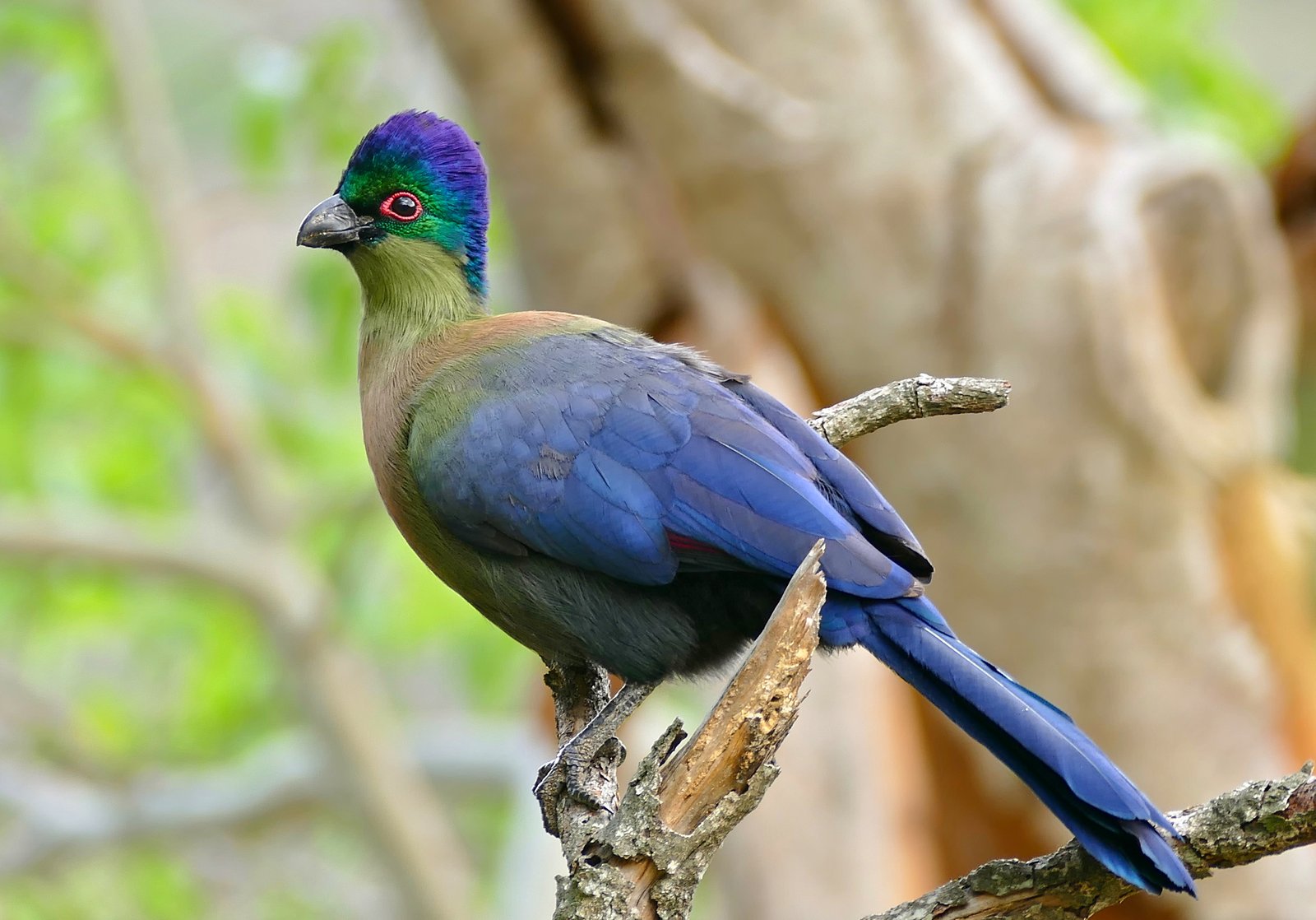
The Purple-Crested Turaco is a colourful turaco of riverine forest and moist woodland in the east, with a glossy violet crest, a green head and a pinkish breast. In flight the crimson flight feathers flash.
Voice
A loud, rasping series of kok-kok-kok-kok-kok, swelling and accelerating and ending abruptly, harsher and less barking than Knysna Turaco. Partners often call in duet; a hoarse krrr in alarm.
Recording: JJSUN — CC BY-NC-SA 4.0 · converted to mono · xeno-canto
Identification
About 42 to 46 cm, with a long tail. The rounded crest is glossy violet-purple; the head is green with a bare red ring around the eye and a dark bill. Neck and upper breast are green washed pinkish-brown to ochre, the belly dark grey-green. Back, wings and tail are deep blue-violet with a metallic sheen. The primaries are crimson and show only when the bird flies or spreads its wings. Sexes alike. It runs along branches like a squirrel and glides with spread wings from tree to tree.
Confusion species
Knysna Turaco (Tauraco corythaix) and Livingstone's Turaco (Tauraco livingstonii) have a tall green crest with white tips, white facial lines and a red bill. Schalow's Turaco (Tauraco schalowi) also has a white-tipped green crest. Only Purple-crested combines a violet crest with a green head lacking white.
Habitat
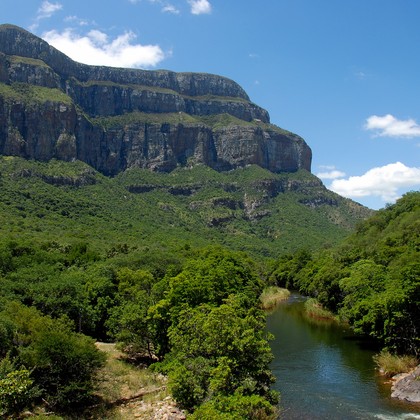
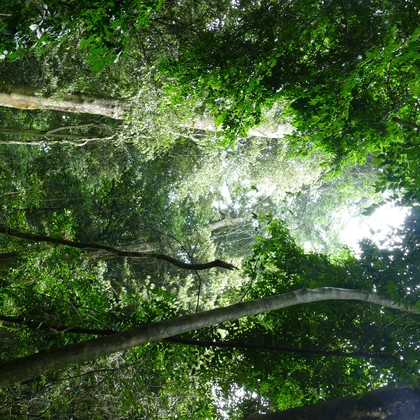
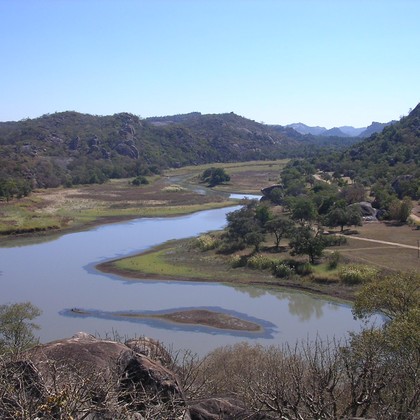
Riverine forest, coastal forest, moist and dense woodland, sand forest and thickets in savanna, also large gardens with fruit trees. It eats mainly fruit, with wild figs a favourite, also flowers, buds and occasionally insects.
Where the bird is most at home, classified by the vegetation units of southern Africa.
Range and movements
In the east of the region: north-eastern Eastern Cape, KwaZulu-Natal, Eswatini, Mpumalanga and Limpopo in South Africa, then all of Mozambique, eastern and southern Zimbabwe, Malawi and eastern Zambia, especially the Luangwa Valley. Beyond the region to eastern Tanzania and south-eastern Kenya.
- Resident
- Summer visitor (c. Oct–Mar)
- Winter visitor (c. Apr–Sep)
- Passage (Mar–Apr, Oct–Nov)
- dark = core range, pale = thinly spread
How and when to look
Usually seen in the riverine forest of Kruger National Park, at Pafuri and Skukuza, and in the coastal forests of Zululand, such as at St Lucia. Watch for a green bird running along a branch; as it crosses an opening the red wing appears. Fruiting figs often attract several birds at once.
Conservation status
Not threatened and common in suitable habitat. Clearing of riverine and coastal forest plays a local role, and in some areas the feathers are used in traditional dress, but the species adapts reasonably well to gardens and plantations.
Scientific name
Gallirex porphyreolophus | (Vigors, 1831) (GBIF: Tauraco porphyreolophus)
Vigors described the species in 1831 as Corythaix porphyreolopha; because it was later moved to another genus, the author and year stand in brackets. The genus Gallirex was introduced in 1844 by Lesson. Gallirex comes from the Latin gallus, 'cockerel', and rex, 'king' — 'king of cocks', possibly for the fine, comb-like crest. porphyreolophus comes from the Greek porphureos, 'purple', and lophos, 'crest', for the purple crest. The specimen the first description was based on came from inland from Algoa Bay (Eastern Cape).