All species › Kingfishers, bee-eaters and rollers › Kingfishers › Pied Kingfisher
Pied Kingfisher | Ceryle rudis
Bonte ijsvogel | Martín Pescador Pío
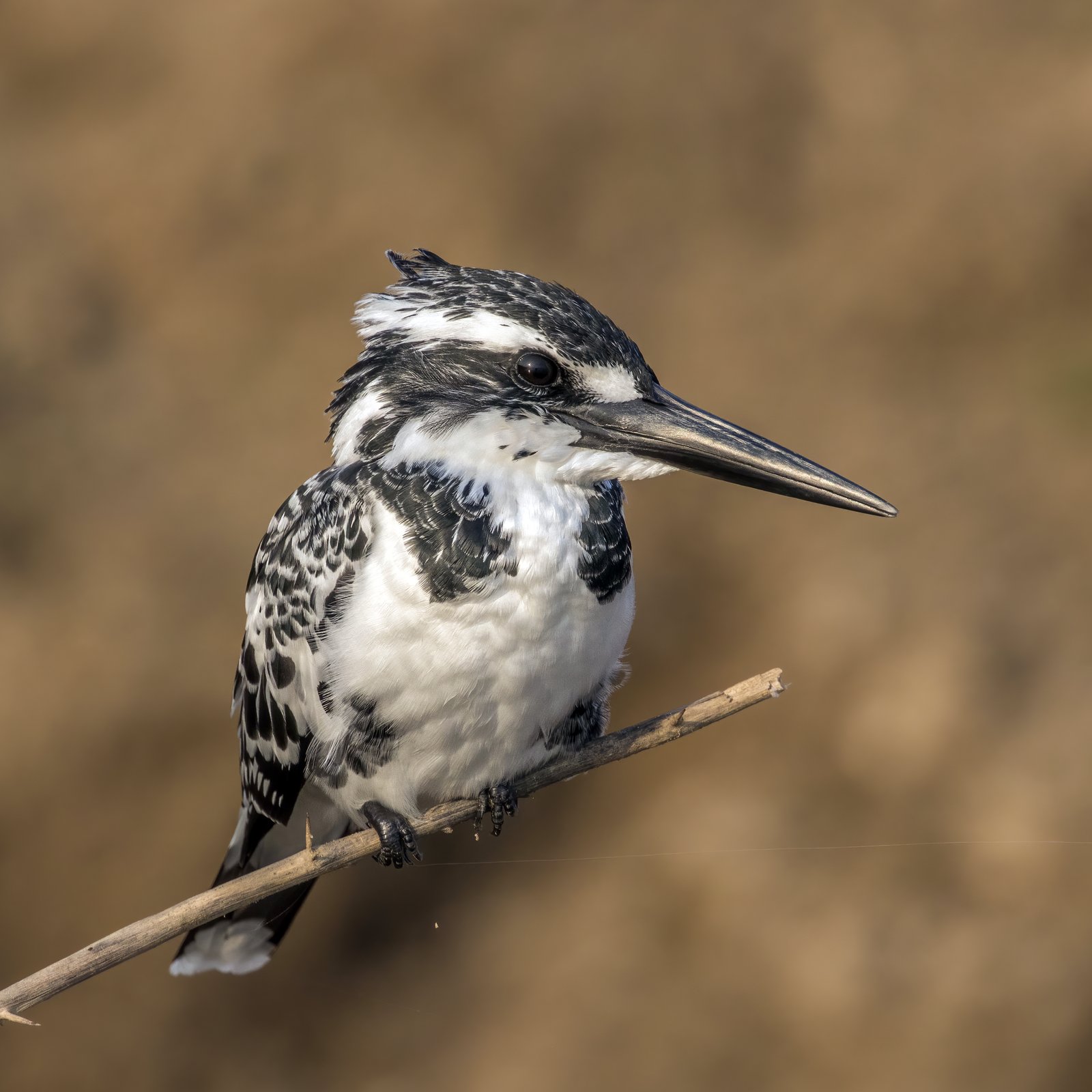
The Pied Kingfisher is a medium-sized, wholly black-and-white kingfisher and the only one in the region that regularly hunts by hovering over open water, which lets it fish far from the bank. It is noisy, social and on many waters the most visible kingfisher.
Voice
A sharp, twittering kwik-kwik or chik-chik, often in flight; groups and pairs give an excited high chirruping and chattering, accompanied by wing-shaking.
Recording: Ray Tsu 诸仁 — CC BY-NC-SA 4.0 · converted to mono · xeno-canto
Identification
About 27 cm. The upperparts are black with much white spotting and fringing, the crest short and ragged, and a white supercilium runs above a black eye mask. The underparts are white. The male has two black breast bands, a broad upper and a narrow lower; the female one, often broken in the centre. The bill is long and black. In flight a white wing stripe and a white tail base with a black terminal band.
Confusion species
The black-and-white plumage and hovering make confusion unlikely. Giant Kingfisher (Megaceryle maxima) is much larger, slate grey with white spots and has much chestnut on breast or belly.
Habitat
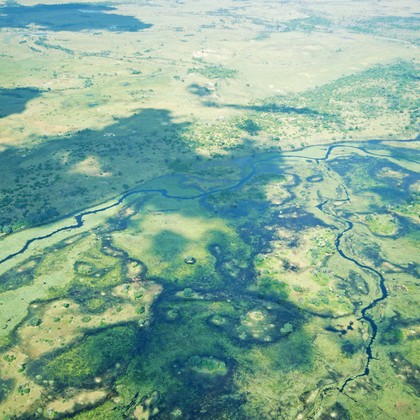
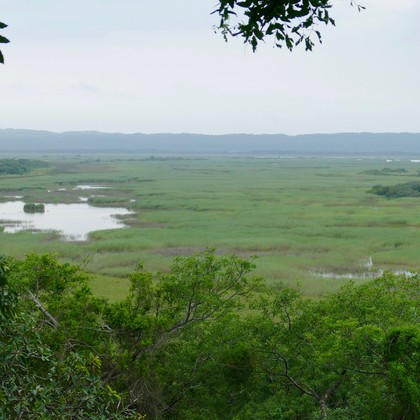
Nearly all open, clear waters: rivers, lakes, dams, pans, lagoons, estuaries and sheltered coastal waters, as long as there are fish and perches or banks nearby. It hunts by hovering a few metres above the water and plunging vertically, or dives from a branch or post. It breeds in tunnels in steep banks, often in loose colonies with helpers that assist with feeding.
Where the bird is most at home, classified by the vegetation units of southern Africa.
Range and movements
Over most of the region wherever there is open water: throughout South Africa except the driest parts of the Karoo and the Northern Cape, in Lesotho, Eswatini, Zimbabwe, Mozambique, Malawi, Zambia, Angola, northern and eastern Botswana and northern and central Namibia, locally also along the Orange River and at dams in drier country. Beyond the region throughout sub-Saharan Africa, in the Nile valley and the Middle East, and in South and South-East Asia to China.
- Resident
- Summer visitor (c. Oct–Mar)
- Winter visitor (c. Apr–Sep)
- Passage (Mar–Apr, Oct–Nov)
- dark = core range, pale = thinly spread
How and when to look
Found on almost any larger dam or river; look for a black-and-white bird hanging still over the water on rapid wingbeats with the bill pointed down. Groups gather in the evening at fixed roosts in reeds or trees. They are especially numerous on Lake Kariba, Lake Malawi and in the Okavango.
Conservation status
Not threatened and common to very common. It benefits from dams and reservoirs, but suffers locally from pollution, turbid water and disturbance of nesting banks.
Scientific name
Ceryle rudis | (Linnaeus, 1758)
Linnaeus described the species in 1758 as Alcedo rudis; because it was later moved to another genus, the author and year stand in brackets. The genus Ceryle was introduced in 1828 by Boie. Ceryle is from Greek kērulos, an unidentified and probably mythical bird mentioned by Aristotle and other authors. rudis is Latin for 'rough' or 'wild'. The specimen the first description was based on came from Egypt.