All species › Passerines › Bulbuls › Pale-Throated Greenbul
Pale-Throated Greenbul | Atimastillas flavigula
Bleekkeelbuulbuul | Bulbul Gorjiclaro
The Pale-Throated Greenbul is a large, noisy greenbul of dense riverine forest and thicket in northern Zambia and eastern Angola. Groups mostly make themselves heard with a hoarse, nasal chattering; the pale throat that the bird puffs out when calling is the best field mark.

Voice
Noisy. A hoarse, nasal chehh, a dry chuk-chuk and a fast rasping chatter, chrr-chrr-chrr, with group members calling over one another. The song consists of short, loud phrases of hoarse and whistled notes.
No recording with a suitable Creative Commons licence is available for this species yet.
Identification
21–23 cm. A bulky, rather heavily built greenbul with a stout bill. The upperparts are olive-brown, the crown slightly greyer. The throat is pale cream to pale yellow and stands out against the greyish-olive breast; the throat is puffed out when calling. The belly is dingy yellowish, the undertail-coverts yellowish. Wings and tail are olive-brown, the tail fairly long and rounded. The bill is dark, the legs grey. The sexes are alike; juveniles are duller, with a less contrasting throat.
Confusion species
Falkenstein's Greenbul Chlorocichla falkensteini in Angola is smaller and greener, with a bright yellow throat that extends like a collar. Yellow-Bellied Greenbul Chlorocichla flaviventris is smaller, with bright yellow underparts and a white half eye-ring. Terrestrial Brownbul Phyllastrephus terrestris is smaller and browner, with a white throat, and forages mainly on the ground in the leaf litter. Common Bulbul Pycnonotus barbatus has a dark head and a white belly and lives in more open country.
Habitat
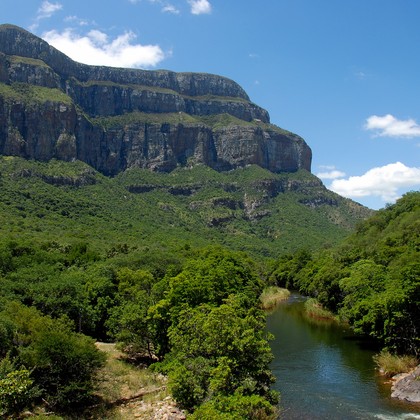
Dense riverine and gallery forest, evergreen thicket along streams and rivers, dense bush on termite mounds in miombo and the edges of evergreen forest patches (mushitu). It lives in pairs or small groups in the mid and lower strata and eats fruit and insects.
Where the bird is most at home, classified by the vegetation units of southern Africa.

Range and movements
In Zambia fairly widespread in the north and north-west: Northern Province, Luapula, the Copperbelt and the north-west (including Mwinilunga). In Angola in the north and east, from Malanje to the Lunda provinces and Moxico. Beyond the region in southern DR Congo and further north-east to western Tanzania, Uganda and western Kenya.
- Resident
- Summer visitor (c. Oct–Mar)
- Winter visitor (c. Apr–Sep)
- Passage (Mar–Apr, Oct–Nov)
- dark = core range, pale = thinly spread
How and when to look
All year. Look for it in northern Zambia in the dense waterside vegetation of streams and rivers; the hoarse group chattering is usually the first sign. Watch the foliage: the birds emerge briefly and then show the pale, puffed-out throat.
Conservation status
Not threatened; fairly common in suitable habitat. Clearing and burning of riverine forest and evergreen forest patches is a local threat.
Scientific name
Atimastillas flavigula | (Cabanis, 1880) (GBIF: Atimastillas flavicollis)
Cabanis described the species in 1880 as Trichophorus flavigula; because it was later moved to another genus, the author and year stand in brackets. The genus Atimastillas was introduced in 1905 by Oberholser. Atimastillas combines the Greek atimastos, 'disdained, slighted', with illas, 'thrush' — perhaps for its plain, greenish appearance. flavigula comes from the Latin flavus, 'yellow', and gula, 'throat' — for the pale yellow throat. The specimen the first description was based on came from Angola (not specified further).