All species › Passerines › Bulbuls › Pale-Olive Greenbul
Pale-Olive Greenbul | Phyllastrephus fulviventris
Angolaloofbuulbuul | Bulbul Ventrirrufo
The Pale-Olive Greenbul is a pale olive-brown bulbul with a warm buffy belly, of the forests of western Central Africa. In the region it occurs only in north-western Angola, including the escarpment forests around Gabela.

Voice
Noisy. A nasal, repeated chehh, a dry chuk and grating group chatter, chrr-chrr-chrrrrr. The song is a short series of chattering and whistled notes.
Recording: Arnon Dattner — CC BY-NC-SA 4.0 · converted to mono · xeno-canto
Identification
18–20 cm, a fairly large, long-tailed greenbul. The upperparts are pale olive-brown, the head slightly greyer, the rump and tail rufous-brown. The throat is white to off-white; the breast, flanks and belly are warm buff to ochre-brown (the scientific name means 'tawny belly'), the centre of the belly paler. The bill is fairly long and slender, dark with a paler lower mandible; the eyes are brown, the legs greyish pink. The sexes are alike, the male larger.
Confusion species
Cabanis's Greenbul Phyllastrephus cabanisi is greener above and yellower below, and lives mainly in northern and north-eastern Angola. White-Throated Greenbul Phyllastrephus albigularis and Angola Greenbul Phyllastrephus viridiceps are smaller and greener, with a yellow rather than buff belly, and sit higher in the mid-stratum. Brown Illadopsis Illadopsis fulvescens is browner, with a shorter tail, and lives on or near the ground; it sings clear whistled notes. Terrestrial Brownbul Phyllastrephus terrestris occurs only in south-eastern Angola.
Habitat
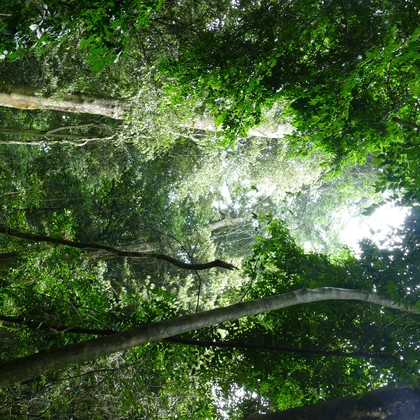
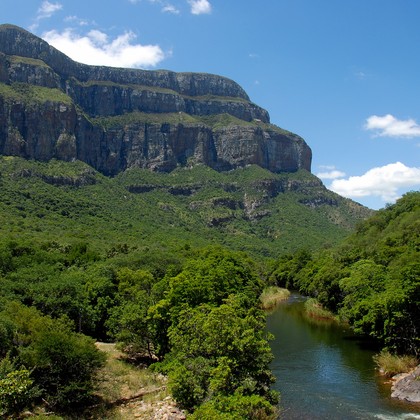
The understorey and mid-stratum of moist lowland and escarpment forest, riverine forest, old coffee plantations under shade trees and dense secondary forest. It forages in pairs or small groups for insects among leaves and creepers, often in mixed foraging flocks.
Where the bird is most at home, classified by the vegetation units of southern Africa.
Range and movements
In the region only in north-western Angola: in Cabinda and in the forests of the western escarpment from Cuanza Norte south to Cuanza Sul, including Kumbira and Gabela. Beyond the region in south-western Gabon, Congo-Brazzaville and western DR Congo.
- Resident
- dark = core range, pale = thinly spread
How and when to look
All year. Kumbira Forest near Gabela is the best-known site; there the species is often heard in the undergrowth and in overgrown coffee plantations with shade trees. Note the large size, the long rufous-brown tail and the warm buffy underparts, and listen for the nasal group chatter.
Conservation status
Not threatened on the Red List, but in Angola strongly dependent on the shrinking escarpment forest, which is being lost to clearing for farming, logging and the removal of shade trees from coffee plantations.
Scientific name
Phyllastrephus fulviventris | Cabanis, 1876
Cabanis described the species in 1876 and placed it straight away in the genus where it still stands. The genus Phyllastrephus was introduced in 1832 by Swainson. Phyllastrephus comes from the Greek phullon, 'leaf', and a form of strephō, 'to turn' — 'leaf-turner', for the way these birds search foliage for insects. fulviventris is Latin for 'tawny-bellied', from fulvus, 'tawny', and venter, 'belly'. The specimen the first description was based on came from Chinchoxo, Loango Coast (Cabinda, Angola).