All species › Birds of prey › Hawks, eagles and kites › Pale Chanting Goshawk
Pale Chanting Goshawk | Melierax canorus
Zanghavik | Azor Lagartijero Claro
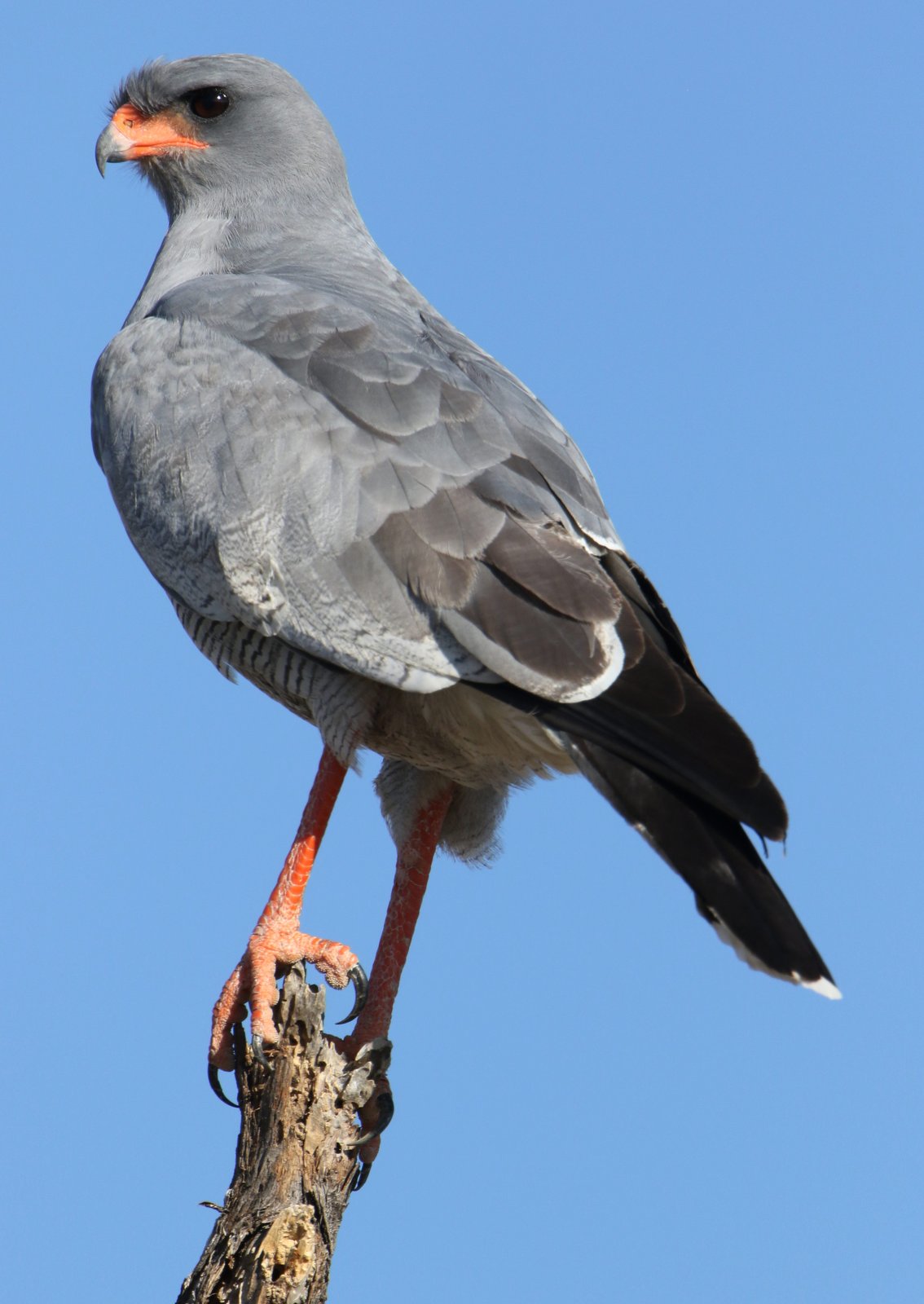
The Pale Chanting Goshawk is the characteristic raptor of the Karoo and the Kalahari: a large, pale grey hawk with long red legs that sits upright on a telephone pole or treetop along the road. From that perch it hunts lizards, rodents, ground squirrels and birds, and also strides over the ground after prey.
Voice
Mainly in the breeding season, at dawn from a treetop: a melodious, fluting klioo-klioo-klioo-klu-klu-klu, repeated at length, and a falling pee-pu-pu-pu. Also a high alarm.
Recording: Raphaël Nussbaumer — CC BY-NC-SA 4.0 · converted to mono · xeno-canto
Identification
54–63 cm, wingspan 95–115 cm. Adults are pale grey above and on the head and breast, with a finely grey-and-white barred belly. The rump is pure white. The secondaries are white to very pale grey and form a large pale area in flight that contrasts strongly with the black primaries; from below the wing looks almost white with black tips. The long tail has white bars on the outer feathers. Cere and long legs are orange-red, the eyes dark. The female is larger. Juveniles are brown, with a streaked breast, barred belly, a white rump barred brown, pale yellow eyes and yellow legs.
Confusion species
Dark Chanting Goshawk Melierax metabates is darker grey, has a grey-barred rump and grey secondaries, and lives in moister woodland further north and east; the two overlap in western Zimbabwe and eastern Botswana. Gabar Goshawk Micronisus gabar is much smaller. Black-Winged Kite Elanus caeruleus is smaller, with black shoulders and short yellow legs. Juveniles can resemble a juvenile African Marsh Harrier Circus ranivorus, which however has a different flight silhouette and hunts over marshes.
Habitat
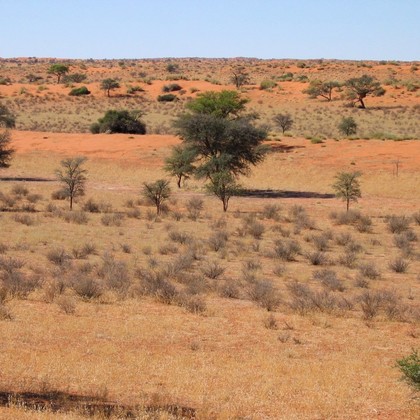
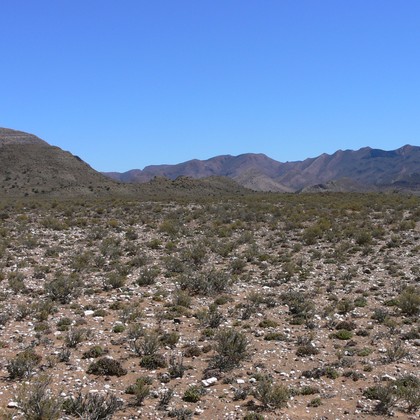
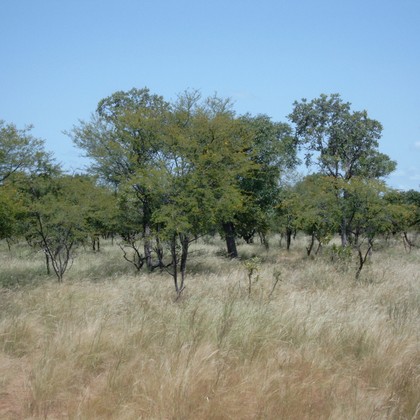
Dry, open country: Kalahari thornveld, Nama Karoo, Succulent Karoo, semi-desert and dry acacia savanna, into the fringes of the Namib. It needs scattered trees, poles or bushes as lookouts. The nest is a stick platform in a thorn tree, often lined with dung, hair and rags.
Where the bird is most at home, classified by the vegetation units of southern Africa.
Range and movements
Almost endemic to southern Africa. Common in Namibia and Botswana, in the west and interior of South Africa (Northern Cape, the inland Western Cape, the Eastern Cape Karoo, Free State, North West and western Limpopo) and in south-western Zimbabwe; also in south-western Angola and marginally in western Lesotho. Absent from the moist east and north. There are no other populations beyond; the related East African birds are now treated as a separate species.
- Resident
- Passage (Mar–Apr, Oct–Nov)
- dark = core range, pale = thinly spread
How and when to look
One of the most frequently seen raptors in the region: drive the roads of the Karoo, the Kalahari or Etosha and scan poles and treetops. They often follow honey badgers or jackals to catch flushed prey. At Kgalagadi and Etosha they come to within a few metres of the car.
Conservation status
Not threatened; common over most of its range. It can fall victim locally to poisoned bait laid for jackals, to traffic and to electrocution on poles, but the population is stable and benefits from the many poles along roads and fences as lookouts.
Scientific name
Melierax canorus | (Thunberg, 1799)
Thunberg described the species in 1799 as Falco canorus; because it was later moved to another genus, the author and year stand in brackets. The genus Melierax was introduced in 1840 by Gray. Melierax comes from the Greek melos, 'song', and hierax, 'hawk' — for the melodious, piping calls of chanting goshawks in the breeding season. canorus is Latin for 'melodious, tuneful' — for the piping call series of Pale Chanting Goshawk. The specimen the first description was based on came from South Africa.