All species › Passerines › Sunbirds › Olive Sunbird
Olive Sunbird | Cyanomitra olivacea
Olijfgroene honingzuiger | Suimanga Oliváceo
The Olive Sunbird is the typical sunbird of the interior of evergreen forest: a plain olive bird with a long, decurved bill and a loud, accelerating song. It is heard more often than seen, but with patience it can be found in the undergrowth.

Click a thumbnail to switch the photo above.
Voice
A sharp, repeated tchik or tchip as contact call. The song is a loud, clear series of notes that first accelerates and then falls and fades away, tchip-tchip-tchip-tchee-tchee-tchoo-tchoo, often kept up for long periods from dense forest.
Recording: Jaap van der Waarde — CC BY-NC-SA 4.0 · converted to mono · xeno-canto
Identification
13 to 15 cm, the male slightly larger than the female, with a long, strongly decurved bill. Both sexes are plain olive-green above and paler, greyish olive to yellowish olive below, without any metallic gloss. In southern Africa both male and female have bright yellow pectoral tufts, which show when the bird lifts or flicks its wings. The tail has narrow pale tips. Juveniles are yellower below and lack the tufts.
Confusion species
Grey Sunbird (Cyanomitra veroxii) of coastal forest is grey rather than olive-green and has red pectoral tufts. Female Amethyst Sunbird (Chalcomitra amethystina) has a pale eyebrow, streaked or mottled underparts and lives mainly in open woodland. Females of the double-collared sunbirds are smaller and shorter-billed. In Angola Fraser's Sunbird (Deleornis fraseri) is also olive-green, but it is smaller, has an almost straight bill and red pectoral tufts.
Habitat
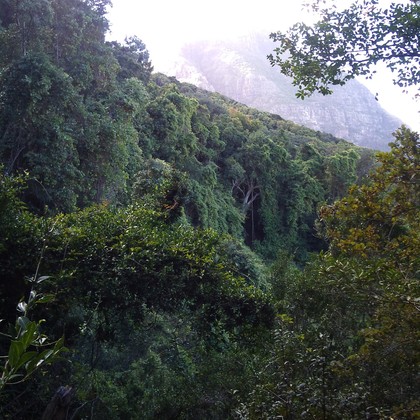
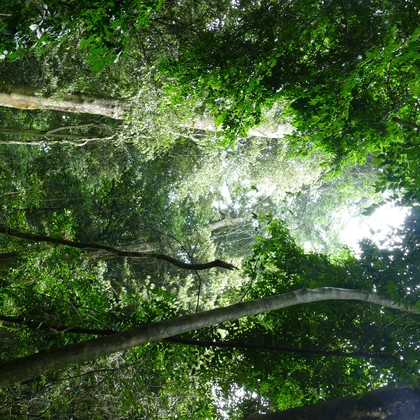
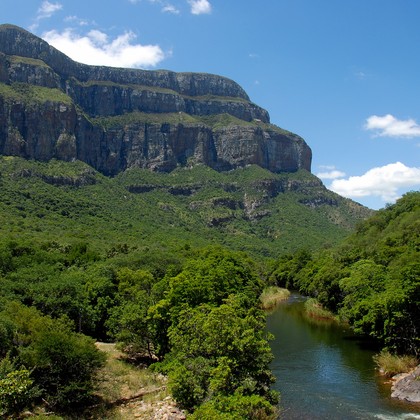
Evergreen forest of all types: montane forest, coastal and dune forest, riverine forest and wooded ravines, especially in the undergrowth and mid-storey, and also gardens and plantations bordering forest. It visits flowering trees, shrubs and creepers, and catches many insects and spiders, sometimes in flight.
Where the bird is most at home, classified by the vegetation units of southern Africa.
Range and movements
In South Africa from the Eastern Cape north-eastwards through KwaZulu-Natal, Eswatini and the escarpment of Mpumalanga and Limpopo; further in the eastern highlands of Zimbabwe, Mozambique, Malawi, northern and eastern Zambia and northern and western Angola. Beyond the region widespread in forested parts of sub-Saharan Africa, from Senegal to Ethiopia and Somalia. The birds of West and Central Africa, including those of Angola, are sometimes treated as a separate species.
- Resident
- Summer visitor (c. Oct–Mar)
- Winter visitor (c. Apr–Sep)
- Passage (Mar–Apr, Oct–Nov)
- dark = core range, pale = thinly spread
How and when to look
Listen in any evergreen forest for the accelerating, falling song; the bird often sings from a fixed song post in the mid-storey. Wing-flicking, which flashes the yellow pectoral tufts, is a good feature. It is common in the forests of Eswatini, Woodbush Forest and the Karkloof in KwaZulu-Natal.
Conservation status
Not threatened. The species is widespread and often the most numerous sunbird in suitable forest. Clearance and fragmentation of evergreen forest, especially near the coast, reduce the habitat locally.
Scientific name
Cyanomitra olivacea | (Smith, 1840)
Smith described the species in 1840 as Cinnyris olivaceus; because it was later moved to another genus, the author and year stand in brackets. The genus Cyanomitra was introduced in 1853 by Reichenbach. Cyanomitra comes from the Greek kuanos, 'dark blue, greenish blue', and mitra, 'headband, diadem' — for the glossy blue or green head or throat of many species. olivacea is Latin for 'olive-coloured', for the plain olive-green plumage. The specimen the first description was based on came from between the Eastern Cape and Durban, South Africa.