All species › Passerines › Chats and flycatchers › Olive-Flanked Ground Robin
Olive-Flanked Ground Robin | Dessonornis anomalus
Bruinflankjanfrederik | Cosifa Anómala
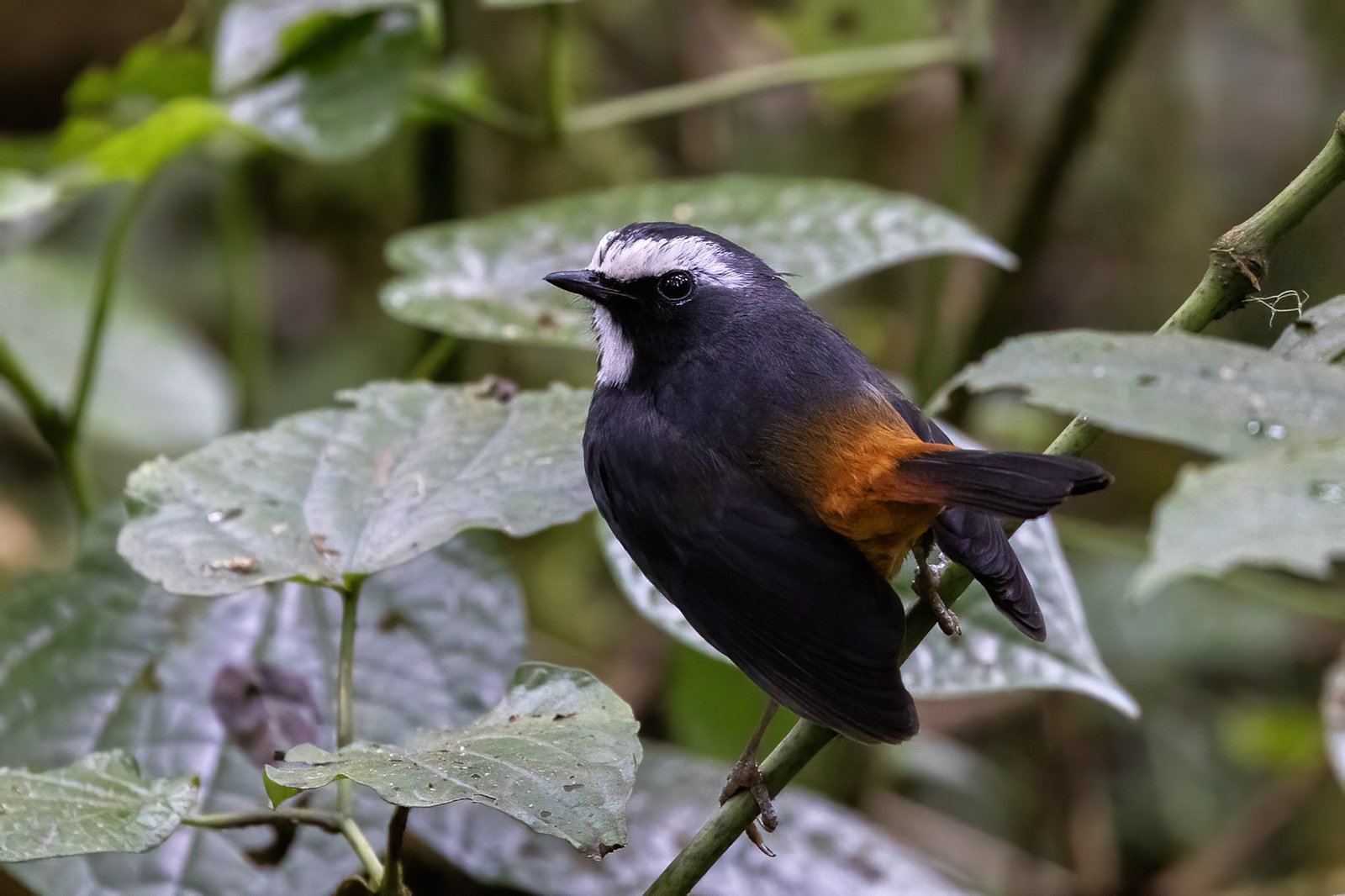
The Olive-Flanked Ground Robin is a shy, ground-dwelling robin-chat of the undergrowth of montane forests in Malawi, north-eastern Zambia and northern Mozambique. It almost always stays in shade and cover and is heard far more often than seen.
Voice
The song is a short, rather plaintive series of three to five high, clear whistles, often descending and repeated endlessly from cover, especially at dawn and dusk. The call is a soft tseep, and when agitated a dry, rattling chrrr. Because of its skulking habits the song is usually the first clue.
No recording with a suitable Creative Commons licence is available for this species yet.
Identification
A compact, rather short-tailed bird of 14 to 15 cm. The upperparts are olive-brown with a warmer rufous-brown rump and tail; the rump colour varies between subspecies. Forehead and supercilium grey, lores and cheeks blackish. The throat is white, the breast grey, the flanks olive-brown and the centre of the belly whitish. The legs are rather long and pinkish-grey. Sexes alike. Juveniles are dark brown with buff spots. It hops over the forest floor and along fallen logs, flicking its tail.
Confusion species
White-Starred Robin (Pogonocichla stellata) has a slate-grey head and yellow underparts with yellow tail patches. Sharpe's Akalat (Sheppardia sharpei) is smaller, with an orange throat and breast. White-Chested Alethe (Chamaetylas fuelleborni) is larger and bulkier, without a grey supercilium and with pure white underparts. Cape Robin-Chat (Dessonornis caffer) has an orange throat, breast and tail, and keeps to forest edges rather than the forest interior. Grey head stripes, white throat and olive flanks in the gloom of the forest are decisive for this species.
Habitat
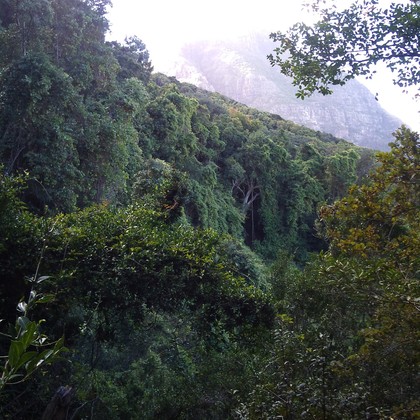
Dense undergrowth of moist montane and submontane evergreen forest, forested stream valleys, forest edges with bramble and ferns and adjacent thicket, mostly between 1000 and 2600 m. Forages on the ground and on fallen logs for insects; regularly attends swarms of driver ants.
Where the bird is most at home, classified by the vegetation units of southern Africa.
Range and movements
In northern Malawi on the Nyika Plateau, in the Misuku Hills and on the Viphya Plateau, south to the montane forests of Zomba and Mulanje; in north-eastern Zambia on the Zambian side of the Nyika Plateau and in the Mafinga Mountains; in northern Mozambique in the montane forests of Namuli and other isolated mountains. Beyond the region in the mountains of southern and eastern Tanzania.
- Resident
- dark = core range, pale = thinly spread
How and when to look
Search along quiet forest trails on the Nyika Plateau or on Zomba and Mulanje, early in the morning. Stand still at an opening in the undergrowth and listen for the high whistled series; the bird often then appears on a fallen log or on the trail itself. The best chance is at a swarm of driver ants.
Conservation status
Near Threatened. Its habitat consists of small, fragmented montane forests that are shrinking through clearance for farming and firewood, forest fires and the spread of plantations. In protected forests such as the Nyika Plateau and Mulanje it is still fairly common locally, but the forests of Namuli and other Mozambican mountains are under heavy pressure.
Scientific name
Dessonornis anomalus | (Shelley, 1893) (GBIF: Cossypha anomala)
Shelley described the species in 1893 as Callene anomala; because it was later moved to another genus, the author and year stand in brackets. The genus Dessonornis was introduced in 1836 by Smith. Dessonornis is a misprint for Bessonornis, from the Greek bēssa, 'wooded glen', and ornis, 'bird'; its author Andrew Smith later corrected the spelling himself, but the original form stands. anomalus is Latin for 'anomalous, irregular' (Greek anōmalos). Shelley (1893), describing it as Callene anomala, noted that the species is quite distinct in coloration from all its allies. The specimen the first description was based on came from Mulanje Plateau, Malawi.