All species › Passerines › Wagtails and pipits › Nicholson's Pipit
Nicholson's Pipit | Anthus nicholsoni
Nicholsons pieper | Bisbita Sudafricano
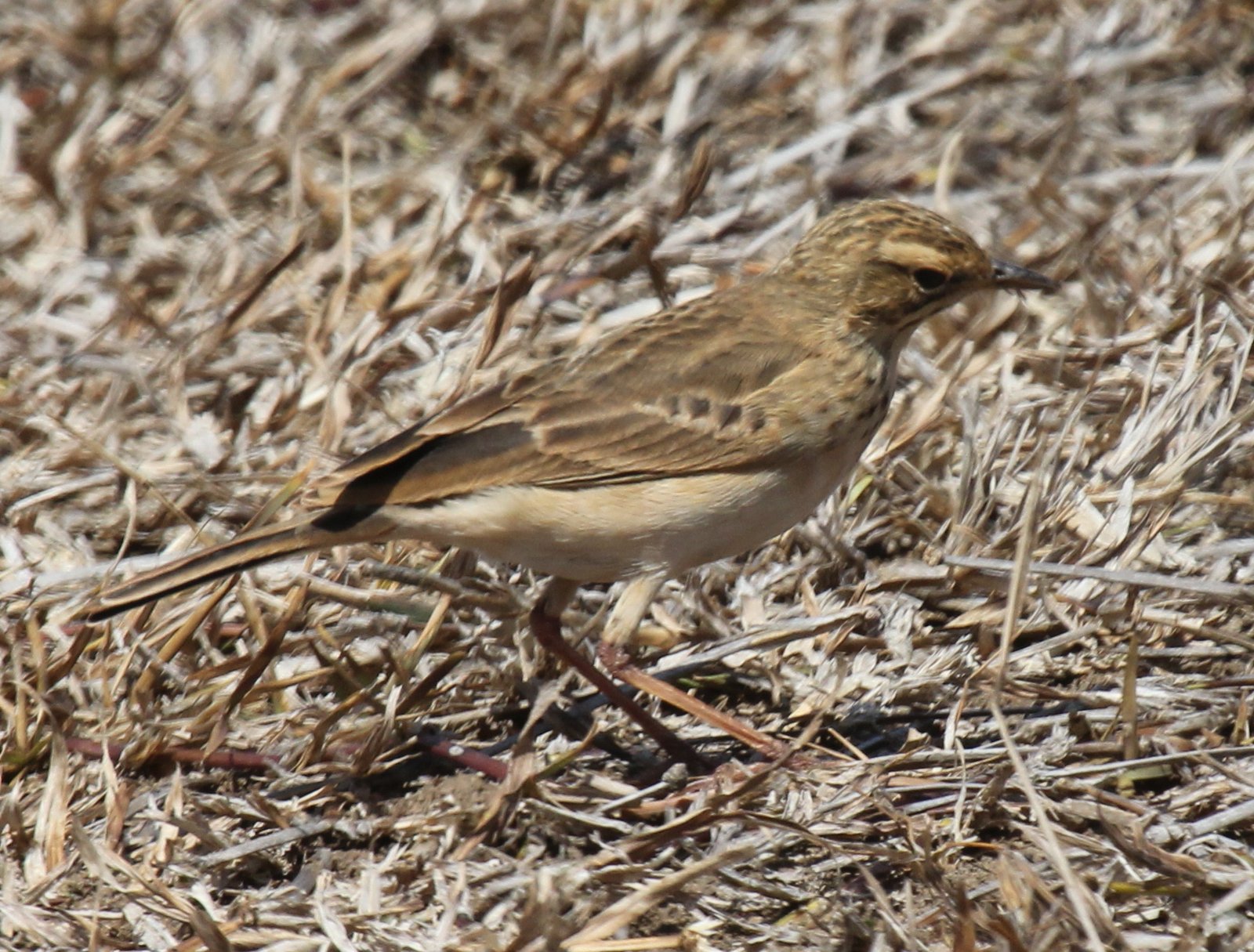
Nicholson's Pipit is the large, long-billed pipit of rocky, vegetated slopes in the south of the region. It was long treated as a subspecies of Long-Billed Pipit and still appears under that name in Roberts and Sasol; it is now regarded as a separate species of southern Africa.
Voice
The song is a slow series of loud, measured chirping notes with distinct pauses, chrip ... chreep ... churr-reep, from a boulder, bush or treetop, or in a display flight. The call is a sharp chip or a soft sheep.
Recording: Campbell Fleming — CC BY-NC-SA 4.0 · converted to mono · xeno-canto
Identification
17 to 19 cm, a large, slender pipit with a long, slightly decurved bill and a long tail. The upperparts are greyish brown to warm brown with faint dark streaking on mantle and crown. The supercilium is pale and fairly narrow, the malar stripe weak. The underparts are pale buff with fine, faint streaks on the breast. The median wing coverts have dark centres with buff fringes. The lower mandible has a pink to yellow base. The outer tail feathers are buff, not white. It walks horizontally with outstretched neck and wags its tail. The sexes are alike; birds in Namibia and the west are paler.
Confusion species
African Rock Pipit (Anthus crenatus) shares the rocky slopes, but is stockier and shorter-billed, olive-brown and almost unmarked, and sings a thin, plaintive tsee-tsoo. Buffy Pipit (Anthus vaalensis) and Plain-Backed Pipit (Anthus leucophrys) have a plain back and live on flat, short grassland. Wood Pipit (Anthus nyassae) is smaller, warmer coloured and more clearly streaked and lives in miombo further north. African Pipit (Anthus cinnamomeus) is smaller, heavily streaked and has white tail sides.
Habitat
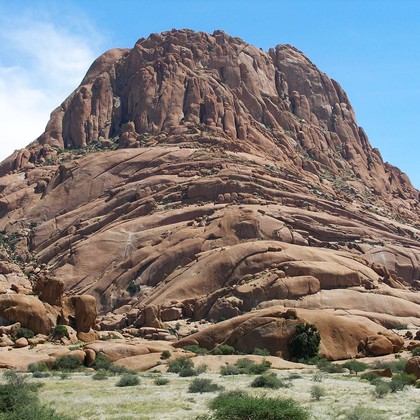
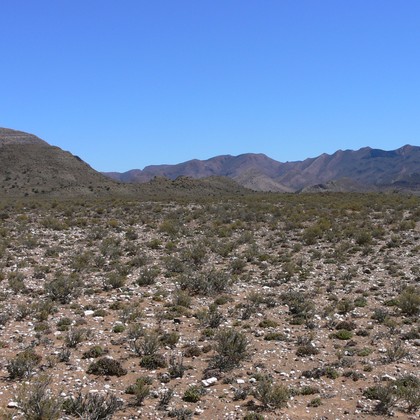
Rocky and stony slopes with scattered bushes and grass tufts, koppies, gully edges, mountainsides up to high altitudes and dry, stony hills in the Karoo and in Namibia. Often on recently burnt slopes. It forages on the ground for insects; it perches a lot on rocks and when disturbed also flies into trees.
Where the bird is most at home, classified by the vegetation units of southern Africa.

Range and movements
Endemic to southern Africa. Widespread in South Africa, from the Western Cape through the Eastern Cape and KwaZulu-Natal to Mpumalanga, Gauteng, Limpopo and the hills of the Northern Cape, also in Lesotho, Eswatini, south-eastern Botswana, central, western and southern Namibia, south-western Angola and locally in southern Zimbabwe.
- Resident
- Summer visitor (c. Oct–Mar)
- Winter visitor (c. Apr–Sep)
- Passage (Mar–Apr, Oct–Nov)
- dark = core range, pale = thinly spread
How and when to look
Search rocky slopes covered with grass and bushes, for example in the Magaliesberg, the Drakensberg foothills or the Swartberg. A large pipit delivering measured, paused song from a boulder is almost certainly this species. In older field guides and checklists, note the name Long-Billed Pipit: until recently it referred to this species.
Conservation status
Not assessed separately by the IUCN; it is included in Long-Billed Pipit (Anthus similis, Least Concern). In the region the species is common in suitable rocky terrain, with no evidence of decline; forestry plantations on mountain slopes and overgrazing pose a local threat.
Scientific name
Anthus nicholsoni | Sharpe, 1884
Sharpe described the species in 1884 and placed it straight away in the genus where it still stands. The genus Anthus was introduced in 1805 by Bechstein. Anthus is the Latin word for a small bird of grasslands mentioned by Pliny the Elder. nicholsoni honours the English ornithologist Francis Nicholson (1843–1925) of Manchester, who studied pipits and wagtails. The specimen the first description was based on came from Sigonell, on the Vaal River, South Africa.