All species › Passerines › Wagtails and pipits › Mountain Wagtail
Mountain Wagtail | Motacilla clara
Bergkwikstaart | Lavandera Clara
The Mountain Wagtail is the longest-tailed wagtail of the region: silvery grey and white, and strictly tied to fast-flowing, rocky streams in forest and gorges. Pairs hold the same stretch of stream year-round.

Voice
A high, metallic cheep or chissik, sharper and thinner than the call of Cape Wagtail and audible above the sound of running water. The song is a melodious series of trills, chee-ree-chee-ree-chooo.
Recording: Lars Lachmann — CC BY-NC-SA 4.0 · converted to mono · xeno-canto
Identification
19 to 20 cm, more than half of which is tail. The upperparts are pale blue-grey; the wings are blackish with broad white edges to the coverts and tertials, which together form a conspicuous white wing panel. A narrow white supercilium. The underparts are pure white with a narrow black breast band. The tail is black with white outer feathers. The sexes are alike; juveniles are browner grey with a faint breast band.
Confusion species
Cape Wagtail (Motacilla capensis) is darker olive-brown, with a shorter tail, dull white underparts with a broader breast band and no white wing panel; it also occurs on forest streams but seldom in the rapids. Grey Wagtail (Motacilla cinerea) shares the habitat in summer but has a yellow rump and undertail and no breast band. African Pied Wagtail (Motacilla aguimp) has a black back and a broad black breast band.
Habitat
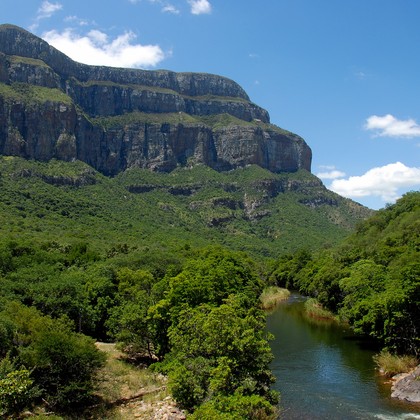
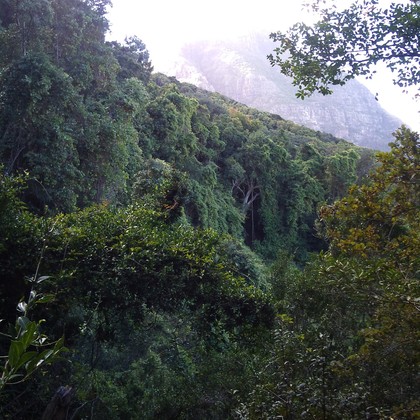
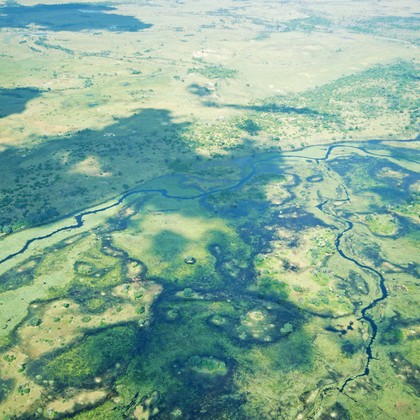
Fast-flowing streams and rivers with rocks, rapids and waterfalls, usually under forest or riverine forest, from sea level to about 2000 m. It forages on wet stones and in the spray for insects and their larvae. The nest is a cup of moss and rootlets in a rock crevice, among tree roots or on a ledge above the water, often under a bridge.
Where the bird is most at home, classified by the vegetation units of southern Africa.
Range and movements
Within the region along the eastern escarpments and in highlands: the east of the Eastern Cape, KwaZulu-Natal, Eswatini, Mpumalanga and Limpopo (including the Soutpansberg and Wolkberg), the Eastern Highlands of Zimbabwe, central and northern Mozambique, Malawi, northern and eastern Zambia and western and northern Angola. Beyond the region from East Africa to Ethiopia and in West Africa from Guinea to Cameroon.
- Resident
- Summer visitor (c. Oct–Mar)
- Winter visitor (c. Apr–Sep)
- Passage (Mar–Apr, Oct–Nov)
- dark = core range, pale = thinly spread
How and when to look
Search at bridges over forest streams and at waterfalls, for example at Magoebaskloof, in the Bvumba or on Mulanje. Territories are stable: once found at a site, the species is usually still there years later. The high call often gives the bird away before it appears on a stone in mid-stream.
Conservation status
Not threatened. Dependent on clean, fast-flowing water with forest cover; declining locally through deforestation, siltation of streams, dams and invasive alien plants along the banks.
Scientific name
Motacilla clara | Sharpe, 1908
Sharpe described the species in 1908 and placed it straight away in the genus where it still stands. The genus Motacilla was introduced in 1758 by Linnaeus. Motacilla was the Roman name for the wagtail; it is really a diminutive of motare 'to move about', but from medieval times -cilla was wrongly taken to mean 'tail'. clara is Latin for 'bright, clear' — for the clean grey-and-white plumage. The specimen the first description was based on came from Simien Mountains, Ethiopia.