All species › Gannets and cormorants › Frigatebirds › Magnificent Frigatebird
Magnificent Frigatebird | Fregata magnificens
Amerikaanse fregatvogel | Rabihorcado Magnífico
The Magnificent Frigatebird is the largest frigatebird, a bird of the tropical coasts of the Americas with a small, almost vanished outpost in the Cape Verde Islands. For southern Africa it is a theoretical vagrant with no documented record.
Voice
Silent at sea. Displaying males produce a drumming roll with the inflated pouch; otherwise bill-clattering and a dry rattle.
Recording: Leonardo Ordóñez-Delgado — CC BY-NC-SA 4.0 · shortened to the first 60 s, mono · xeno-canto
Identification
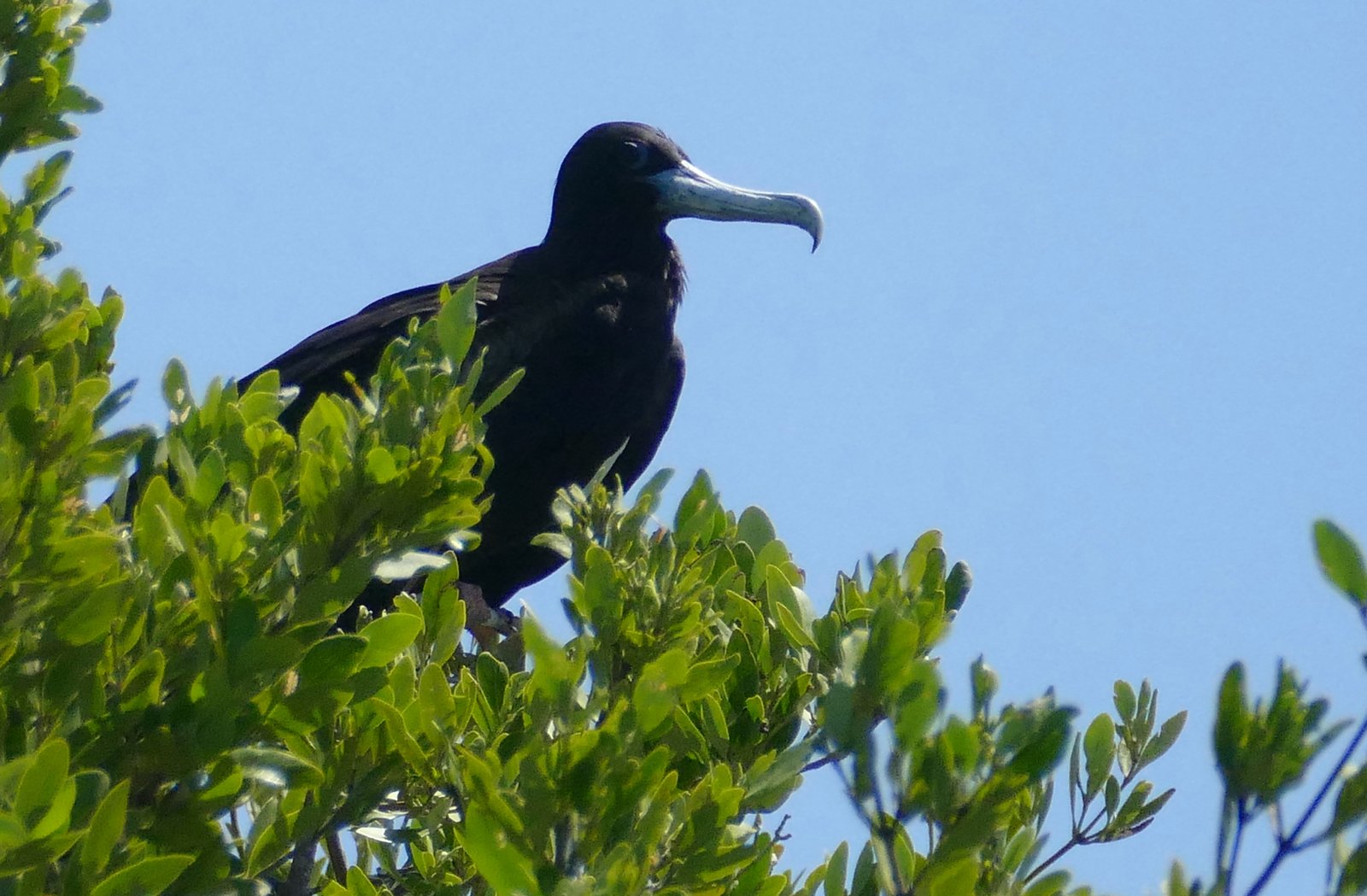
89–114 cm long, wingspan 217–244 cm; the largest and longest-winged frigatebird. The male is wholly black with a purple gloss on head and mantle, no pale wing bar, and a large red gular pouch. The female has a black head and throat, a blue eye-ring and a large white breast patch that does not extend into the armpit. Juveniles have a white head and a white belly that narrows in a diamond towards the breast. Male's feet black, female's pink.
Confusion species
Female Great Frigatebird (Fregata minor) has a grey-white rather than black throat and a red eye-ring. Ascension Frigatebird (Fregata aquila) is smaller; the female usually has a dark belly and a rufous breast band, and the male a green gloss. Lesser Frigatebird (Fregata ariel) is much smaller and shows white into the armpits.
Habitat
Warm inshore waters, lagoons and bays, far more coastal than other frigatebirds. Roosts on masts, buoys and mangroves; breeds in mangroves and shrubs on coastal islands.
Where the bird is most at home, classified by the vegetation units of southern Africa.
Range and movements
Not conclusively recorded within the region; a few reports of frigatebirds at sea off the west coast are undocumented. Beyond the region it breeds along tropical and subtropical coasts of the Americas, from Florida and Mexico to Brazil and Ecuador and on the Galápagos. The small population in the Cape Verde Islands has all but disappeared.
How and when to look
A frigatebird off the west coast should be photographed carefully; in a female check the throat colour and eye-ring, in a male the gloss and the absence of a pale wing bar. Any sighting should be submitted to the rarities committee.
Conservation status
Not globally threatened and numerous in the Americas, although local colonies are declining through disturbance and mangrove clearance. The Cape Verde population numbers at most a few birds and is regarded as virtually extinct.
Scientific name
Fregata magnificens | Mathews, 1914
Mathews described the species in 1914 and placed it straight away in the genus where it still stands. The genus Fregata was introduced in 1799 by De Lacépède. Fregata derives from the French frégate, 'frigate', a fast warship — for the swift flight and the habit of robbing other seabirds. magnificens is Latin for 'magnificent, splendid' — for its size and impressive flight. The specimen the first description was based on came from Santa Fe (Barrington), Galápagos.