All species › Cuckoos › Cuckoos › Madagascar Cuckoo
Madagascar Cuckoo | Cuculus rochii
Madagaskarkoekoek | Cuco Malgache
The Madagascar Cuckoo breeds only on Madagascar and crosses the Mozambique Channel to the African mainland in the austral winter. In the north-east of the region it is a rare, silent visitor that resembles other cuckoos.
Voice
Usually silent in Africa. The song on Madagascar is a loud, descending four-note kok-kok-kok-kok; it is occasionally heard in the wintering range too, mainly just before the return passage in August and September.
Recording: Ross Gallardy — CC BY-NC-SA 4.0 · converted to mono · xeno-canto
Identification
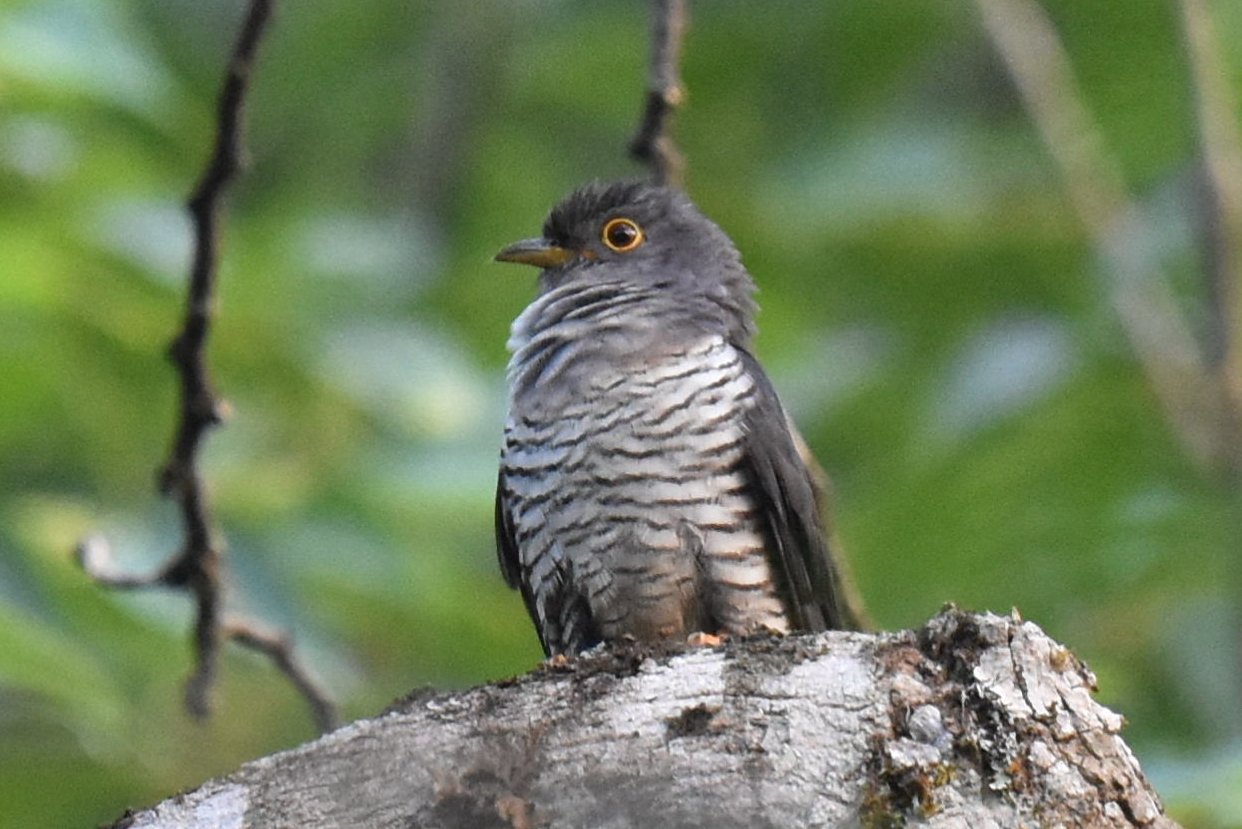
About 27 to 29 cm long and around 60 grams in weight: a small version of the Common Cuckoo. Upperparts, head and breast grey, the belly white with fairly broad dark bars; the undertail coverts are often pale buff and only lightly barred. Bill dark with a yellow base, eye-ring and legs yellow. The tail is dark grey with white spots along the shafts and a white tip. Juveniles are browner and scaled white.
Confusion species
Common Cuckoo (Cuculus canorus) and African Cuckoo (Cuculus gularis) are clearly larger, though the difference is often not apparent in the field without comparison; African Cuckoo also has a largely yellow bill. Lesser Cuckoo (Cuculus poliocephalus) is almost identical but winters in East Africa in the opposite season, from November to April. Without sound or a photograph a firm identification is often impossible.
Habitat
Miombo and other open woodland, forest edges and riverine forest. On Madagascar it breeds in forest and scrub from sea level high into the mountains, as a brood parasite of small songbirds.
Where the bird is most at home, classified by the vegetation units of southern Africa.


Range and movements
Within the region a rare and irregularly recorded non-breeding visitor to Malawi, Zambia and Mozambique, with the odd record further south in Zimbabwe. The core of the wintering range lies further north, from Tanzania to the Great Lakes and eastern Congo. It breeds only on Madagascar.
- Summer visitor (c. Oct–Mar)
- Passage (Mar–Apr, Oct–Nov)
- dark = core range, pale = thinly spread
How and when to look
Watch for it in April–May and August–September in miombo in Malawi and northern Zambia, and take every small grey Cuculus in the austral winter seriously. Try to record any bird that calls: the descending four-note phrase is the best feature. Report sightings with a photo or recording, as there are few documented records.
Conservation status
Not threatened. On Madagascar the species is widespread and common and copes well with degraded forest and scrub. Deforestation on the island is the main long-term threat, but no clear decline has so far been detected.
Scientific name
Cuculus rochii | Hartlaub, 1863
Hartlaub described the species in 1863 and placed it straight away in the genus where it still stands. The genus Cuculus was introduced in 1758 by Linnaeus. Cuculus is the Latin word for the cuckoo. rochii honours Sampson Roch (1829–1906), British Army surgeon in the Crimea, India, Mauritius, Madagascar and Abyssinia. The specimen the first description was based on came from Madagascar.