All species › Pelicans, herons and ibises › Herons and bitterns › Little Egret
Little Egret | Egretta garzetta
Kleine zilverreiger | Garceta Común
The Little Egret is the slimmest of the white egrets in the region: a black bill, black legs and bright yellow feet. It often hunts actively, running and foot-stirring, and that behaviour frequently gives it away from afar.

Voice
Mostly silent away from the colony. On take-off a hoarse kaark; at the colony gargling and bubbling sounds.
Recording: MERCIER Christophe — CC BY-NC-SA 4.0 · converted to mono · xeno-canto
Identification
About 60 cm, wholly white, with a thin, pointed black bill and black legs with yellow feet. The lores are grey-green to yellowish; during display they briefly flush pink or red and the feet turn orange. In breeding plumage there are two long, narrow nape plumes and fine ornamental plumes on the back and breast. The neck is fairly short and straight. The sexes are alike; juveniles have a slightly paler bill and greener legs. It flies with the neck retracted, on brisk wingbeats, with the yellow feet projecting beyond the tail.
Confusion species
Great Egret Ardea alba is much larger, with a long, kinked neck, a yellow bill outside the breeding season, black feet and a black gape line extending behind the eye. Yellow-Billed Egret Ardea brachyrhyncha has a shorter yellow bill, a shorter neck and dark feet. Western Cattle Egret Ardea ibis is smaller and stocky, with a short yellow bill, and usually feeds on dry ground among livestock.
Habitat
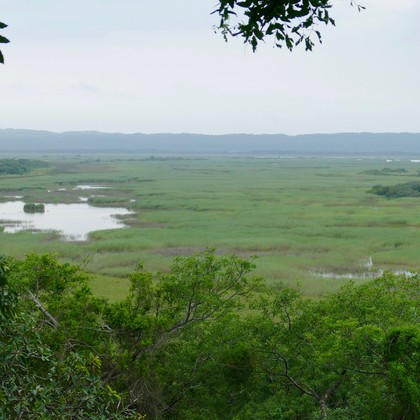
Almost any shallow water: the edges of rivers and dams, pans, marshes, rice fields, estuaries, tidal mudflats, mangroves and rocky shores. It hunts small fish, frogs, shrimps and insects, often by vibrating one foot in the substrate or by running and wing-flicking after prey. It breeds in mixed heronries in reeds or trees.
Where the bird is most at home, classified by the vegetation units of southern Africa.

Range and movements
Distributed across the whole region wherever there is water, both inland and on the coast, from Angola and Zambia to the Cape; scarcer in the arid west of Namibia and the Karoo. Beyond the region it occurs across almost all of Africa, southern Europe, Asia and Australasia.
- Resident
- Summer visitor (c. Oct–Mar)
- Winter visitor (c. Apr–Sep)
- Passage (Mar–Apr, Oct–Nov)
- dark = core range, pale = thinly spread
How and when to look
All year at almost any pool or estuary mouth. On tidal mudflats and in lagoons along the coasts of KwaZulu-Natal and Mozambique the birds are most active on a falling tide. With white egrets, look at the feet first: yellow toes below black legs point straight to this species.
Conservation status
Not threatened, common and widespread. Drainage and pollution of wetlands have local effects, but the species also benefits from artificial dams and rice fields.
Scientific name
Egretta garzetta | (Linnaeus, 1766)
Linnaeus described the species in 1766 as Ardea Garzetta; because it was later moved to another genus, the author and year stand in brackets. The genus Egretta was introduced in 1817 by Forster. Egretta comes from Provençal aigrette, the name for the little egret, a diminutive of aigron 'heron'. garzetta is the Italian name for this heron. The specimen the first description was based on came from the Orient.