All species › Waders, gulls and terns › Sandpipers and snipes › Lesser Yellowlegs
Lesser Yellowlegs | Tringa flavipes
Kleine geelpootruiter | Archibebe Patigualdo Chico
The Lesser Yellowlegs is a North American sandpiper that normally winters from the southern United States to Argentina. The odd bird crosses the Atlantic and ends up in southern Africa, usually among Wood or Marsh Sandpipers on a freshwater pan.

Voice
A soft, flat tew or tew-tew, usually one or two notes, milder and less high than the series of Wood Sandpiper.
Recording: Tony Rinaud — CC BY-NC-SA 4.0 · converted to mono · xeno-canto
Identification
23–25 cm. A slender sandpiper with long, bright yellow legs, a straight, thin black bill about as long as the head, and long wings that project well beyond the tail. In non-breeding plumage grey-brown above with fine white spots and fringes, a grey-washed breast and white belly; a short pale supercilium reaching only to the eye. In flight a plain dark wing without a wing bar and a square white rump that does not extend up the back, with a finely barred tail.
Confusion species
Wood Sandpiper Tringa glareola is smaller and more compact, with a longer white supercilium reaching behind the eye, duller yellowish-green legs and shorter wings. Marsh Sandpiper Tringa stagnatilis has a needle-fine bill, greenish legs, a paler face and a white wedge extending far up the back. Common Greenshank Tringa nebularia is much larger, with greenish-grey legs, an upturned bill and likewise a white back wedge.
Habitat
Shallow fresh and brackish waters with open muddy margins: pans, dams, sewage ponds and salt works, rarely tidal mud. It wades actively and picks quickly at prey on the surface.
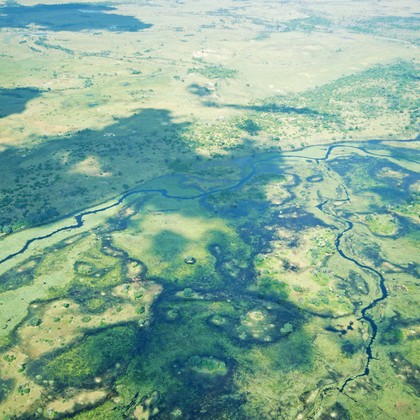
Where the bird is most at home, classified by the vegetation units of southern Africa.
Range and movements
A vagrant with a small number of records, mainly in South Africa (both inland and on the coast) and also in Namibia; elsewhere in the region not or hardly recorded. It breeds in the boreal zone of Alaska and Canada and winters from the Gulf of Mexico to southern South America; it strays regularly to western Europe and far more rarely to Africa.
How and when to look
Check groups of Wood and Marsh Sandpipers on a pan or sewage pond for a bird with longer, bright yellow legs and long wing tips. A sandpiper with the build of a Wood Sandpiper but lacking the long supercilium deserves a second look and a photograph for the rarities committee.
Conservation status
Vulnerable. The world population has shrunk sharply over a few decades, mainly through hunting on the wintering grounds in the Caribbean and South America and the loss of staging sites. As a vagrant the species plays no part in conservation in the region.
Scientific name
Tringa flavipes | (Gmelin, 1789)
Gmelin described the species in 1789 as Scolopax flavipes; because it was later moved to another genus, the author and year stand in brackets. The genus Tringa was introduced in 1758 by Linnaeus. Tringa is the Neo-Latin name Aldrovandi gave to the green sandpiper, after Ancient Greek trungas, a thrush-sized, white-rumped, tail-bobbing wading bird mentioned by Aristotle. flavipes is Latin, from flavus 'yellow' and pes 'foot', after the yellow legs. The specimen the first description was based on came from New York.