All species › Passerines › Shrikes › Lesser Grey Shrike
Lesser Grey Shrike | Lanius minor
Kleine klapekster | Alcaudón Chico
The Lesser Grey Shrike is a grey, black and white shrike from south-eastern Europe and Central Asia that spends the northern winter almost entirely in the Kalahari. After a long migration via East Africa it arrives in the dry west of the region in November, where it is a familiar sight on wires and treetops along the roads.

Voice
Largely silent in Africa. Occasionally a short, hard chek or a grating shrrek. Before departure in March and April a soft, varied warbling is heard, including imitations of other birds.
Recording: András Schmidt — CC BY-NC-SA 4.0 · converted to mono · xeno-canto
Identification
20–22 cm. Crown, nape and back are soft grey, the wings black with a striking white patch at the base of the primaries. In adults a broad black mask also crosses the forehead, so that the mask forms one continuous band. The underparts are white with a pink to salmon wash on breast and flanks. The tail is black with white outer feathers. The bill is short and heavy. The wings are long, with a long primary projection. First-winter birds have a grey forehead, a narrower and browner mask and fine barring on the head; they make up a large share of the birds in winter.
Confusion species
Southern Fiscal Lanius collaris is black above with a white V on the scapulars and has a longer, narrower tail. Red-Backed Shrike Lanius collurio has a chestnut back and no white wing patch; the female is brown with scaled underparts. Red-Tailed Shrike Lanius phoenicuroides is sandy brown with a rufous tail.
Habitat
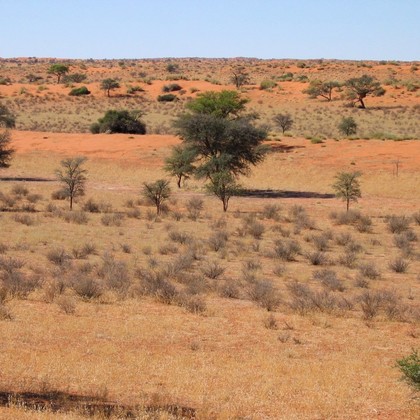
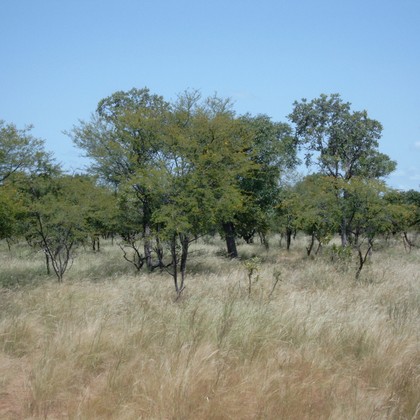
Open, dry savanna and thornveld with scattered trees and bushes, especially in the Kalahari; also grazing land, field margins and roadsides with wires and posts. It hunts from a high perch, often a telephone wire, for large insects, especially beetles and grasshoppers.
Where the bird is most at home, classified by the vegetation units of southern Africa.
Range and movements
Winters mainly in the Kalahari of Botswana, Namibia (except the Namib) and northern and western South Africa (Northern Cape, North West, Free State and western Limpopo), and in south-western Zimbabwe and southern Angola. On passage, mainly in November and March–April, in Zambia, Malawi, Zimbabwe and Mozambique; scarce in eastern South Africa. Breeds from southern and eastern Europe to Central Asia.
- Summer visitor (c. Oct–Mar)
- Passage (Mar–Apr, Oct–Nov)
- dark = core range, pale = thinly spread
How and when to look
From December to March on wires along the roads in the Kalahari, for example around the Kgalagadi Transfrontier Park and in central Botswana. Look for a grey shrike with a pink breast and black forehead; in first-winter birds the white primary patch in flight is decisive.
Conservation status
Not threatened; still numerous globally, but sharply declined in western and central Europe and lost as a breeding bird from several countries. On the wintering grounds, bush encroachment of the savanna may degrade its habitat.
Scientific name
Lanius minor | Gmelin, 1788
Gmelin described the species in 1788 and placed it straight away in the genus where it still stands. The genus Lanius was introduced in 1758 by Linnaeus. Lanius is Latin for 'butcher', from shrikes' habit of impaling prey on thorns and barbed wire. minor is Latin for 'smaller', this bird being smaller than the great grey shrike. The specimen the first description was based on came from Italy.