All species › Passerines › Starlings › Lesser Blue-Eared Starling
Lesser Blue-Eared Starling | Lamprotornis chloropterus
Blauwoorglansspreeuw | Estornino de Swainson
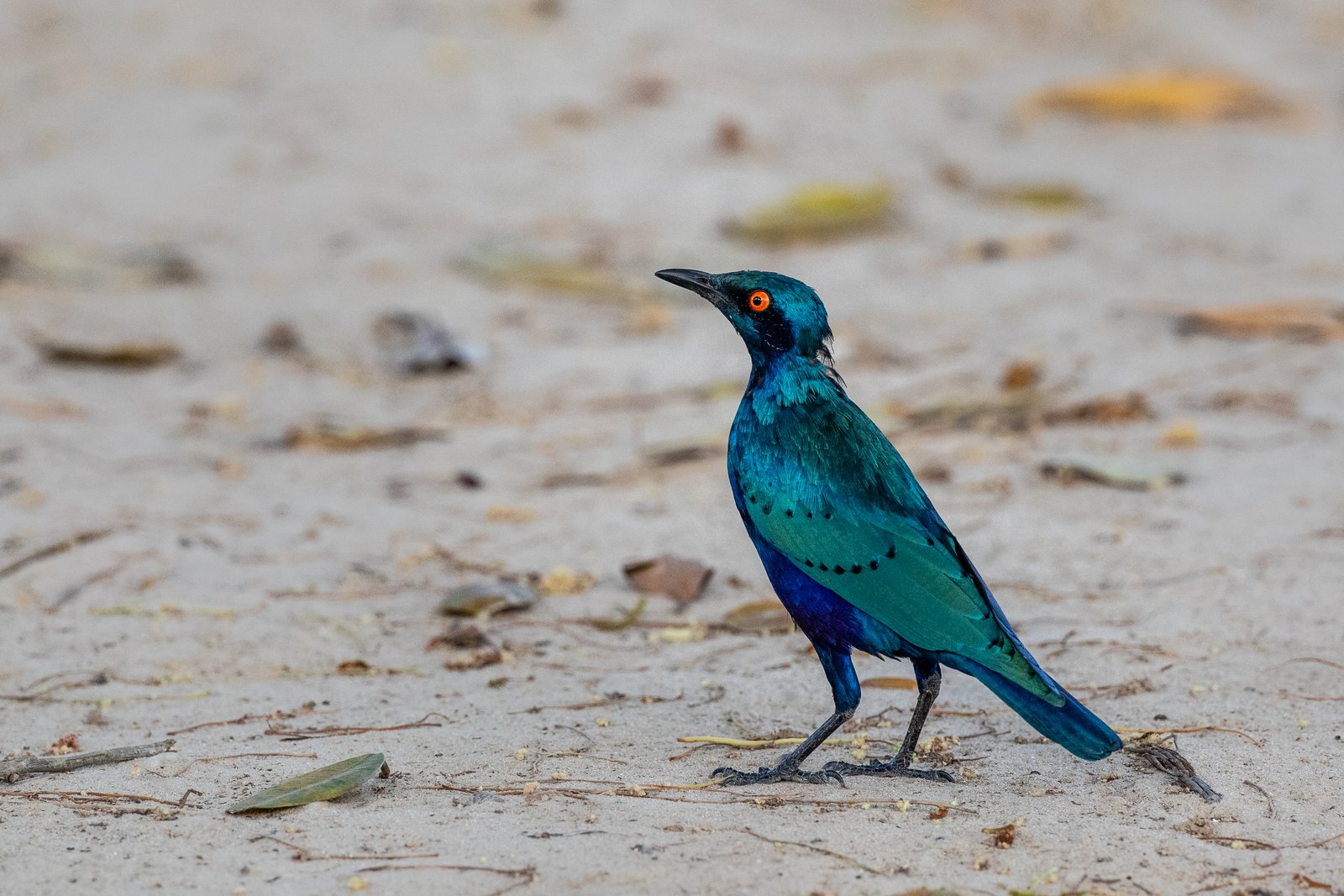
The Lesser Blue-Eared Starling is the smallest of the region's blue-green glossy starlings and a characteristic bird of miombo. The southern subspecies elisabeth is sometimes called Miombo Blue-Eared Starling; outside the breeding season it forms busy flocks that roam through the woodland.
Voice
Higher and thinner than Greater Blue-eared. The flight call is a high rolling wirri-girri or chirrip; also soft twittering and a babbling song of whistled and grating notes. The nasal squee-aar of Greater Blue-eared is lacking.
Recording: Andrew Spencer — CC BY-NC-SA 4.0 · converted to mono · xeno-canto
Identification
18–20 cm. Glossy blue-green with a dark blue ear patch that runs as a narrow, sharply defined band from the lores back behind the eye. The flanks and belly are violet to magenta-blue, more clearly purple than in Greater Blue-Eared Starling. The wing coverts show two rows of dark spots. The eye is yellow-orange; bill and legs are black. The bill is proportionately shorter and finer than in Greater Blue-eared, the head rounder and the tail shorter. The sexes are alike. Juveniles are the best feature: their underparts are plain rufous-brown to grey-brown, with a dark eye, and they stand out at once in mixed flocks.
Confusion species
Greater Blue-Eared Starling Lamprotornis chalybaeus is larger and heavier, with a longer bill, a broader, less sharply defined ear patch and a blue belly with magenta flanks; juveniles are dull blackish, never rufous below. It lives mainly in mopane and open savanna. Cape Starling Lamprotornis nitens lacks the dark ear patch and has a purple shoulder patch; it is largely absent from miombo. Sharp-Tailed Starling Lamprotornis acuticaudus, in western Zambia and Angola, has a wedge-shaped tail and a red eye. Voice is the best help in the field.
Habitat
Miombo and other deciduous woodland with Brachystegia and Julbernardia, also woodland edge, clearings and farmland with scattered trees within the miombo. It feeds in the canopy and on the ground: fruit, especially figs, and insects, including flying termites. It nests in tree holes, often old woodpecker holes.
Where the bird is most at home, classified by the vegetation units of southern Africa.

Range and movements
In the miombo of Zambia (almost throughout except the dry south-west), Malawi, northern and central Mozambique, and northern and eastern Zimbabwe. Wanderers reach northern Kruger and eastern Botswana, but the species is rare and irregular there. Outside the region it occurs in southern Tanzania and south-eastern DR Congo; the nominate form lives much further north, in the Sahel and Sudan zones from Senegal to Ethiopia and Uganda.
- Resident
- dark = core range, pale = thinly spread
How and when to look
All year in miombo, but commonest and most often seen outside the breeding season, when flocks roam and gather at fruiting figs. In mixed flocks look for the rufous-brown juveniles, which confirm the species faster than the adults do. In Zimbabwe and Mozambique, where both blue-eared species occur, the high rolling flight call helps.
Conservation status
Not threatened and locally common in miombo. Clearing of miombo for charcoal and cultivation reduces its habitat, but the species tolerates open, disturbed woodland well.
Scientific name
Lamprotornis chloropterus | Swainson, 1838
Swainson described the species in 1838 and placed it straight away in the genus where it still stands. The genus Lamprotornis was introduced in 1820 by Temminck. Lamprotornis comes from the Greek lampros, 'shining, brilliant', and ornis, 'bird' — for the metallic, iridescent plumage of the glossy starlings. chloropterus combines the Greek khlōros, 'green', with pteron, 'wing' — for the glossy metallic-green wings. The specimen the first description was based on came from West Africa (not further specified).