All species › Pigeons and doves › Pigeons and doves › Lemon Dove
Lemon Dove | Aplopelia larvata
Kaneeltortel | Paloma Caripálida
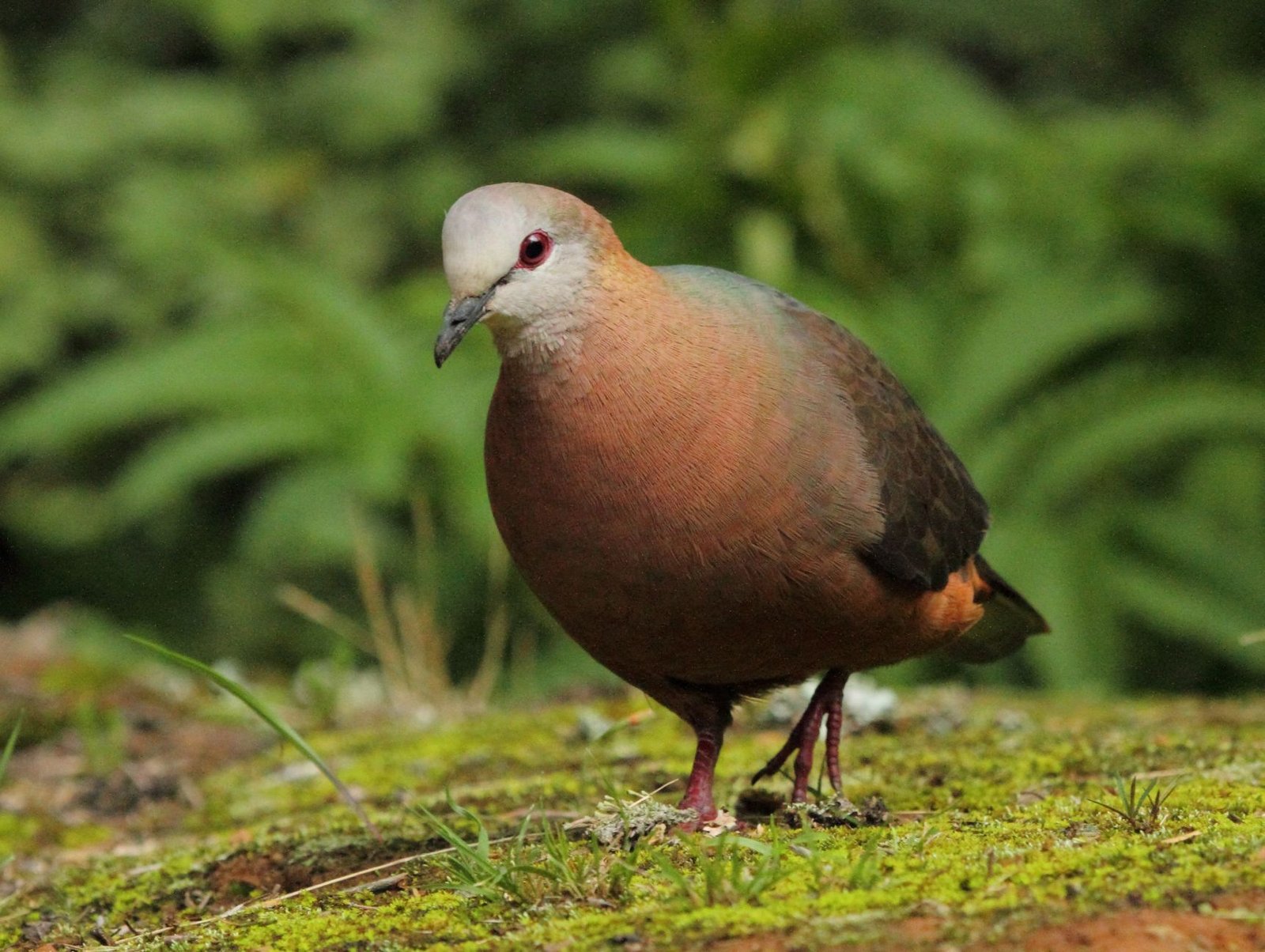
The Lemon Dove is a shy, compact forest dove that walks the forest floor in the gloom of montane and coastal forest. A pale, almost white facial mask above cinnamon underparts makes it recognisable as soon as it steps into a patch of light.
Voice
A soft, low, deep hoo-oo, rising slightly and repeated with long pauses, ventriloquial, so its direction is poorly defined. A loud wing clatter is heard on take-off.
No recording with a suitable Creative Commons licence is available for this species yet.
Identification
About 25 cm, compact, with a fairly short tail and a rounded head. Forehead and face are pale grey to whitish, crown and hindneck grey with a green and purple iridescent sheen. Breast and belly are warm cinnamon to rufous, the upperparts dark olive-brown with a bronzy-green gloss. The eye is red, surrounded by a bare reddish-purple eye ring; the legs are pinkish red. In flight the wings are plain dark, without rufous primaries. The female is duller with a less clean face; juveniles are dark brown with rufous feather fringes.
Confusion species
Tambourine Dove (Turtur tympanistria) is smaller, the male with bright white underparts and a white face, and shows rufous primaries in flight. Emerald-Spotted Wood Dove (Turtur chalcospilos) and Blue-Spotted Wood Dove (Turtur afer) are smaller, with glossy wing spots, rufous primaries and dark bands across the rump. Red-Eyed Dove (Streptopelia semitorquata) is larger with a collar and usually sits high in trees.
Habitat
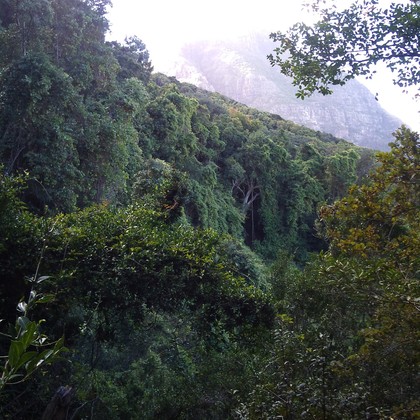
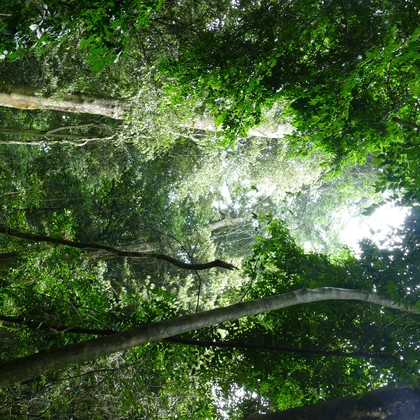
Moist montane forest, ravine forest, coastal and dune forest with an open, shaded floor and plenty of leaf litter; also dense gardens and plantations adjoining forest. It searches the ground for seeds, fallen fruit, small snails and insects, turning over leaves. When disturbed it flies off low and fast between the trunks.
Where the bird is most at home, classified by the vegetation units of southern Africa.
Range and movements
In forested parts of the east and south of the region: in South Africa from the Western Cape (Cape Peninsula, Knysna) through the Eastern Cape and KwaZulu-Natal to Mpumalanga and Limpopo, and in Eswatini, the eastern highlands of Zimbabwe, the montane and coastal forests of Mozambique, the Malawi highlands, north-eastern Zambia and the western escarpment forests of Angola. Beyond the region it occurs in forests from East Africa to Ethiopia and in West and Central Africa.
- Resident
- Summer visitor (c. Oct–Mar)
- Passage (Mar–Apr, Oct–Nov)
- dark = core range, pale = thinly spread
How and when to look
Walk quietly along forest trails early in the morning, for example at Kirstenbosch, the Knysna forests, Karkloof or the Vumba, and scan the ground ahead: the bird often walks ahead of you and then steps into a patch of light. Bird baths and feeders in forest gardens sometimes attract it. All year.
Conservation status
Not threatened; the IUCN lists it under the older name Columba larvata. The species is widespread and locally common but depends on indigenous forest, making it sensitive to logging, fragmentation and disturbance of the understorey.
Scientific name
Aplopelia larvata | (Temminck, 1809) (GBIF: Columba larvata)
Temminck described the species in 1809 as Columba Larvata; because it was later moved to another genus, the author and year stand in brackets. The genus Aplopelia was introduced in 1855 by Bonaparte. Aplopelia comes from the Greek haplos, 'simple, plain', and peleia, 'dove' — for the unpatterned, rather plain plumage. larvata is Latin for 'masked' — for the pale, contrasting face. The specimen the first description was based on came from Knysna, South Africa.