All species › Passerines › Grasshopper warblers › Knysna Warbler
Knysna Warbler | Bradypterus sylvaticus
Kaapse struikzanger | Zarzalero del Knysna
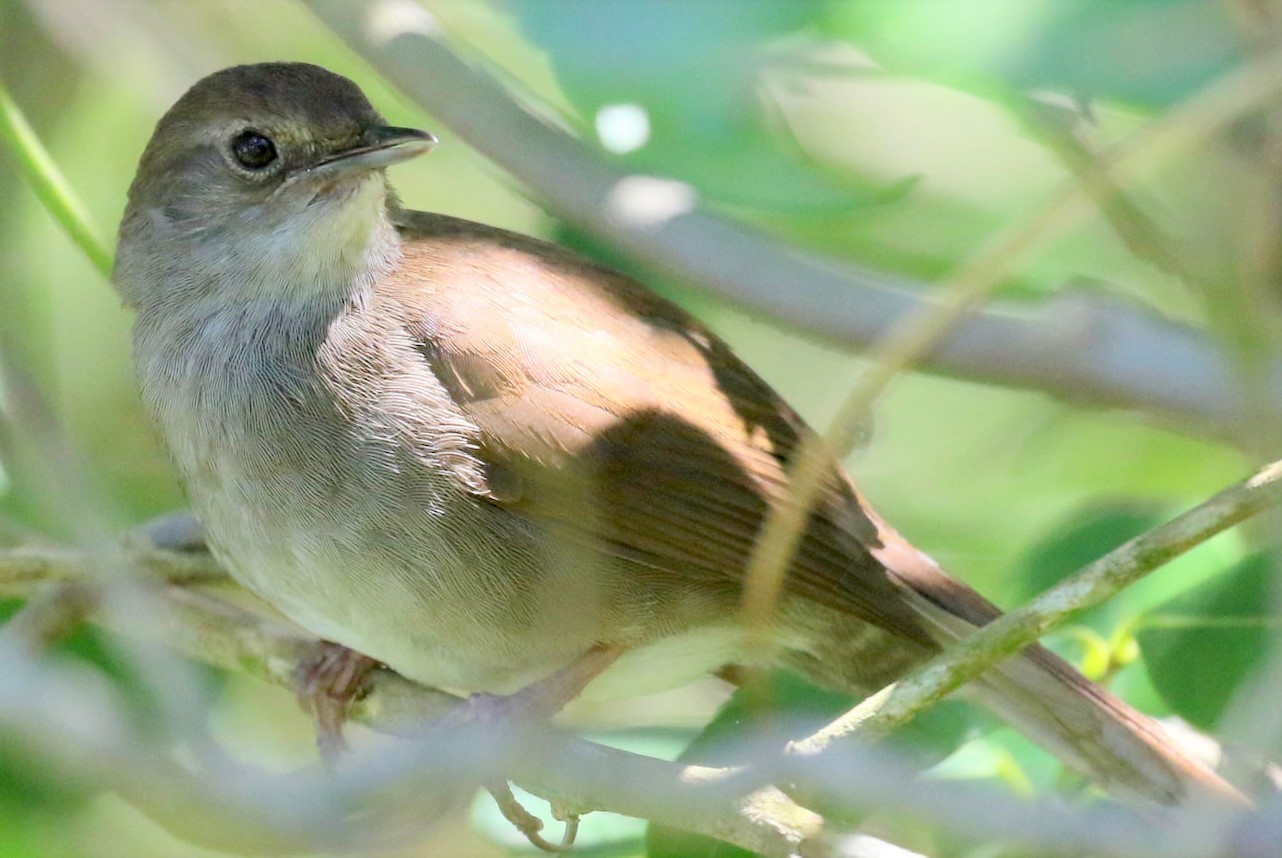
The Knysna Warbler is a dark brown, extremely secretive warbler of dense tangles at forest edges along the south coast of South Africa. It is endemic to the country and is almost always heard first: a loud, accelerating series of notes ending in a dry trill.
Voice
A loud, clear song that starts with a few separate notes and then speeds up into a dry, descending trill: chip ... chip, chip-chip-chip-chipchip-trrrrrr. It sings mainly from August to January, in the early morning and towards dusk, from a hidden perch low in the bushes. Call a sharp tchek and a rattling alarm.
Recording: Walter Wallner — CC BY-NC-SA 4.0 · shortened to the first 60 s, mono · xeno-canto
Identification
14–15 cm, compact, with short, rounded wings and a fairly broad, rounded tail. Upperparts uniform dark warm brown, underparts slightly paler greyish-brown, with a vague paler throat and indistinct dark spots or streaks on the throat and upper breast. A narrow pale supercilium is weak. The eye and bill are dark and the legs pinkish-brown. The sexes are alike; juveniles are warmer and yellower below. It keeps low in dense vegetation and shuffles over the ground.
Confusion species
Victorin's Warbler Cryptillas victorini has a grey face, a cinnamon breast and an orange eye and lives in montane fynbos. Barratt's Warbler Bradypterus barratti has a more clearly streaked breast, yellower flanks and a different song, and occurs only from the east of the Eastern Cape eastwards. Little Rush Warbler Bradypterus baboecala lives in reeds and wet rank growth and sings with wing-snaps. Terrestrial Brownbul Phyllastrephus terrestris is larger, with a white throat, and lives in noisy parties. Song, behaviour and range are the key.
Habitat
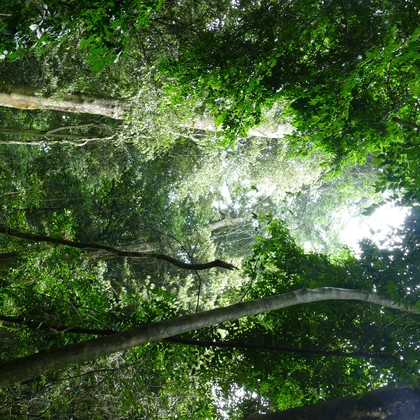
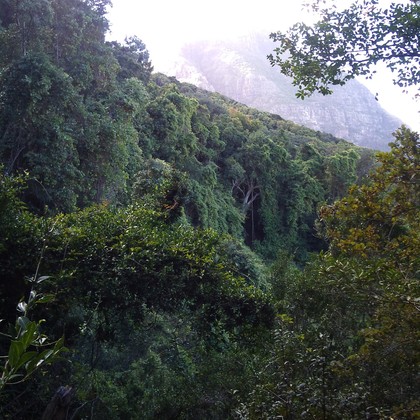
Dense, tangled scrub with brambles, creepers and ferns at the edges of forest, in wooded kloofs and along streams, also coastal forest, dense coastal fynbos and overgrown large gardens. It forages on and just above the leaf litter for insects and other invertebrates.
Where the bird is most at home, classified by the vegetation units of southern Africa.

Range and movements
Endemic to South Africa: in the Western Cape from the Cape Peninsula and Stellenbosch east along the south coast and the Garden Route, then in the Eastern Cape from Tsitsikamma to around Makhanda (Grahamstown) and East London, and locally in Pondoland and southern KwaZulu-Natal. It does not occur outside this area.
- Resident
- Winter visitor (c. Apr–Sep)
- dark = core range, pale = thinly spread
How and when to look
Well-known sites are Kirstenbosch and the forest edges on the slopes of Table Mountain, the Knysna area, Wilderness and Nature's Valley. Go early in spring, listen for the accelerating trill and wait quietly by a dense, low edge of scrub; the bird sometimes pops up briefly to sing on an exposed twig but otherwise hardly shows itself.
Conservation status
Near Threatened. The population is small and fragmented and has declined in the Western Cape through the loss of forest edges and scrub to development, overly frequent fires, invasive alien plants and the clearing of undergrowth. Part of its habitat lies in protected forests and nature reserves.
Scientific name
Bradypterus sylvaticus | Sundevall, 1860
Sundevall described the species in 1860 and placed it straight away in the genus where it still stands. The genus Bradypterus was introduced in 1837 by Swainson. Bradypterus comes from the Greek bradus, 'slow', and -pteros, '-winged' — for the short, rounded wings and weak flight. sylvaticus is Latin for 'of the woods', for its habitat: the undergrowth of native forest. The specimen the first description was based on came from Knysna, South Africa.