All species › Passerines › Weavers › Katanga Masked Weaver
Katanga Masked Weaver | Ploceus katangae
Katangamaskerwever | Tejedor de Katanga
The Katanga Masked Weaver is a small masked weaver with a very restricted range in south-eastern DR Congo and northern Zambia. It lives in the swamps and floodplains of the Luapula, Lake Mweru and Bangweulu, where it breeds in reeds and papyrus. For this guide it is one of the true endemics of the Zambezi–Congo border country.
Voice
A soft, rapid, rasping chatter with sizzling notes, a chi-chi-zzweezzwee, sung at the nest while the male hangs with quivering wings. There is also a short chuk contact call. Close to a colony a continuous hubbub can be heard.
Recording: Dries Van de Loock — CC BY-NC-SA 4.0 · converted to mono · xeno-canto
Identification
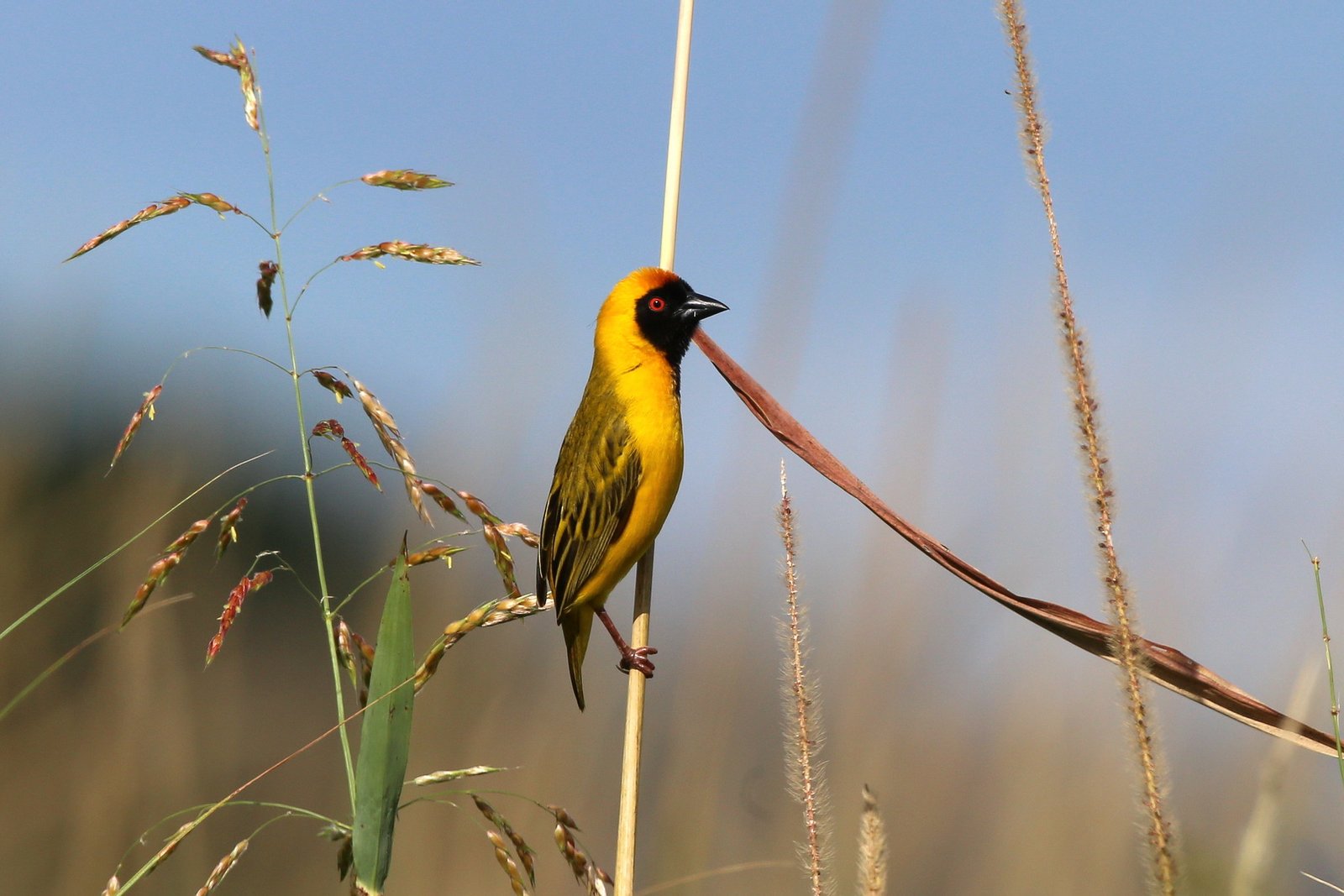
12–13 cm; a small, compact masked weaver with a fairly short black bill. The breeding male is bright yellow, with a black mask over forehead, face and throat; at the edges of the mask, on the crown and upper breast, the black shades into a warm chestnut to orange-brown wash. The back is yellow-green and only lightly streaked, wings and tail dark with yellow edges. The eye is reddish brown. The female and non-breeding male are olive-green with faint streaking above, yellowish on throat and breast and whitish on the belly, with a horn-coloured bill. Juveniles resemble the female. Size, the small bill and the rather plain back, together with the framed mask, are the best features.
Confusion species
Southern Masked Weaver (Ploceus velatus) is larger, with a more clearly streaked back and a mask without a chestnut frame; it lives in drier woodland and gardens. Tanzanian Masked Weaver (Ploceus reichardi) of far north-eastern Zambia is slightly larger and heavier-billed. Lesser Masked Weaver (Ploceus intermedius) has a pale eye and a mask that extends over the crown. Village Weaver (Ploceus cucullatus) is clearly larger with a black-spotted back. Slender-Billed Weaver (Ploceus pelzelni) breeds in the same habitat but is thinner-billed and has a smaller mask. Females are practically inseparable from related species; look for accompanying males and consider the locality.
Habitat
Reed and papyrus swamps, floodplains, lake and river margins and adjacent bushes, rank growth and fields. It breeds in small colonies with nests in reeds, papyrus or bushes over or near water. It eats seeds and insects.
Where the bird is most at home, classified by the vegetation units of southern Africa.

Range and movements
Within the region only in northern Zambia: the Luapula, the shores of Lake Mweru and the Bangweulu swamps. Beyond the region only in south-eastern DR Congo, along the Luapula and in the Upemba depression on the Lualaba, where a larger-billed form (upembae) occurs.
- Resident
- Summer visitor (c. Oct–Mar)
- dark = core range, pale = thinly spread
How and when to look
In the rains, search the fringes of the Bangweulu swamps or the Luapula for colonies in reeds and papyrus over the water. Breeding males sing from the nest and are then most often photographed. Outside the breeding season the birds are inconspicuous and hardly identifiable with certainty; when in doubt, record only well-seen males.
Conservation status
Not threatened, although the range is small. The species depends on swamps and floodplains, which in places are under pressure from drainage, grazing and fires.
Scientific name
Ploceus katangae | (Verheyen, 1947)
Verheyen described the species in 1947 as Sitagra velatus katangae; because it was later moved to another genus, the author and year stand in brackets. The genus Ploceus was introduced in 1816 by Cuvier, GLCFD. Ploceus comes from the Greek plokeus, 'plaiter, weaver', for the tightly woven, ball-shaped nest that gives weavers their name. katangae means 'of Katanga' — for the region in south-eastern DR Congo where the type was collected. The specimen the first description was based on came from Musosa, Katanga (DR Congo).